Hydrocotyle ranunculoides
Floating marsh pennywort
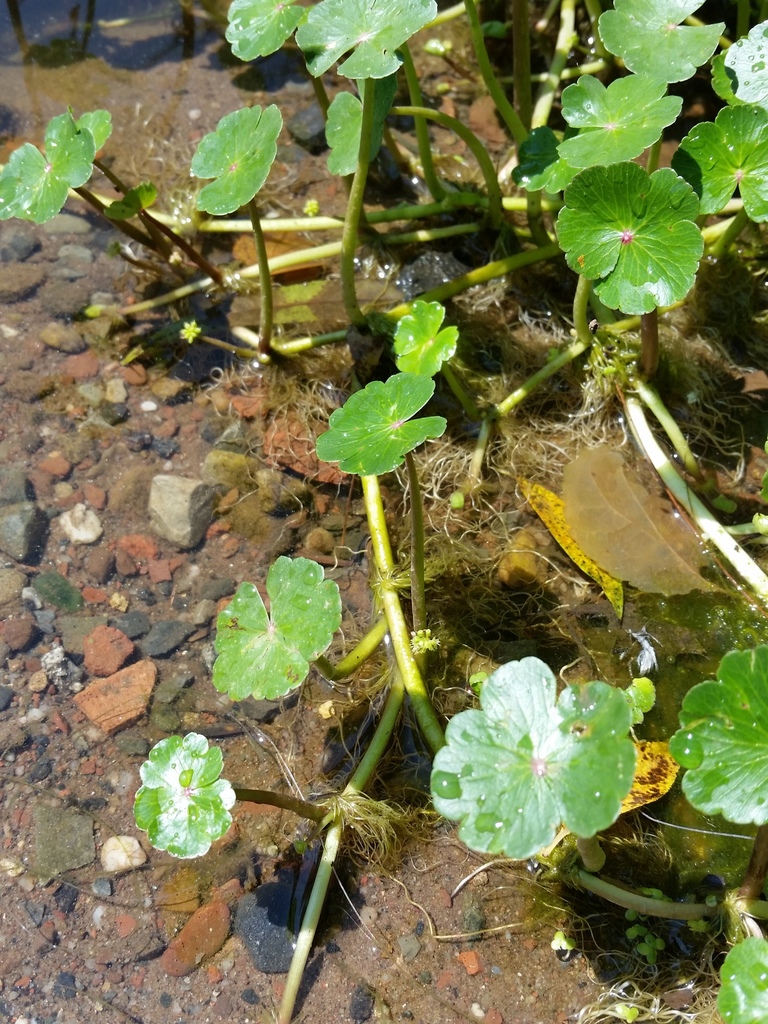
(c) Zihao Wang, some rights reserved (CC BY), uploaded by Zihao Wang · licence
Family: Araliaceae · Type: Herb · Native
Hydrocotyle ranunculoides (Floating marsh pennywort) is a native California herb in the Araliaceae family.
Floating marsh pennywort is a native perennial found in coastal, northern California, central valley, central western, and southwestern regions in lake margins, ponds, and slow-moving streams at elevations below 1,500 meters. Flowering from March to August, this plant produces small, barely noticeable white or greenish flowers in dense umbels with 5 to 10 blooms. Growing as a fleshy, floating or creeping plant with stout stems, it spreads across water surfaces with distinctive round to kidney-shaped leaves. Its leaves are deeply divided into 3 to 7 lobes, typically 2 to 5 centimeters wide and wider than they are long, with slightly scalloped edges. The plant's small fruits are elliptical to round, measuring 1 to 3 millimeters long with barely visible ribs.
Identification and appearance
Key characters: 2 sympatric species; key differentiator is non-peltate leaves that are deeply 3-7 lobed vs peltate leaves with shallow 8+ lobes
Habitat and range
Habitat: Lake margins, ponds, slow-moving streams
Elevation: < 1500 m
California counties: San Diego, Riverside, San Bernardino, Los Angeles, Santa Barbara, Monterey, San Luis Obispo, Orange, Kern, Sacramento, San Mateo, Humboldt, Alameda, Sonoma, Tehama, Kings, Santa Cruz, San Joaquin, Marin, Merced, Napa, Santa Clara, San Francisco
Outside California: to eastern North America, South America
Bloom period
Hydrocotyle ranunculoides blooms Mar-Aug.
How to tell it apart
vs Oxalis: Hydrocotyle has round leaves attached at the center; Oxalis has heart-shaped leaflets in threes attached at the edges.; vs Geranium: Hydrocotyle has shield-like leaves attached at the center; Geranium has deeply lobed leaves attached at the edges.; vs Pilea: Hydrocotyle has perfectly round peltate leaves; Pilea has oval to lance-shaped leaves attached at the edge.; vs Claytonia: Hydrocotyle has round leaves attached at blade center; Claytonia has oval to spoon-shaped leaves attached at the edge.; vs Tropaeolum: Hydrocotyle is tiny and creeping; Tropaeolum is larger and trailing with distinctive spurred flowers.
Frequently asked questions
Is Hydrocotyle ranunculoides native to California?
Yes. Hydrocotyle ranunculoides is native to California (recorded as native).
When does Hydrocotyle ranunculoides bloom?
Hydrocotyle ranunculoides blooms Mar-Aug.
Where in California does Hydrocotyle ranunculoides grow?
Hydrocotyle ranunculoides occurs in San Diego, Riverside, San Bernardino, Los Angeles, Santa Barbara, Monterey, San Luis Obispo, Orange and other counties, at elevations of < 1500 m.
What plant family does Hydrocotyle ranunculoides belong to?
Hydrocotyle ranunculoides is in the Araliaceae family, genus Hydrocotyle.
What habitat does Hydrocotyle ranunculoides grow in?
Hydrocotyle ranunculoides grows in Lake margins, ponds, slow-moving streams.
Related species
Other California species in the same genus, family, or bioregion.
Sources: Jepson eFlora · Index of California Plant Names · CalPhotos
Last updated 2026-10-07
Data from The California Species Project — 14,000+ California species with verified data from CNPS, CDFW, USFWS, Cal-IPC, and more.