Hymenopappus filifolius var. megacephalus
Fineleaf hymenopappus
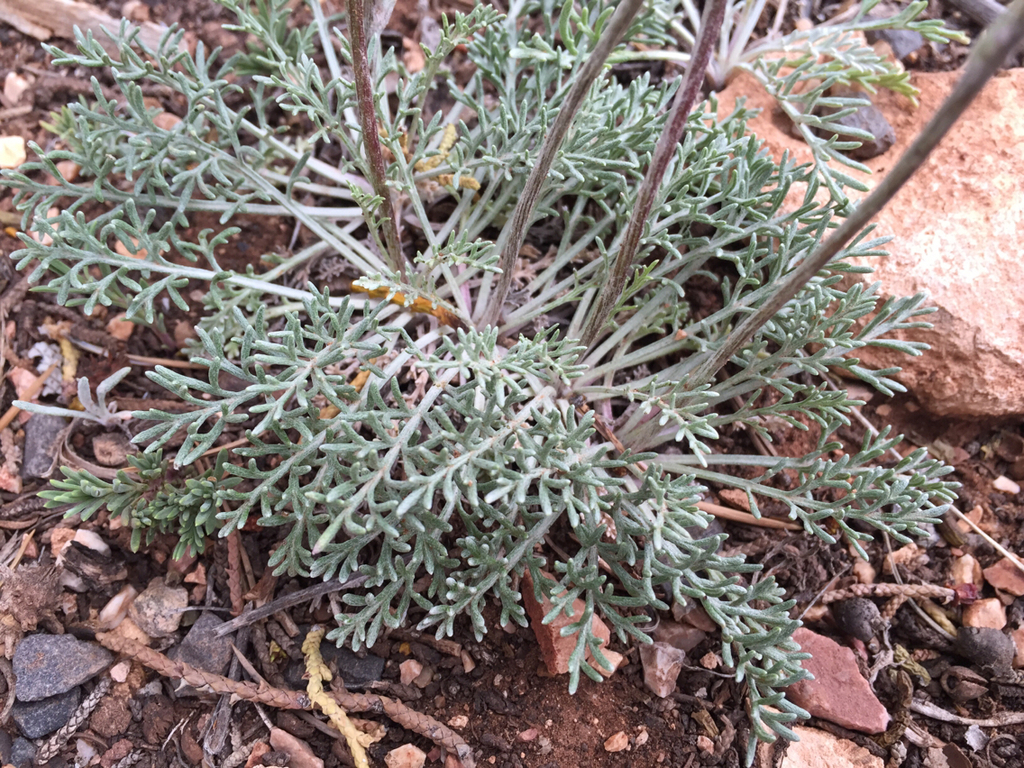
Photo: parent species Hymenopappus filifolius · no rights reserved, uploaded by Robbie Hannawacker · CC0
Family: Asteraceae · Type: Subshrub · Native
Hymenopappus filifolius var. megacephalus (Fineleaf hymenopappus) is a native California subshrub in the Asteraceae family, recognized by 2 sympatric varieties; key features are consistent pubescence, large phyllaries, and numerous heads.
Fineleaf hymenopappus is a California native perennial found in the eastern Providence Mountains in sandy, gravelly soils of pinyon and juniper woodland at elevations of 1,000 to 1,500 meters. Flowering from June to July, this plant produces yellow flowers in heads 3 to 14, with individual flower clusters supported by peduncles 2 to 10 centimeters long. Growing 30 to 70 centimeters tall with a tomentose (densely woolly) appearance, it develops an intricate branching structure with (1) to 7 cauline leaves. Its distinctive basal leaves are 8 to 20 centimeters long, with fine linear divisions 5 to 30 millimeters in length and only 1 to 2 millimeters wide. The fruit is 5 to 7 millimeters long, covered in even, 1 to 2 millimeter hairs that give the plant a soft, textured appearance.
Identification and appearance
Key characters: 2 sympatric varieties; key features are consistent pubescence, large phyllaries, and numerous heads
Habitat and range
Habitat: Sandy, gravelly soils in valleys, washes, pinyon/juniper woodland
Elevation: +- 1000-1500 m.
Outside California: to western Colorado, Arizona
Bloom period
Hymenopappus filifolius var. megacephalus blooms Jun-Jul.
How to tell it apart
vs Chaenactis: Hymenopappus is perennial with 12-22 seed scales; Chaenactis is typically annual with fewer seed scales.; vs Pseudognaphalium: Hymenopappus has finely divided leaves and papery flower bracts; Pseudognaphalium has simple, woolly-white leaves.; vs Trichoptilium: Hymenopappus has 12-22 blunt seed scales; Trichoptilium has feathery bristles instead of scales.; vs Carlquistia: Hymenopappus is perennial with papery flower bracts; Carlquistia is a small alpine cushion plant.; vs Raillardella: Hymenopappus has finely divided feathery leaves; Raillardella has simple, undivided leaves.
Frequently asked questions
Is Hymenopappus filifolius var. megacephalus native to California?
Yes. Hymenopappus filifolius var. megacephalus is native to California (recorded as native).
When does Hymenopappus filifolius var. megacephalus bloom?
Hymenopappus filifolius var. megacephalus blooms Jun-Jul.
What plant family does Hymenopappus filifolius var. megacephalus belong to?
Hymenopappus filifolius var. megacephalus is in the Asteraceae family, genus Hymenopappus.
What habitat does Hymenopappus filifolius var. megacephalus grow in?
Hymenopappus filifolius var. megacephalus grows in Sandy, gravelly soils in valleys, washes, pinyon/juniper woodland.
Related species
Other California species in the same genus, family, or bioregion.
- Hymenopappus filifolius var. nanus — Little cutleaf
- Hymenopappus sp.
- Hymenopappus filifolius — Columbia cutleaf
- Hymenopappus filifolius var. eriopodus — Hairy-podded fine-leaf hymenopappus
- Hymenopappus filifolius var. lugens — Columbia cutleaf
- Hymenothrix dissecta
- Hymenothrix loomisii — Loomis' thimblehead
Sources: Jepson eFlora · Index of California Plant Names · CalPhotos
Last updated 2026-10-07
Data from The California Species Project — 14,000+ California species with verified data from CNPS, CDFW, USFWS, Cal-IPC, and more.