Hymenopappus filifolius var. nanus
Little cutleaf, Little Cutleaf
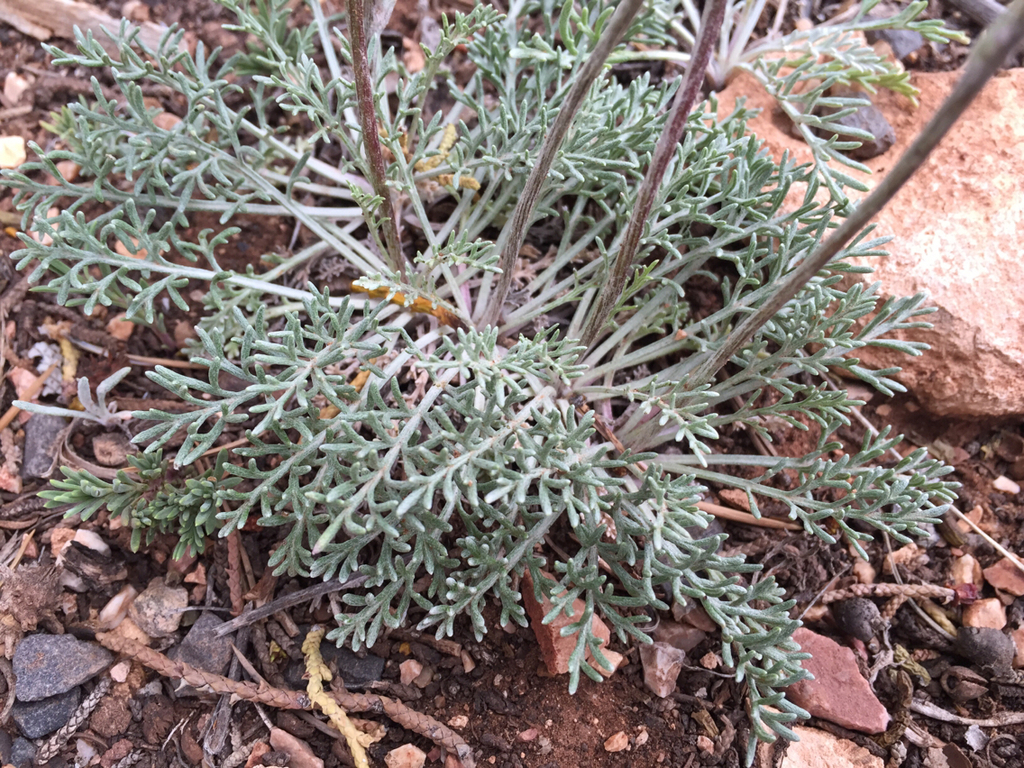
Photo: parent species Hymenopappus filifolius · no rights reserved, uploaded by Robbie Hannawacker · CC0
Family: Asteraceae · Type: Subshrub · Native
Conservation status: CNPS 2B.3
Hymenopappus filifolius var. nanus (Little cutleaf) is a native California subshrub in the Asteraceae family, recognized by by location alone with distinctive small stature.
Little cutleaf is a rare (CNPS 2B.3) California native perennial found in western and Inyo Mountains in limestone soil, pinyon and juniper woodland, and subalpine forest at elevations of 1,500 to 3,100 meters. Flowering from May to August, this plant produces pale yellow flowers in small heads 6 to 9 millimeters long. Growing with slender stems 5 to 50 centimeters tall and covered in sparse, even tomentose hairs, it forms a delicate, widely spreading habit. Its basal leaves are finely divided into thread-like segments 5 to 15 millimeters long, less than one millimeter wide, creating an intricate, lacy appearance. The fruit is 4.5 to 5.5 millimeters long and evenly covered with short hairs.
Identification and appearance
Key characters: Geographically isolated; diagnostic by location alone with distinctive small stature
Habitat and range
Habitat: Limestone soil, pinyon/juniper woodland, subalpine forest
Elevation: 1500-3100 m
Outside California: also central and eastern Nevada to western Utah, northwestern Arizona
Bloom period
Hymenopappus filifolius var. nanus blooms May-Aug.
Conservation status
CNPS 2B.3
How to tell it apart
vs Chaenactis: Hymenopappus is perennial with 12-22 seed scales; Chaenactis is typically annual with fewer seed scales.; vs Pseudognaphalium: Hymenopappus has finely divided leaves and papery flower bracts; Pseudognaphalium has simple, woolly-white leaves.; vs Trichoptilium: Hymenopappus has 12-22 blunt seed scales; Trichoptilium has feathery bristles instead of scales.; vs Carlquistia: Hymenopappus is perennial with papery flower bracts; Carlquistia is a small alpine cushion plant.; vs Raillardella: Hymenopappus has finely divided feathery leaves; Raillardella has simple, undivided leaves.
Frequently asked questions
Is Hymenopappus filifolius var. nanus native to California?
Yes. Hymenopappus filifolius var. nanus is native to California (recorded as native).
When does Hymenopappus filifolius var. nanus bloom?
Hymenopappus filifolius var. nanus blooms May-Aug.
What plant family does Hymenopappus filifolius var. nanus belong to?
Hymenopappus filifolius var. nanus is in the Asteraceae family, genus Hymenopappus.
Is Hymenopappus filifolius var. nanus rare or endangered?
Hymenopappus filifolius var. nanus carries California Rare Plant Rank 2B.3, state rank S3.
What habitat does Hymenopappus filifolius var. nanus grow in?
Hymenopappus filifolius var. nanus grows in Limestone soil, pinyon/juniper woodland, subalpine forest.
Related species
Other California species in the same genus, family, or bioregion.
- Hymenopappus sp.
- Hymenopappus filifolius — Columbia cutleaf
- Hymenopappus filifolius var. eriopodus — Hairy-podded fine-leaf hymenopappus
- Hymenopappus filifolius var. lugens — Columbia cutleaf
- Hymenopappus filifolius var. megacephalus — Fineleaf hymenopappus
- Hymenothrix dissecta
- Hymenothrix loomisii — Loomis' thimblehead
- Hymenothrix sp.
Sources: Jepson eFlora · CNPS Rare Plant Inventory · Index of California Plant Names · CalPhotos · CDFW CNDDB
Last updated 2026-10-07
Data from The California Species Project — 14,000+ California species with verified data from CNPS, CDFW, USFWS, Cal-IPC, and more.