Hyparrhenia hirta
Thatching grass
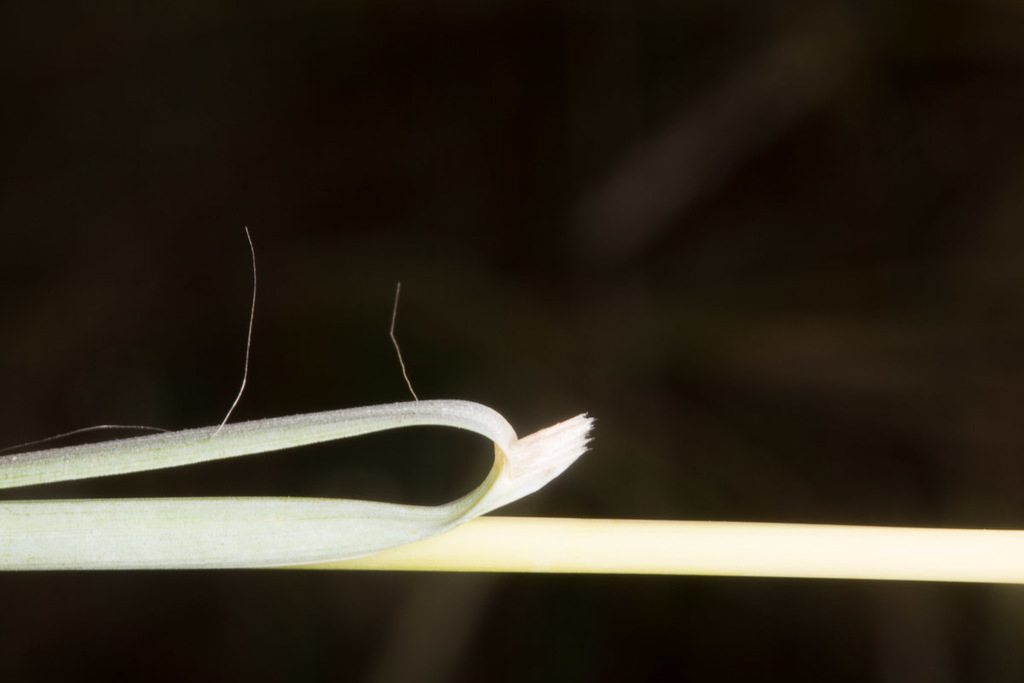
(c) Drepanostoma, some rights reserved (CC BY), uploaded by Drepanostoma · licence
Family: Poaceae · Type: Grass · Not Native
Conservation status: Cal-IPC Yes
Hyparrhenia hirta (Thatching grass) is a non-native California grass in the Poaceae family, recognized by African genus with limited California naturalization; recognized fire hazard species.
Thatching grass is a naturalized perennial found in southern California coastal areas including Los Angeles and San Diego counties in disturbed sites and urban canyon habitats at elevations below 300 meters. Flowering from March to July, this grass produces pale tan to green-yellow spikelets with densely hairy glumes in compact clusters. Growing in clustered clumps 30 to 100 centimeters tall with short rhizomes, the plant forms dense grass-like stands. Its narrow leaves are 5 to 30 centimeters long, typically folded or tightly rolled and less than 3 millimeters wide. The grass produces distinctive awns 1 to 3.5 centimeters long, with lemmas becoming hairy in the upper half of the spikelet.
Identification and appearance
Key characters: African genus with limited California naturalization; recognized fire hazard species
Habitat and range
Habitat: Disturbed sites, canyons near urban areas
Elevation: < 300 m
California counties: San Diego, Los Angeles
Outside California: native to warm temperate Eurasia, Africa
Bloom period
Hyparrhenia hirta blooms Mar-Jul.
Conservation status
Cal-IPC Yes
How to tell it apart
vs Sorghum: Hyparrhenia has branched, open seed heads; Sorghum has dense, compact seed heads.; vs Bothriochloa: Hyparrhenia stalks are smooth; Bothriochloa has translucent grooves that catch light.; vs Heteropogon: Hyparrhenia has branched flower heads; Heteropogon has a single unbranched spike.; vs Andropogon: Hyparrhenia has paired spikelets at nodes; Andropogon has single spikelets.
Frequently asked questions
Is Hyparrhenia hirta native to California?
No. Hyparrhenia hirta is not native to California (recorded as not native).
When does Hyparrhenia hirta bloom?
Hyparrhenia hirta blooms Mar-Jul.
Where in California does Hyparrhenia hirta grow?
Hyparrhenia hirta occurs in San Diego, Los Angeles, at elevations of < 300 m.
What plant family does Hyparrhenia hirta belong to?
Hyparrhenia hirta is in the Poaceae family, genus Hyparrhenia.
Is Hyparrhenia hirta invasive in California?
Hyparrhenia hirta is listed by Cal-IPC with an invasiveness rating of Yes.
Related species
Other California species in the same genus, family, or bioregion.
Sources: Jepson eFlora · Index of California Plant Names · CalPhotos
Last updated 2026-10-07
Data from The California Species Project — 14,000+ California species with verified data from CNPS, CDFW, USFWS, Cal-IPC, and more.