Hypericum anagalloides
Tinker's penny, Tinker's Penny
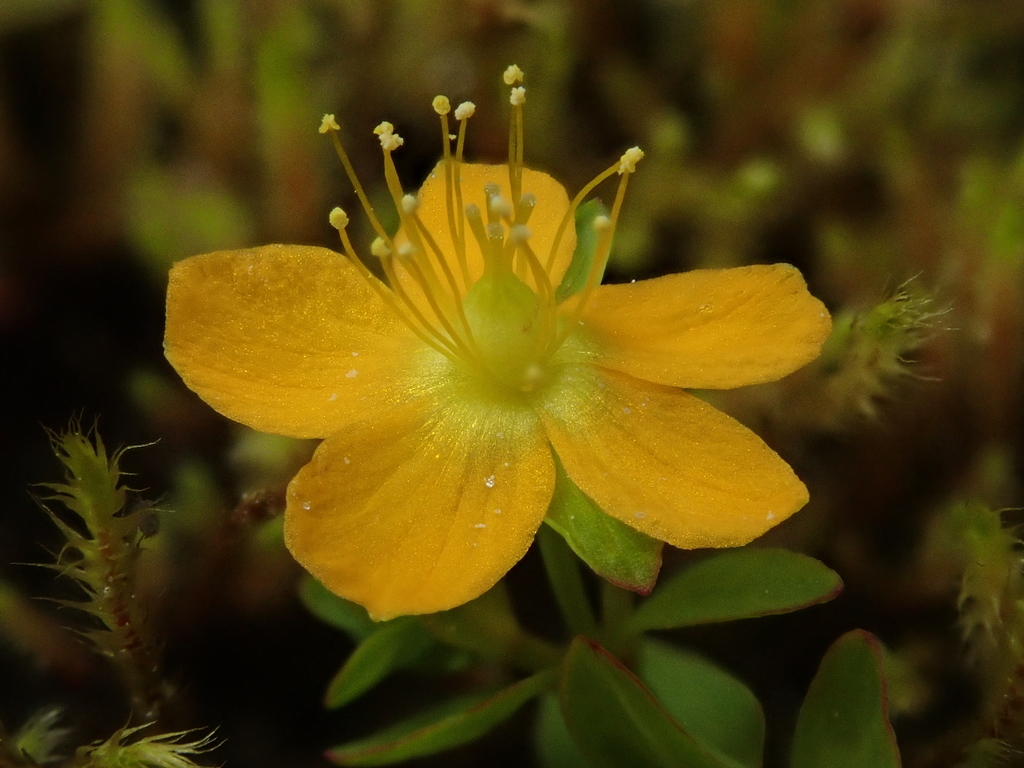
(c) Nolan Exe, some rights reserved (CC BY) · licence
Family: Hypericaceae · Type: Herb · Native
Hypericum anagalloides (Tinker's penny) is a native California herb in the Hypericaceae family, recognized by prostrate matted growth form.
Tinker's penny is a California native perennial found in northwestern California, Cascade Range, Sierra Nevada, northeastern Sacramento Valley, eastern San Joaquin Valley, Central Coast, San Francisco Bay Area, southern California mountains, San Bernardino Mountains, Peninsular Ranges, and Modoc Plateau in meadows, marshes, seeps, springs, streambanks, and lake margins at elevations up to 3,220 meters. Flowering from May to September, this plant produces gold to salmon-colored flowers 2 to 4 millimeters long with typically 15 to 25 stamens. Growing with prostrate to decumbent slender stems 3 to 30 centimeters tall that root at lower nodes, it spreads through matted stolons. Its leaves are elliptic to nearly round, 4 to 15 millimeters long with clear to green gland-dots, becoming linear and reduced near stem tips. The fruit is a small spheric to oblong capsule approximately 3 millimeters long.
Identification and appearance
Key characters: 7 sympatric species; diagnostic prostrate matted growth form
Habitat and range
Habitat: Meadows, marshes, seeps, springs, streambanks, lake margins
Elevation: < 3220 m
California counties: Mendocino, Tuolumne, Butte, Plumas, Tulare, San Bernardino, San Luis Obispo, Kern, Fresno, San Diego, Placer, El Dorado, Amador, Mono, Modoc, San Mateo, Marin, Alpine, Calaveras, Del Norte, Glenn, Humboldt, Inyo, Los Angeles, Madera, Merced, Napa, Riverside, San Joaquin, Santa Barbara, Santa Clara, Sierra, Tehama, Trinity, Lake, Mariposa, Monterey, Nevada, Shasta, San Francisco, Sonoma, Santa Cruz, Siskiyou, Yuba, Solano, Lassen, Stanislaus
Outside California: to British Columbia, Montana, Arizona, Baja California
Bloom period
Hypericum anagalloides blooms May-Sep.
How to tell it apart
vs Euphorbia: Euphorbia has milky sap and tiny flowers in cups; Hypericum has clear sap and showy yellow flowers.; vs Lysimachia: Lysimachia has stamens separate, not bundled; Hypericum's stamens cluster into 3-5 distinct bunches.; vs Lonicera: Lonicera is a woody vine or shrub; Hypericum is herbaceous with opposite leaves.; vs Dendromecon: Dendromecon is a woody shrub with 4 petals; Hypericum is herbaceous with 5 petals.; vs Mentzelia: Mentzelia has rough, sandpapery leaves; Hypericum has smooth leaves with translucent dots.
Frequently asked questions
Is Hypericum anagalloides native to California?
Yes. Hypericum anagalloides is native to California (recorded as native).
When does Hypericum anagalloides bloom?
Hypericum anagalloides blooms May-Sep.
Where in California does Hypericum anagalloides grow?
Hypericum anagalloides occurs in Mendocino, Tuolumne, Butte, Plumas, Tulare, San Bernardino, San Luis Obispo, Kern and other counties, at elevations of < 3220 m.
What plant family does Hypericum anagalloides belong to?
Hypericum anagalloides is in the Hypericaceae family, genus Hypericum.
What habitat does Hypericum anagalloides grow in?
Hypericum anagalloides grows in Meadows, marshes, seeps, springs, streambanks, lake margins.
Related species
Other California species in the same genus, family, or bioregion.
Sources: Jepson eFlora · Index of California Plant Names · CalPhotos
Last updated 2026-10-07
Data from The California Species Project — 14,000+ California species with verified data from CNPS, CDFW, USFWS, Cal-IPC, and more.