Imperata brevifolia
California satintail
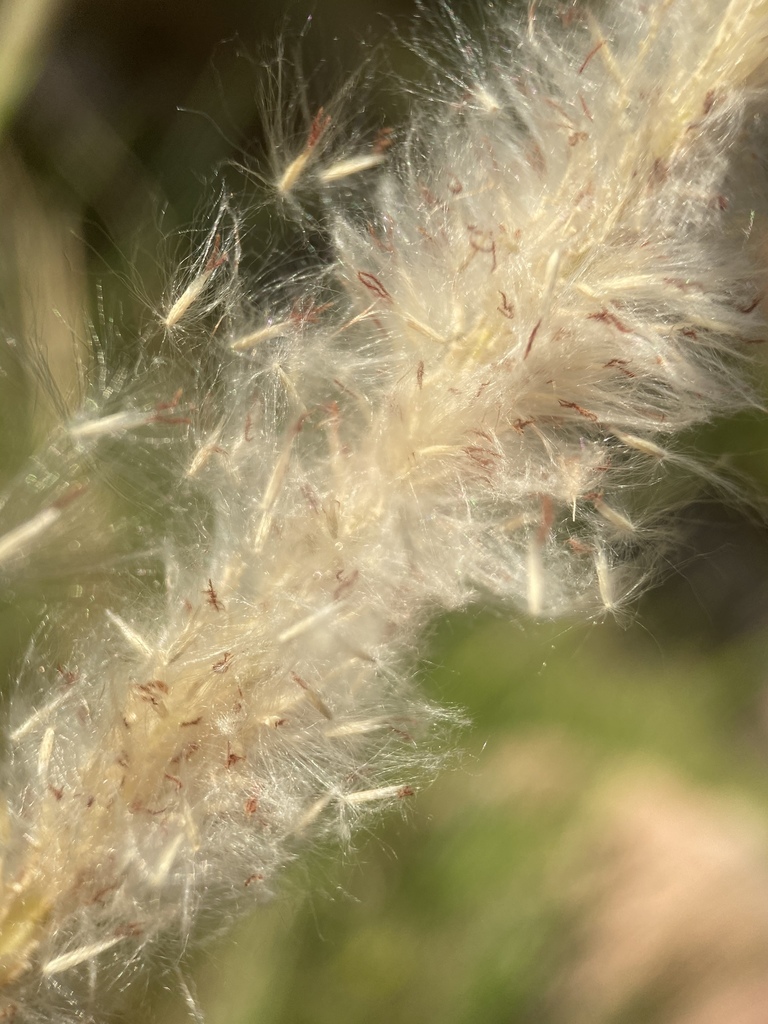
(c) Matt Berger, some rights reserved (CC BY), uploaded by Matt Berger · licence
Family: Poaceae · Type: Grass · Native
Conservation status: CNPS 2B.1
Imperata brevifolia (California satintail) is a native California grass in the Poaceae family, recognized by Disjunct from main Imperata distribution; relict species with limited California populations.
California satintail is a rare (CNPS 2B.1) California native perennial found in northern Coast Ranges, Cascade Range foothills, southern Sierra Nevada foothills, San Joaquin Valley, southern California coastal areas, Transverse Ranges, and desert regions in wet springs, meadows, streambanks, and floodplains at elevations below 500 meters. Flowering from September to May, this plant produces white plume-like inflorescences densely covered in silky hairs that appear speckled with brown anthers. Growing with robust rhizomes 70 to 150 centimeters tall, it forms dense grass-like clumps with hard, scaly underground stems. Its leaves are narrow, 15 to 50 centimeters long and 4 to 15 millimeters wide, with densely ciliate ligules at the base of each blade. Its distinctive white-silky flower plumes, which can reach 1 to 3 decimeters in length, create a soft, feathery appearance characteristic of this grassland species.
Identification and appearance
Key characters: Disjunct from main Imperata distribution; relict species with limited California populations
Habitat and range
Habitat: Wet springs, meadows, streambanks, floodplains
Elevation: < 500 m
California counties: Riverside, San Bernardino, Los Angeles, Ventura, Lake, Inyo, Fresno, Tehama, Tulare, Imperial, Butte, Kern
Outside California: to Utah, Texas, Mexico
Bloom period
Imperata brevifolia blooms Sep-May.
Conservation status
CNPS 2B.1
How to tell it apart
vs Phyllostachys: Imperata has silky flower plumes and herbaceous stems; bamboo has woody, hollow stems with nodes.; vs Cortaderia: Imperata's plume is narrow and cylinder-shaped under 2 feet tall; pampas grass is massive with huge feathery plumes.; vs Arundo: Imperata has intact flower heads and solid stems; giant reed has breaking seed heads and hollow stems.; vs Phragmites: Imperata's silvery plume stays intact; common reed's tan-purple plume breaks apart into segments.; vs Saccharum: Imperata has unequally stalked spikelet pairs; sugarcane has one sessile and one stalked spikelet.
Frequently asked questions
Is Imperata brevifolia native to California?
Yes. Imperata brevifolia is native to California (recorded as native).
When does Imperata brevifolia bloom?
Imperata brevifolia blooms Sep-May.
Where in California does Imperata brevifolia grow?
Imperata brevifolia occurs in Riverside, San Bernardino, Los Angeles, Ventura, Lake, Inyo, Fresno, Tehama and other counties, at elevations of < 500 m.
What plant family does Imperata brevifolia belong to?
Imperata brevifolia is in the Poaceae family, genus Imperata.
Is Imperata brevifolia rare or endangered?
Imperata brevifolia carries California Rare Plant Rank 2B.1, state rank S3.
Related species
Other California species in the same genus, family, or bioregion.
Sources: Jepson eFlora · CNPS Rare Plant Inventory · Index of California Plant Names · CalPhotos · CDFW CNDDB
Last updated 2026-10-07
Data from The California Species Project — 14,000+ California species with verified data from CNPS, CDFW, USFWS, Cal-IPC, and more.