Ipomopsis aggregata subsp. bridgesii
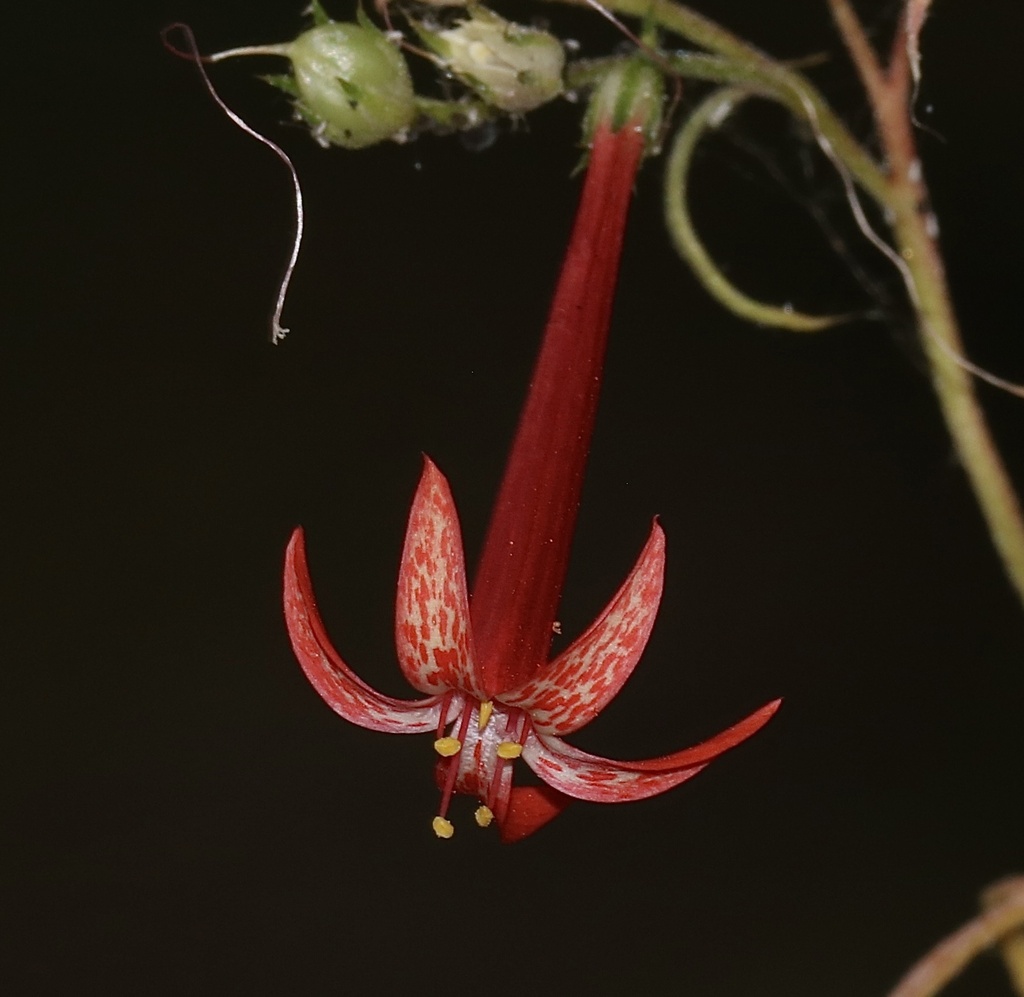
(c) Dustin Snider, some rights reserved (CC BY), uploaded by Dustin Snider · licence
Family: Polemoniaceae · Type: Herb · Native
Ipomopsis aggregata subsp. bridgesii is a native California herb in the Polemoniaceae family, recognized by leaf lobe shape, flower cluster size, and pollen color.
Scarlet gilia is a California native perennial found in the Sierra Nevada Mountains in forest openings and woodland at elevations of 1,800 to 3,300 meters. Flowering from June to September, this plant produces scarlet tubular flowers in small clusters of 1 to 5 blooms, with distinctive blue pollen. Growing with delicate stems up to one meter tall, it develops slender, deeply lobed leaves with rounded leaflet tips. Its leaf lobes are blunt to rounded, creating an elegant, finely divided foliage structure. The flowers feature small calyx lobes 1 to 2 millimeters long, with 1 to 4 stamens extending beyond the flower's throat.
Identification and appearance
Key characters: 2 sympatric species; key features are leaf lobe shape, flower cluster size, and pollen color
Habitat and range
Habitat: Openings in forests, woodland
Elevation: 1800-3300 m
California counties: Fresno, Mono, Tulare, Mariposa, Kern, Inyo, Madera, Tuolumne, Alpine, Plumas, Sierra, Lassen, Siskiyou, Amador
Bloom period
Ipomopsis aggregata subsp. bridgesii blooms Jun-Sep.
How to tell it apart
vs Penstemon: Ipomopsis has radial or slightly bilateral tubular flowers; Penstemon has distinctly 2-lipped bilateral flowers.; vs Epilobium: Ipomopsis has tubular 5-petaled flowers in dense clusters; Epilobium has 4 spreading petals and long capsules.; vs Silene: Ipomopsis has tubular flowers with fused petals; Silene has separate petals emerging from inflated calyx.; vs Delphinium: Ipomopsis has radial tubular flowers; Delphinium has spurred bilateral flowers with upper hooded petals.; vs Castilleja: Ipomopsis has showy tubular flowers; Castilleja has colorful bracts hiding small tubular flowers.
Frequently asked questions
Is Ipomopsis aggregata subsp. bridgesii native to California?
Yes. Ipomopsis aggregata subsp. bridgesii is native to California (recorded as native).
When does Ipomopsis aggregata subsp. bridgesii bloom?
Ipomopsis aggregata subsp. bridgesii blooms Jun-Sep.
Where in California does Ipomopsis aggregata subsp. bridgesii grow?
Ipomopsis aggregata subsp. bridgesii occurs in Fresno, Mono, Tulare, Mariposa, Kern, Inyo, Madera, Tuolumne and other counties, at elevations of 1800-3300 m.
What plant family does Ipomopsis aggregata subsp. bridgesii belong to?
Ipomopsis aggregata subsp. bridgesii is in the Polemoniaceae family, genus Ipomopsis.
What habitat does Ipomopsis aggregata subsp. bridgesii grow in?
Ipomopsis aggregata subsp. bridgesii grows in Openings in forests, woodland.
Related species
Other California species in the same genus, family, or bioregion.
Sources: Jepson eFlora · Index of California Plant Names · CalPhotos
Last updated 2026-10-07
Data from The California Species Project — 14,000+ California species with verified data from CNPS, CDFW, USFWS, Cal-IPC, and more.