Ipomopsis tenuifolia
Slender-leaved ipomopsis
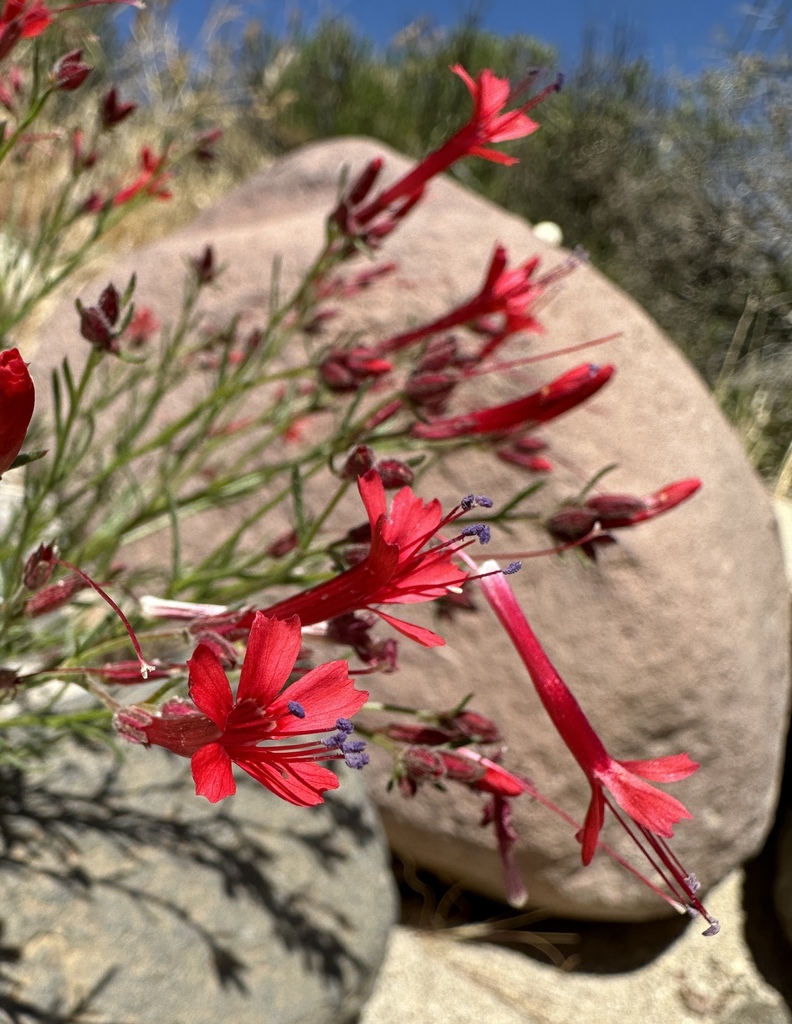
(c) Matt Berger, some rights reserved (CC BY), uploaded by Matt Berger · licence
Family: Polemoniaceae · Type: Subshrub · Native
Conservation status: CNPS 2B.3
Ipomopsis tenuifolia (Slender-leaved ipomopsis) is a native California subshrub in the Polemoniaceae family, recognized by CNPS 2B.3 ranking.
Slender-leaved ipomopsis is a rare (CNPS 2B.3) California native perennial found in southern San Diego County and the southeastern Peninsular Ranges in gravelly to rocky slopes and canyons at elevations of 100 to 1,200 meters. Flowering from April to June, this plant produces striking red flowers with white mottling, 15 to 28 millimeters long, with delicate tube and lobes. Growing with slender stems 10 to 40 centimeters tall that are sparsely puberulent, it develops an open branching habit. Its basal leaves are intricately divided into 3 to 5 remote linear lobes, while upper stem leaves remain entire. The plant features strongly exserted stamens and style, creating a distinctive profile against rocky canyon landscapes.
Identification and appearance
Key characters: 0 sympatric species - geographically isolated; CNPS 2B.3 ranking
Habitat and range
Habitat: Gravelly to rocky slopes, canyons
Elevation: 100-1200 m
California counties: Imperial, San Diego, Tulare, San Luis Obispo, Riverside, Siskiyou, San Bernardino
Outside California: Baja California
Bloom period
Ipomopsis tenuifolia blooms Apr-Jun.
Conservation status
CNPS 2B.3
How to tell it apart
vs Penstemon: Ipomopsis has radial or slightly bilateral tubular flowers; Penstemon has distinctly 2-lipped bilateral flowers.; vs Epilobium: Ipomopsis has tubular 5-petaled flowers in dense clusters; Epilobium has 4 spreading petals and long capsules.; vs Silene: Ipomopsis has tubular flowers with fused petals; Silene has separate petals emerging from inflated calyx.; vs Delphinium: Ipomopsis has radial tubular flowers; Delphinium has spurred bilateral flowers with upper hooded petals.; vs Castilleja: Ipomopsis has showy tubular flowers; Castilleja has colorful bracts hiding small tubular flowers.
Frequently asked questions
Is Ipomopsis tenuifolia native to California?
Yes. Ipomopsis tenuifolia is native to California (recorded as native).
When does Ipomopsis tenuifolia bloom?
Ipomopsis tenuifolia blooms Apr-Jun.
Where in California does Ipomopsis tenuifolia grow?
Ipomopsis tenuifolia occurs in Imperial, San Diego, Tulare, San Luis Obispo, Riverside, Siskiyou, San Bernardino, at elevations of 100-1200 m.
What plant family does Ipomopsis tenuifolia belong to?
Ipomopsis tenuifolia is in the Polemoniaceae family, genus Ipomopsis.
Is Ipomopsis tenuifolia rare or endangered?
Ipomopsis tenuifolia carries California Rare Plant Rank 2B.3, state rank S2.
Related species
Other California species in the same genus, family, or bioregion.
- Ipomopsis tenuituba — Narrow tube ipomopsis
- Ipomopsis aggregata — Scarlet gilia
- Ipomopsis aggregata subsp. aggregata
- Ipomopsis aggregata subsp. bridgesii
- Ipomopsis arizonica — Arizona ipomopsis
- Ipomopsis congesta — Ball headed gilia
- Langloisia setosissima — Bristly langloisia
- Langloisia setosissima subsp. punctata — Lilac sunbonnet
- Langloisia setosissima subsp. setosissima — Bristly langloisia
Sources: Jepson eFlora · CNPS Rare Plant Inventory · Index of California Plant Names · CalPhotos · CDFW CNDDB
Last updated 2026-10-07
Data from The California Species Project — 14,000+ California species with verified data from CNPS, CDFW, USFWS, Cal-IPC, and more.