Ipomopsis tenuituba
Narrow tube ipomopsis
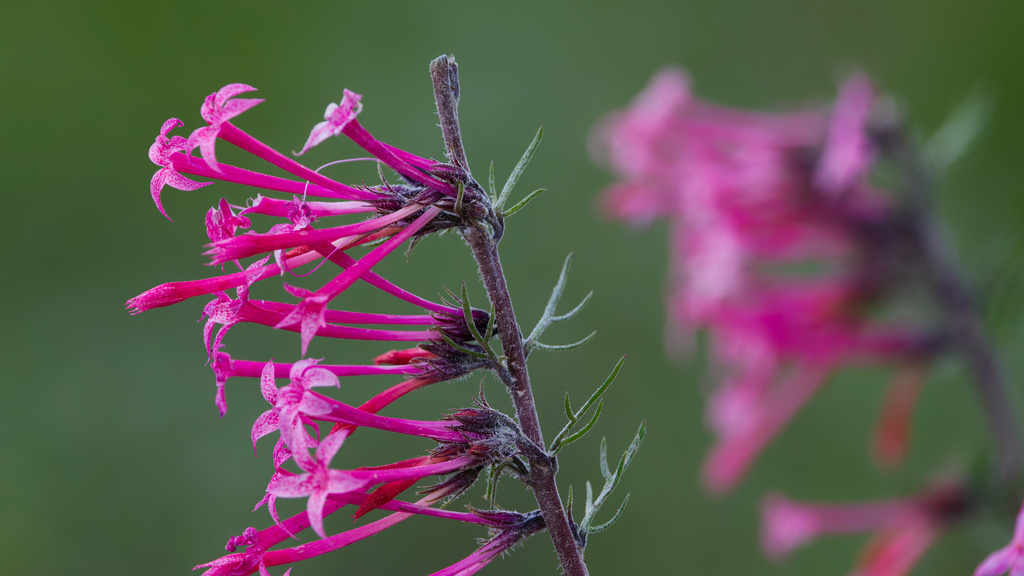
(c) Daughter Dad, some rights reserved (CC BY) · licence
Family: Polemoniaceae · Type: Subshrub · Native
Ipomopsis tenuituba (Narrow tube ipomopsis) is a native California subshrub in the Polemoniaceae family, recognized by very long narrow tubes, pale flower colors, and included stamens.
Narrow tube ipomopsis is a California native perennial found in southern California Ranges, Sierra Nevada, Modoc Plateau, and northern Sierra Nevada Eastern areas on gravelly to rocky slopes at elevations of 2,400 to 3,050 meters. Flowering from June to September, this plant produces white to pink or lavender flowers with subtle speckles at the base, arranged in clusters of 3 to 7 blooms with a distinctive tubular corolla 25 to 45 millimeters long. Growing with erect stems that are glabrous or glandular and slightly hairy, it develops up to 45 centimeters tall. Its basal leaves are pinnately divided into 9 to 17 narrow lobes, typically withering by flowering time, with cauline leaves generally puberulent. The delicate white to yellow pollen and radial flower structure make this alpine wildflower a unique botanical specimen.
Identification and appearance
Key characters: 7 sympatric species; key features are very long narrow tubes, pale flower colors, and included stamens
Habitat and range
Habitat: Gravelly to rocky slopes
Elevation: 2400-3050 m
California counties: Tuolumne, Inyo, Mono, Fresno, Modoc, El Dorado, Nevada, Placer, Lassen, Plumas, Alpine
Outside California: to Rocky Mountains
Bloom period
Ipomopsis tenuituba blooms Jun-Sep.
How to tell it apart
vs Penstemon: Ipomopsis has radial or slightly bilateral tubular flowers; Penstemon has distinctly 2-lipped bilateral flowers.; vs Epilobium: Ipomopsis has tubular 5-petaled flowers in dense clusters; Epilobium has 4 spreading petals and long capsules.; vs Silene: Ipomopsis has tubular flowers with fused petals; Silene has separate petals emerging from inflated calyx.; vs Delphinium: Ipomopsis has radial tubular flowers; Delphinium has spurred bilateral flowers with upper hooded petals.; vs Castilleja: Ipomopsis has showy tubular flowers; Castilleja has colorful bracts hiding small tubular flowers.
Frequently asked questions
Is Ipomopsis tenuituba native to California?
Yes. Ipomopsis tenuituba is native to California (recorded as native).
When does Ipomopsis tenuituba bloom?
Ipomopsis tenuituba blooms Jun-Sep.
Where in California does Ipomopsis tenuituba grow?
Ipomopsis tenuituba occurs in Tuolumne, Inyo, Mono, Fresno, Modoc, El Dorado, Nevada, Placer and other counties, at elevations of 2400-3050 m.
What plant family does Ipomopsis tenuituba belong to?
Ipomopsis tenuituba is in the Polemoniaceae family, genus Ipomopsis.
What habitat does Ipomopsis tenuituba grow in?
Ipomopsis tenuituba grows in Gravelly to rocky slopes.
Related species
Other California species in the same genus, family, or bioregion.
- Ipomopsis aggregata — Scarlet gilia
- Ipomopsis aggregata subsp. aggregata
- Ipomopsis aggregata subsp. bridgesii
- Ipomopsis arizonica — Arizona ipomopsis
- Ipomopsis congesta — Ball headed gilia
- Ipomopsis congesta subsp. congesta
- Langloisia setosissima — Bristly langloisia
- Langloisia setosissima subsp. punctata — Lilac sunbonnet
- Langloisia setosissima subsp. setosissima — Bristly langloisia
- Langloisia sp.
Sources: Jepson eFlora · Index of California Plant Names · CalPhotos
Last updated 2026-10-07
Data from The California Species Project — 14,000+ California species with verified data from CNPS, CDFW, USFWS, Cal-IPC, and more.