Iris macrosiphon
Bowltube iris
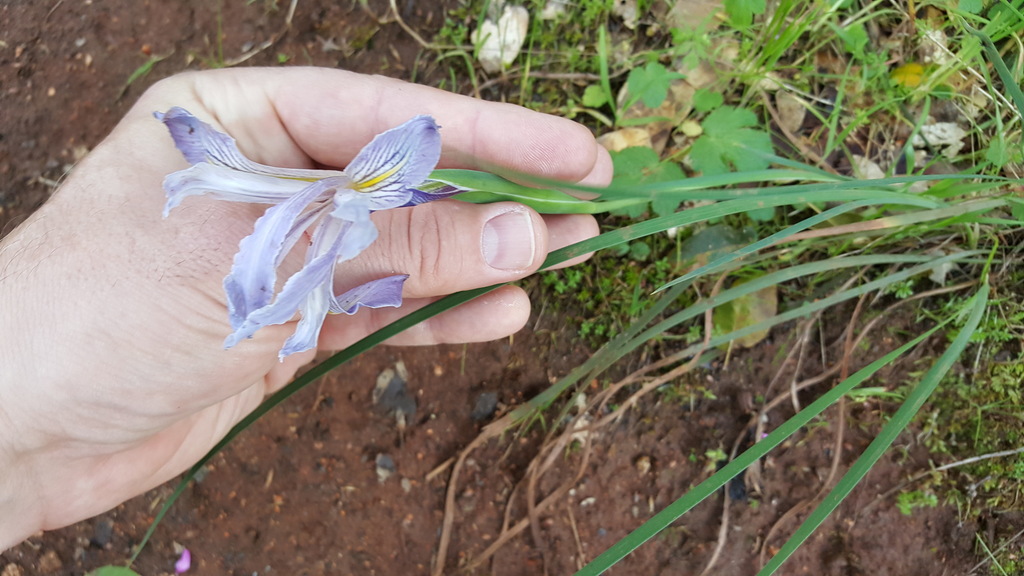
(c) Justin Johnsen, some rights reserved (CC BY) · licence
Family: Iridaceae · Type: Herb · Native
Iris macrosiphon (Bowltube iris) is a native California herb in the Iridaceae family, recognized by bowl-shaped tube highly diagnostic.
Bowltube iris is a California native perennial found in southern Klamath Ranges, northern Coast Ranges, northern Sierra Nevada foothills, and San Francisco Bay Area in open to partly shaded oak and pine woodlands at elevations generally below 1,000 meters. Flowering from March to May, this iris produces cream to gold-yellow or lavender to deep blue-purple flowers with distinctive bowl-like perianth tubes 34 to 65 millimeters long, often veined in darker tones. Growing with unbranched stems up to 15 centimeters tall, it emerges from a rhizome 7 to 9 millimeters in diameter. Its basal leaves are 3 to 6 millimeters wide with colorless bases, while the flower bracts are opposite and enclose the perianth tube. The large sepals are widely elliptic, 4 to 7 centimeters long and 14 to 22 millimeters wide, creating a dramatic flared appearance at the base of the flower.
Identification and appearance
Key characters: 14 sympatric species; bowl-shaped tube highly diagnostic
Habitat and range
Habitat: Common. Open to partly shaded slopes in oak or pine woodland
Elevation: generally < 1000 m
California counties: Mendocino, El Dorado, Santa Cruz, Placer, Butte, Santa Clara, Lake, Siskiyou, San Mateo, Nevada, Marin, Shasta, Tuolumne, Napa, Trinity, Humboldt, Tehama, Solano, Sonoma, Mariposa, Colusa, Plumas, Yuba, Glenn, Madera, Del Norte, Amador, San Bernardino, San Francisco, Yolo
Bloom period
Iris macrosiphon blooms Mar-May.
How to tell it apart
vs Dietes: Iris has broad petal-like style branches; Dietes has thread-like styles and flowers lasting only one day.; vs Canna: Iris has six-parted flowers with drooping sepals; Canna has asymmetric flowers with one petal-like stamen.; vs Hemerocallis: Iris has petal-like style branches opposite stamens; Hemerocallis has simple thread-like styles and six equal tepals.; vs Typha: Iris has showy six-parted flowers; Typha has dense brown cylindrical flower spikes (cattails).; vs Sisyrinchium: Iris has large flowers with drooping outer sepals; Sisyrinchium has small flat flowers with six equal tepals.
Frequently asked questions
Is Iris macrosiphon native to California?
Yes. Iris macrosiphon is native to California (recorded as native).
When does Iris macrosiphon bloom?
Iris macrosiphon blooms Mar-May.
Where in California does Iris macrosiphon grow?
Iris macrosiphon occurs in Mendocino, El Dorado, Santa Cruz, Placer, Butte, Santa Clara, Lake, Siskiyou and other counties, at elevations of generally < 1000 m.
What plant family does Iris macrosiphon belong to?
Iris macrosiphon is in the Iridaceae family, genus Iris.
What habitat does Iris macrosiphon grow in?
Iris macrosiphon grows in Common. Open to partly shaded slopes in oak or pine woodland.
Related species
Other California species in the same genus, family, or bioregion.
Sources: Jepson eFlora · Index of California Plant Names · CalPhotos
Last updated 2026-10-07
Data from The California Species Project — 14,000+ California species with verified data from CNPS, CDFW, USFWS, Cal-IPC, and more.