Isatis tinctoria
Woad, Woad
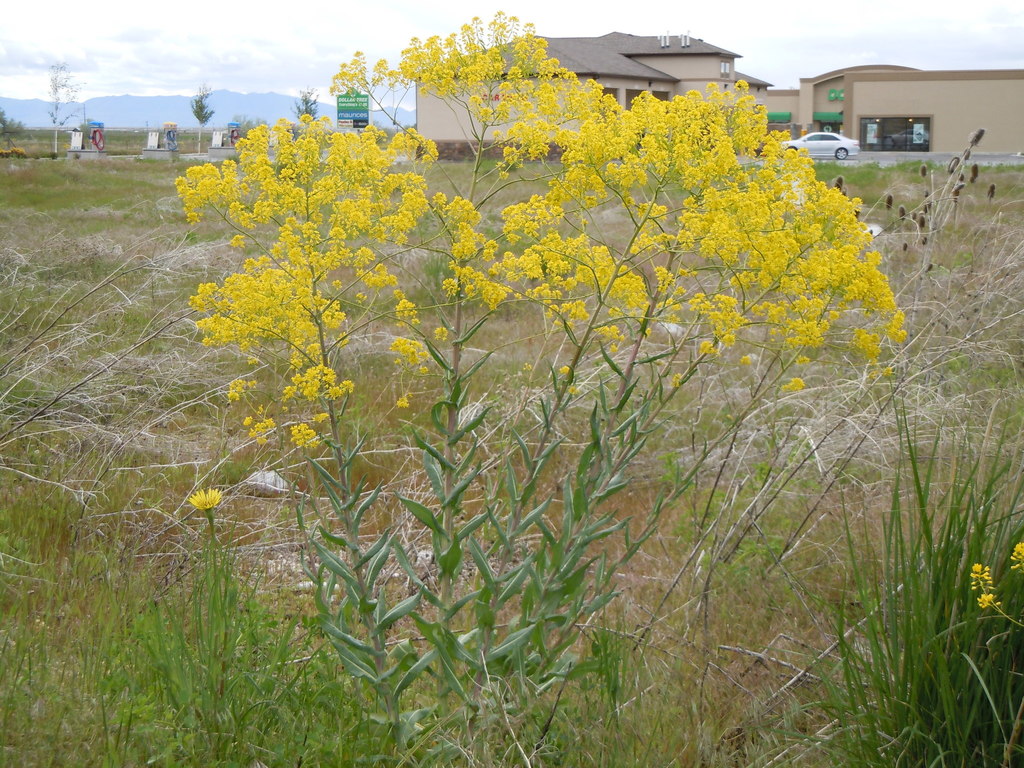
(c) Matt Lavin, some rights reserved (CC BY-SA) · licence
Family: Brassicaceae · Type: Herb · Not Native
Conservation status: Cal-IPC Yes
Isatis tinctoria (Woad) is a non-native California herb in the Brassicaceae family, recognized by Eurasian genus with limited naturalization; historically important dye plant.
Woad is a naturalized biennial found in the Klamath Ranges, northern California Ranges, northern Sierra Nevada, and Modoc Plateau in disturbed areas and pastures at elevations of 100 to 2,200 meters. Flowering from April to July, this plant produces distinctive yellow flowers in small clusters, each petal approximately 2.5 to 4 millimeters long. Growing with tall branching stems 30 to 100 centimeters high that become glaucous and glabrous, the plant develops a robust, spreading structure. Its basal leaves are oblong to oblanceolate, ranging from 6 to 20 centimeters long, with entire or slightly wavy edges that transition to smaller entire cauline leaves along the stem. The plant produces distinctive elongated fruits 1 to 2 centimeters long with reflexed pedicels, characteristic of its weedy, naturalized nature.
Identification and appearance
Key characters: Eurasian genus with limited naturalization; historically important dye plant
Habitat and range
Habitat: Disturbed areas, pastures
Elevation: 100-2200 m
California counties: Mendocino, Humboldt, Siskiyou, El Dorado, Tehama, Nevada, Placer, Modoc, Yolo, Calaveras, Sierra, Marin, Trinity, Tuolumne, Colusa, Butte, Amador, Glenn, Lassen, Del Norte, Shasta, Napa, Alameda
Outside California: western and eastern North America, native to Eurasia
Bloom period
Isatis tinctoria blooms Apr-Jul.
Conservation status
Cal-IPC Yes
How to tell it apart
vs Thysanocarpus: Bright yellow petals versus white or purple-tinged petals in Thysanocarpus.; vs Lepidium: Fruits hang downward versus standing upright or spreading in Lepidium.; vs Noccaea: Yellow flowers with lance-shaped hanging fruits versus white flowers with heart-shaped upright fruits.; vs Thlaspi: Hanging lance-shaped fruits versus heart-shaped upright fruits in Thlaspi.; vs Iberis: Yellow flowers with winged hanging fruits versus white-purple flowers with upright notched pods.
Frequently asked questions
Is Isatis tinctoria native to California?
No. Isatis tinctoria is not native to California (recorded as not native).
When does Isatis tinctoria bloom?
Isatis tinctoria blooms Apr-Jul.
Where in California does Isatis tinctoria grow?
Isatis tinctoria occurs in Mendocino, Humboldt, Siskiyou, El Dorado, Tehama, Nevada, Placer, Modoc and other counties, at elevations of 100-2200 m.
What plant family does Isatis tinctoria belong to?
Isatis tinctoria is in the Brassicaceae family, genus Isatis.
Is Isatis tinctoria invasive in California?
Isatis tinctoria is listed by Cal-IPC with an invasiveness rating of Yes.
Related species
Other California species in the same genus, family, or bioregion.
Sources: Jepson eFlora · Index of California Plant Names · CalPhotos
Last updated 2026-10-07
Data from The California Species Project — 14,000+ California species with verified data from CNPS, CDFW, USFWS, Cal-IPC, and more.