Isocoma menziesii var. vernonioides
Coastal goldenbush
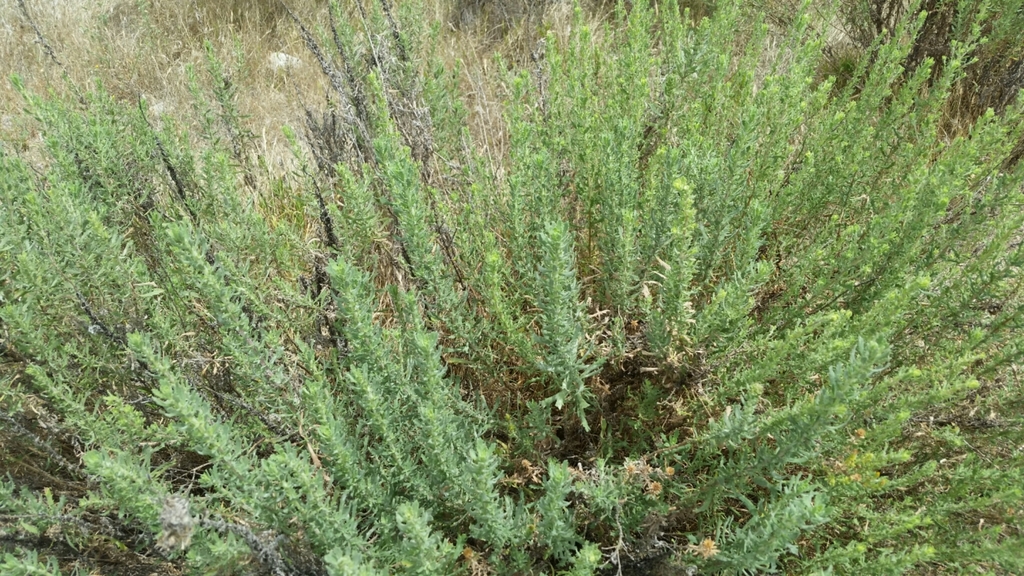
(c) Millie Basden, some rights reserved (CC BY), uploaded by Millie Basden · licence
Family: Asteraceae · Type: Subshrub · Native
Isocoma menziesii var. vernonioides (Coastal goldenbush) is a native California subshrub in the Asteraceae family, recognized by densely clustered axillary leaves diagnostic.
Coastal goldenbush is a California native shrub found in southwestern Sacramento Valley, central and southern coastal regions, Channel Islands in protected sites on dunes, lagoon shores, marshes, and dry slopes in grassland and coastal scrub at elevations below 400 meters. Flowering from June to December, this plant produces yellow flowers in dense, flat-topped clusters with individual flower heads 5 to 7 millimeters long. Growing to 1.2 meters tall with erect to decumbent stems that branch at the base, it has a distinctive appearance with densely clustered leaves that often obscure the stem. Its leaves are 10 to 45 millimeters long, varying from linear-oblong to oblanceolate or obovate, with herbage that can be stalked-glandular or gray tomentose. The plant's variable texture ranges from long-soft-hairy to potentially becoming glabrous as it matures.
Identification and appearance
Key characters: 9 sympatric species; densely clustered axillary leaves diagnostic
Habitat and range
Habitat: Protected sites on dunes, lagoon shores, marshes, dry slopes in grassland and coastal scrub
Elevation: < 400 m
Outside California: northern Baja California
Bloom period
Isocoma menziesii var. vernonioides blooms Jun-Dec.
How to tell it apart
vs Ericameria: Isocoma has randomly arranged bracts; Ericameria has bracts in 5 distinct vertical rows.; vs Hazardia: Isocoma has smooth or slightly hairy stems; Hazardia has densely hairy stems and leaves.; vs Baccharis: Isocoma has yellow bisexual flowers; Baccharis has whitish flowers on separate male/female plants.; vs Heterotheca: Isocoma has only disk flowers; Heterotheca has showy yellow ray flowers around the disk.; vs Eriogonum: Isocoma has yellow composite flowers; Eriogonum has small clustered flowers with colorful sepals but no petals.
Frequently asked questions
Is Isocoma menziesii var. vernonioides native to California?
Yes. Isocoma menziesii var. vernonioides is native to California (recorded as native).
When does Isocoma menziesii var. vernonioides bloom?
Isocoma menziesii var. vernonioides blooms Jun-Dec.
What plant family does Isocoma menziesii var. vernonioides belong to?
Isocoma menziesii var. vernonioides is in the Asteraceae family, genus Isocoma.
What habitat does Isocoma menziesii var. vernonioides grow in?
Isocoma menziesii var. vernonioides grows in Protected sites on dunes, lagoon shores, marshes, dry slopes in grassland and coastal scrub.
Related species
Other California species in the same genus, family, or bioregion.
- Isocoma sp. — Goldenbush
- Isocoma acradenia — Alkali goldenbush
- Isocoma acradenia var. acradenia — Alkali goldenbush
- Isocoma acradenia var. bracteosa — Bracted alkali goldenbush
- Isocoma acradenia var. eremophila — Solitary leaved alkali goldenbush
- Isocoma arguta — Carquinez goldenbush
- Iva axillaris — Poverty weed
- Iva hayesiana — San diego marsh-elder
- Iva sp. — Marsh-elder
Sources: Jepson eFlora · Index of California Plant Names · CalPhotos
Last updated 2026-10-07
Data from The California Species Project — 14,000+ California species with verified data from CNPS, CDFW, USFWS, Cal-IPC, and more.