Isoetes bolanderi
Bolander's quillwort
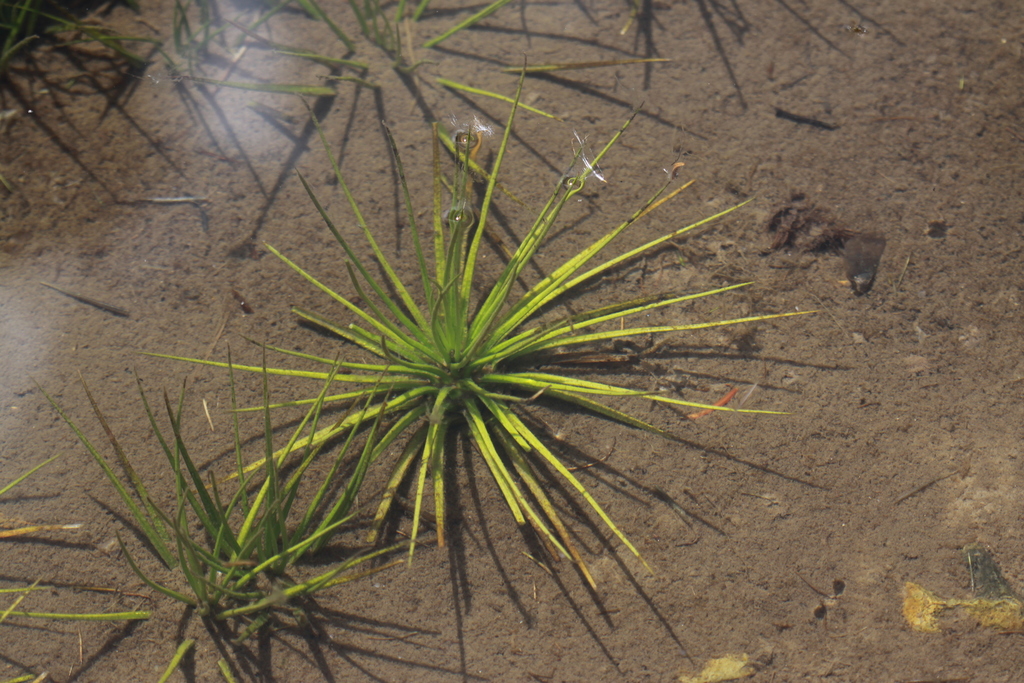
(c) Andrey Zharkikh, some rights reserved (CC BY) · licence
Family: Isoetaceae · Type: Grass · Native
Isoetes bolanderi (Bolander's quillwort) is a native California grass in the Isoetaceae family, recognized by habitat (persistent water), elevation, and abruptly narrowed leaf tips.
Bolander's quillwort is a California native perennial found in the Klamath Ranges, northern Coast Ranges, high Cascade Range, Sierra Nevada, San Francisco Bay Area, San Bernardino Mountains, and Warner Mountains in persistent lakes and pools at elevations above 1,300 meters. This unique aquatic plant grows entirely underwater with bright green, rigid leaves less than 20 centimeters long that are abruptly narrowed at the tip, with white to light brown leaf bases. Growing as a delicate underwater perennial, it produces distinctive sporangia with membranes covering less than 30% of the surface and complex spore structures. Its leaves are deciduous and have a distinctive bright green coloration, with male spores measuring 0.02 to 0.03 millimeters and female spores ranging from 0.3 to 0.5 millimeters with intricate ridged and tubercled surfaces. The plant reproduces through these specialized spores, which appear brown when massed together.
Identification and appearance
Key characters: 5 sympatric species - key features are habitat (persistent water), elevation, and abruptly narrowed leaf tips
Habitat and range
Habitat: Persistent lakes, pools
Elevation: > 1300 m (250 m in Marin Co.)
California counties: Tuolumne, Siskiyou, San Bernardino, Sierra, Fresno, Inyo, Tulare, Alpine, Butte, Madera, Mariposa, Modoc, Mono, Nevada, Placer, Plumas, Shasta, El Dorado, Trinity, Lake, Lassen, Amador, Humboldt, Marin, Del Norte
Outside California: to British Columbia, Wyoming, New Mexico
How to tell it apart
vs Juncus: Isoetes has a bulbous corm-like base with embedded spore capsules; Juncus has fibrous roots without sporangia.; vs Subularia: Isoetes leaves arise from a bulbous base; Subularia has a thin taproot with small white flowers above the leaves.; vs Triglochin: Isoetes has spore capsules at leaf bases; Triglochin produces tall flower spikes with tiny greenish flowers.; vs Sparganium: Isoetes forms tight tufts from a corm; Sparganium has creeping stems and round, burr-like flower heads.; vs Pilularia: Isoetes leaves stand rigidly erect; Pilularia leaves coil in fiddlehead fashion when young.
Frequently asked questions
Is Isoetes bolanderi native to California?
Yes. Isoetes bolanderi is native to California (recorded as native).
Where in California does Isoetes bolanderi grow?
Isoetes bolanderi occurs in Tuolumne, Siskiyou, San Bernardino, Sierra, Fresno, Inyo, Tulare, Alpine and other counties, at elevations of > 1300 m (250 m in Marin Co.).
What plant family does Isoetes bolanderi belong to?
Isoetes bolanderi is in the Isoetaceae family, genus Isoetes.
What habitat does Isoetes bolanderi grow in?
Isoetes bolanderi grows in Persistent lakes, pools.
Related species
Other California species in the same genus, family, or bioregion.
Sources: Jepson eFlora · Index of California Plant Names · CalPhotos
Last updated 2026-10-07
Data from The California Species Project — 14,000+ California species with verified data from CNPS, CDFW, USFWS, Cal-IPC, and more.