Isolepis cernua
Low bulrush
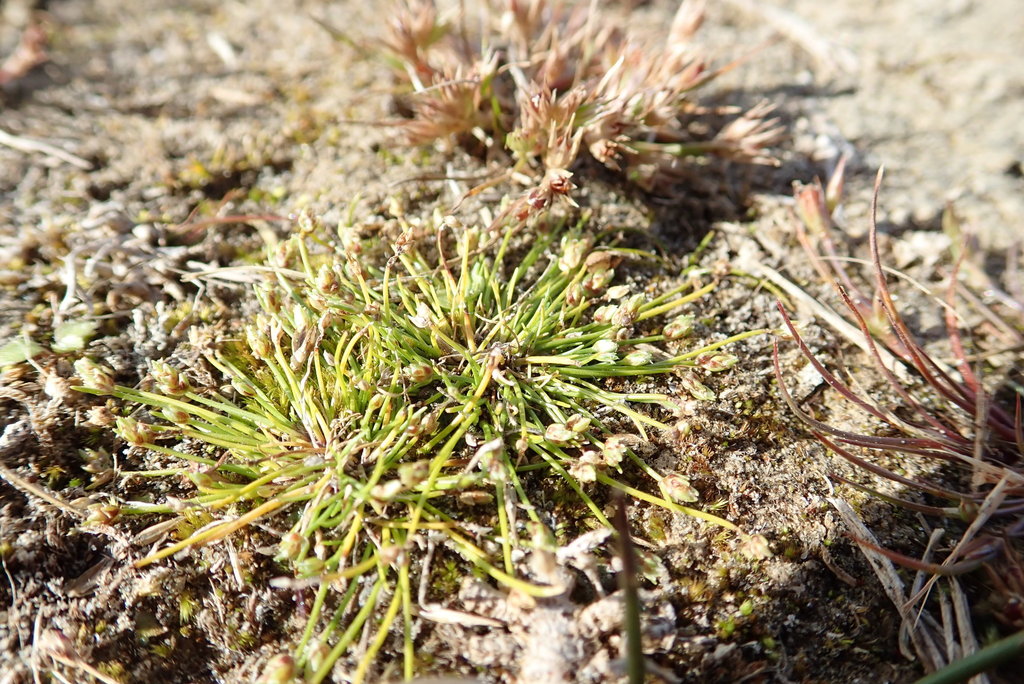
(c) Arnim Littek, some rights reserved (CC BY) · licence
Family: Cyperaceae · Type: Grass · Native
Isolepis cernua (Low bulrush) is a native California grass in the Cyperaceae family, recognized by fruit shallower than wide with convex sides.
Low bulrush is a California native perennial found in northern coastal, Central Coast, San Francisco Bay, southern coastal, and San Bernardino Mountains regions in sandy sea shores, bluffs, sand dunes, creeks, and marshes at elevations below 800 meters. Flowering from late spring to winter, this plant produces small, delicate flowers in clustered inflorescences. Growing 4 to 40 centimeters tall with slender, arching stems, it forms dense tufted clumps in moist habitats. Its single leaf is typically short and narrow, arising from the base of the plant. The tiny fruit is less than one millimeter long, with a distinctive two to three-sided shape and slightly convex or concave surfaces.
Identification and appearance
Key characters: 3 sympatric species; key feature is fruit shallower than wide with convex sides
Habitat and range
Habitat: Sandy, sometimes brackish sea shores, bluffs, sand dunes, creeks, marshes
Elevation: < 800 m
California counties: Orange, Los Angeles, Riverside, San Diego, Alameda, Contra Costa, Del Norte, Fresno, Humboldt, Marin, Mendocino, Monterey, San Francisco, San Luis Obispo, San Mateo, Santa Barbara, Solano, Sonoma, Stanislaus, Ventura, San Bernardino, Butte, El Dorado, Santa Cruz, Santa Clara, Shasta, San Benito, Yuba, Calaveras, Sacramento
Outside California: to British Columbia, Texas (naturalized), South America, Eurasia, Africa, Australia, New Zealand
Bloom period
Isolepis cernua blooms Late spring-winter.
How to tell it apart
vs Eleocharis: Isolepis has multiple parallel veins in its bracts; Eleocharis bracts have just a single midvein.; vs Juncus: Isolepis flowers grow in spikelets with overlapping scales; Juncus has separate flowers with 6 perianth parts.; vs Carex: Isolepis has bisexual flowers in open spikelets; Carex has separate male/female flowers in enclosed sacs.; vs Triglochin: Isolepis has scaly spikelets typical of sedges; Triglochin has spike-like flower clusters with capsules.; vs Lipocarpha: Isolepis has one bract per flower; Lipocarpha has two nested bracts (inner and outer) per flower.
Frequently asked questions
Is Isolepis cernua native to California?
Yes. Isolepis cernua is native to California (recorded as native).
When does Isolepis cernua bloom?
Isolepis cernua blooms Late spring-winter.
Where in California does Isolepis cernua grow?
Isolepis cernua occurs in Orange, Los Angeles, Riverside, San Diego, Alameda, Contra Costa, Del Norte, Fresno and other counties, at elevations of < 800 m.
What plant family does Isolepis cernua belong to?
Isolepis cernua is in the Cyperaceae family, genus Isolepis.
What habitat does Isolepis cernua grow in?
Isolepis cernua grows in Sandy, sometimes brackish sea shores, bluffs, sand dunes, creeks, marshes.
Related species
Other California species in the same genus, family, or bioregion.
Sources: Jepson eFlora · Index of California Plant Names · CalPhotos
Last updated 2026-10-07
Data from The California Species Project — 14,000+ California species with verified data from CNPS, CDFW, USFWS, Cal-IPC, and more.