Iva hayesiana
San diego marsh-elder, San Diego Marsh-Elder
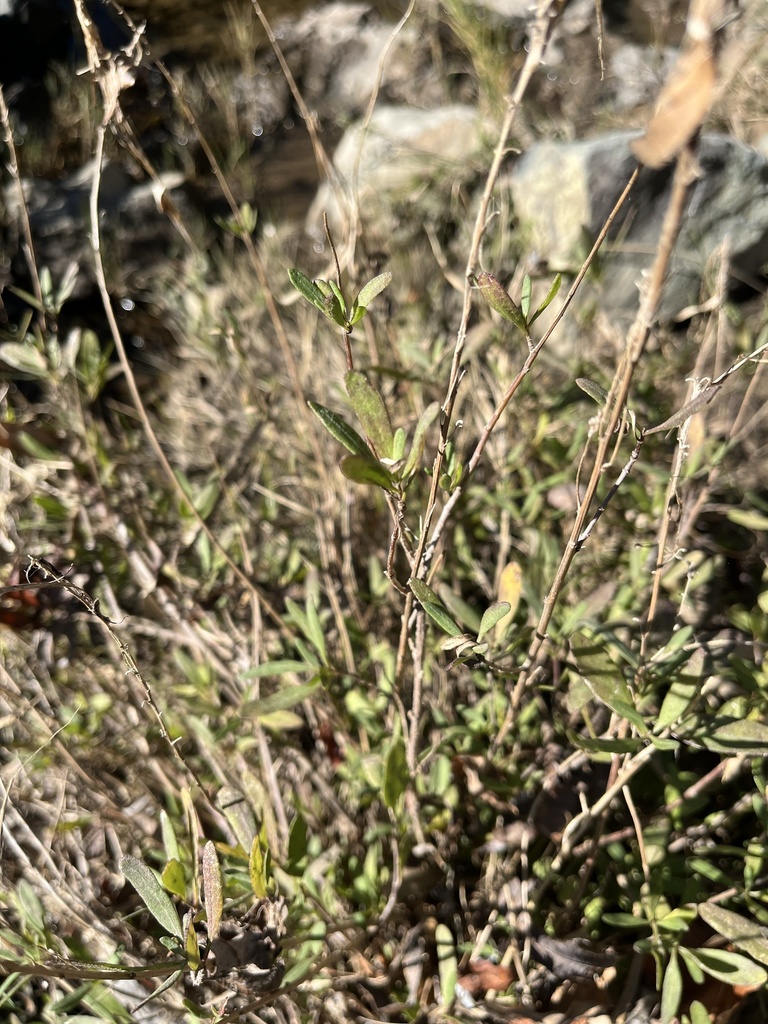
(c) Justin Felder, some rights reserved (CC BY-SA) · licence
Family: Asteraceae · Type: Subshrub · Native
Conservation status: CNPS 2B.2
Iva hayesiana (San diego marsh-elder) is a native California subshrub in the Asteraceae family, recognized by CNPS 2B.2 rare plant, distinguished by larger size, leaves, and restricted low-elevation range.
San diego marsh-elder is a rare (CNPS 2B.2) California native perennial found in southern Southern California Coast and southwestern Peninsular Ranges in alkaline flats, depressions, and streambanks at elevations below 300 meters. Flowering from March to September, this plant produces small greenish to white flowers in compact clusters with green outer phyllaries. Growing as a sprawling to erect herb up to one meter tall with glandular stems, it develops a distinctive branching structure. Its leaves are lance-elliptic to oblanceolate, 2 to 5 centimeters long, sparsely hairy with gland-dotted surfaces and narrow blades 5 to 10 millimeters wide. The plant's small fruits are approximately 2 to 2.5 millimeters long, characteristic of its marsh-dwelling adaptation.
Identification and appearance
Key characters: 1 sympatric species; CNPS 2B.2 rare plant, distinguished by larger size, leaves, and restricted low-elevation range
Habitat and range
Habitat: Alkaline flats, depressions, streambanks
Elevation: < 300(900) m
Outside California: to Baja California
Bloom period
Iva hayesiana blooms Mar-Sep.
Conservation status
CNPS 2B.2
How to tell it apart
vs Ambrosia: Iva has simple, usually entire leaves and weakly fused anthers; Ambrosia has deeply lobed leaves and completely free anthers.; vs Atriplex: Iva is in the sunflower family with tiny flower heads; Atriplex is in the goosefoot family with scaly-mealy leaves and wind-pollinated flowers.; vs Encelia: Iva has inconspicuous heads without rays in wet alkaline sites; Encelia has showy yellow daisy heads in dry upland habitats.; vs Isocoma: Iva has entire leaves and anthers free or weakly fused; Isocoma has toothed leaves and completely fused anthers.; vs Baccharis: Iva has bisexual disk flowers with anthers; Baccharis has male and female flowers on separate plants.
Frequently asked questions
Is Iva hayesiana native to California?
Yes. Iva hayesiana is native to California (recorded as native).
When does Iva hayesiana bloom?
Iva hayesiana blooms Mar-Sep.
What plant family does Iva hayesiana belong to?
Iva hayesiana is in the Asteraceae family, genus Iva.
Is Iva hayesiana rare or endangered?
Iva hayesiana carries California Rare Plant Rank 2B.2, state rank S2.
What habitat does Iva hayesiana grow in?
Iva hayesiana grows in Alkaline flats, depressions, streambanks.
Related species
Other California species in the same genus, family, or bioregion.
Sources: Jepson eFlora · CNPS Rare Plant Inventory · Index of California Plant Names · CalPhotos · CDFW CNDDB
Last updated 2026-10-07
Data from The California Species Project — 14,000+ California species with verified data from CNPS, CDFW, USFWS, Cal-IPC, and more.