Ivesia lycopodioides var. megalopetala
Clubmoss ivesia
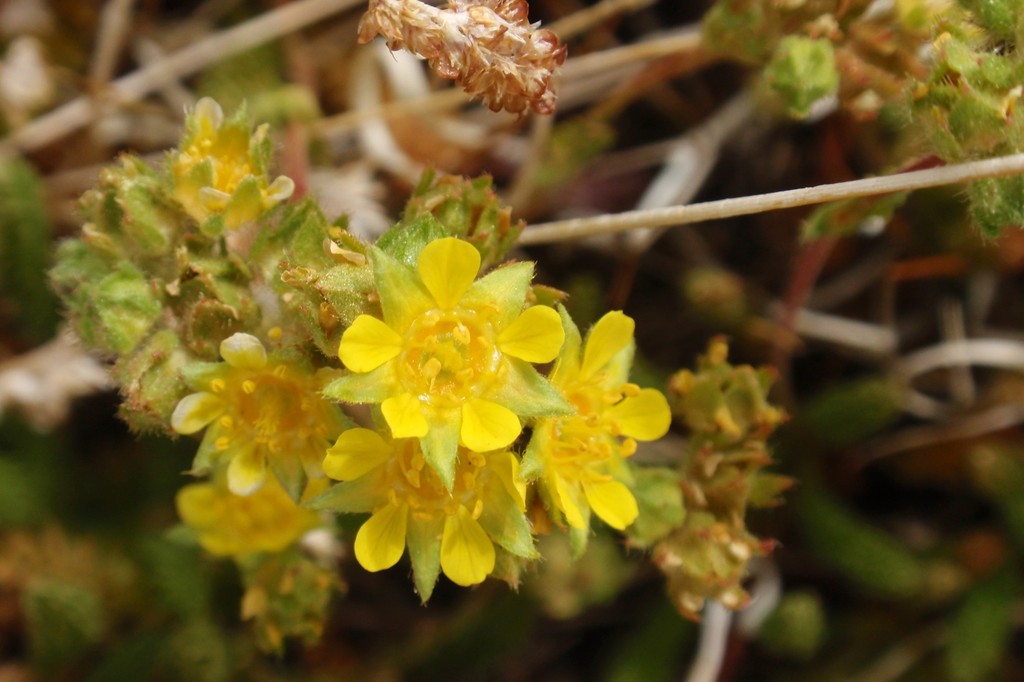
(c) Tom Hilton, some rights reserved (CC BY), uploaded by Tom Hilton · licence
Family: Rosaceae · Type: Herb · Native
Ivesia lycopodioides var. megalopetala (Clubmoss ivesia) is a native California herb in the Rosaceae family, recognized by no sympatric species.
Clubmoss ivesia is a California native perennial found in the central Sierra Nevada Mountains in wet meadows at elevations of 2,300 to 3,700 meters. Flowering from June to September, this plant produces white to cream-colored flowers with widely obovate petals 3 to 5 millimeters long. Growing with stems 10 to 30 centimeters tall, it forms dense, low-growing clusters characteristic of alpine meadow environments. Its finely divided leaves extend 4 to 15 centimeters long, with delicate oblanceolate lobes 2 to 8 millimeters in length that are nearly glabrous. The plant's compact growth and intricate leaf structure make it a distinctive component of high-elevation Sierra Nevada mountain meadows.
Identification and appearance
Key characters: Geographically isolated; no sympatric species
Habitat and range
Habitat: Wet meadows
Elevation: 2300-3700 m
California counties: Inyo, Mono, Tuolumne, Tulare, Fresno, Mariposa
Bloom period
Ivesia lycopodioides var. megalopetala blooms Jun-Sep.
How to tell it apart
vs Achillea: Ivesia has rose-like flowers with separate petals; Achillea has composite flower heads with ray and disk flowers.; vs Potentilla: Ivesia has cylindrical bottlebrush leaves with 4-80 tiny leaflets per side; Potentilla has flat leaves with spread-out leaflets.; vs Horkelia: Ivesia has cylindrical leaves with overlapping leaflets; Horkelia has flat leaves with 2-15 distinct, separated leaflets.; vs Eremogone: Ivesia has compound bottlebrush leaves; Eremogone has simple, needle-like or thread-like leaves.; vs Cryptantha: Ivesia has rose-family flowers with separate petals; Cryptantha has fused tubular corollas typical of borages.
Frequently asked questions
Is Ivesia lycopodioides var. megalopetala native to California?
Yes. Ivesia lycopodioides var. megalopetala is native to California (recorded as native).
When does Ivesia lycopodioides var. megalopetala bloom?
Ivesia lycopodioides var. megalopetala blooms Jun-Sep.
Where in California does Ivesia lycopodioides var. megalopetala grow?
Ivesia lycopodioides var. megalopetala occurs in Inyo, Mono, Tuolumne, Tulare, Fresno, Mariposa, at elevations of 2300-3700 m.
What plant family does Ivesia lycopodioides var. megalopetala belong to?
Ivesia lycopodioides var. megalopetala is in the Rosaceae family, genus Ivesia.
What habitat does Ivesia lycopodioides var. megalopetala grow in?
Ivesia lycopodioides var. megalopetala grows in Wet meadows.
Related species
Other California species in the same genus, family, or bioregion.
Sources: Jepson eFlora · Index of California Plant Names · CalPhotos
Last updated 2026-10-07
Data from The California Species Project — 14,000+ California species with verified data from CNPS, CDFW, USFWS, Cal-IPC, and more.