Juglans californica
Southern california black walnut, Southern California Black Walnut
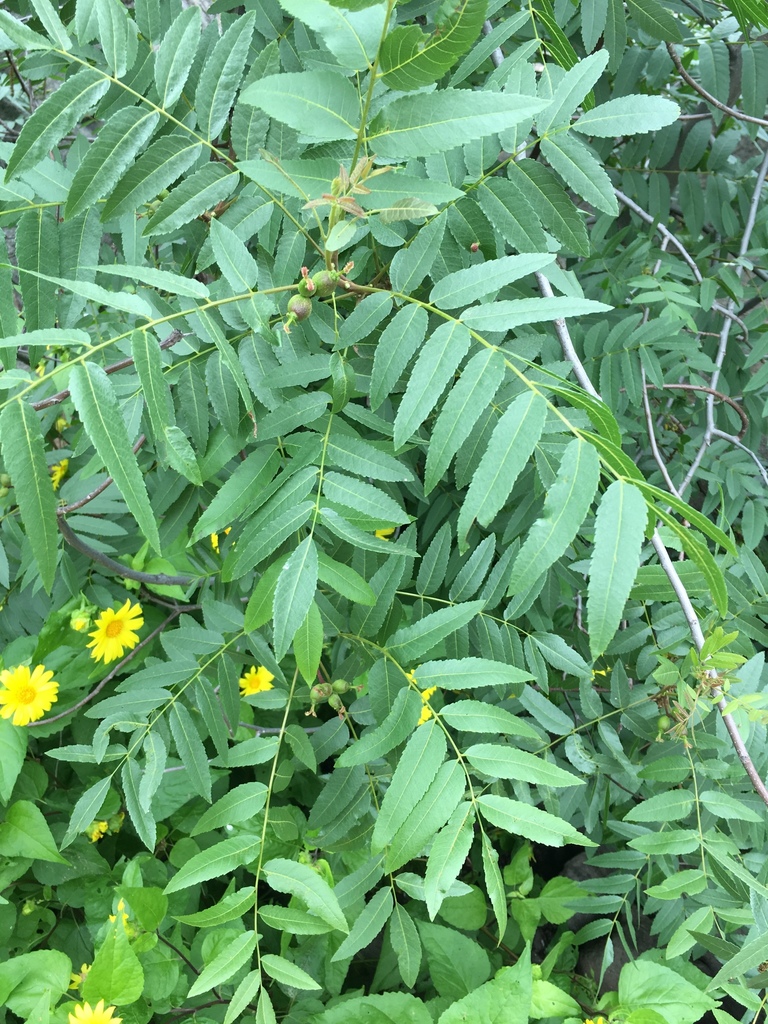
(c) Adam J. Searcy, some rights reserved (CC BY), uploaded by Adam J. Searcy · licence
Family: Juglandaceae · Type: Shrub / Tree · Native
Conservation status: CNPS 4.2
Juglans californica (Southern california black walnut) is a native California shrub / tree in the Juglandaceae family, recognized by (J. regia). Key features: smaller fruit, more leaflets, serrate margins.
Southern california black walnut is a native shrub ranked 4.2 by CNPS, found in the Santa Lucia Range and southwestern California in hillsides and canyons at elevations of 30 to 900 meters. Flowering from March to May, this plant produces small greenish flowers in clusters. Growing with a trunk 6 to 9 meters tall, it develops a distinctive branching structure with multiple stems. Its compound leaves have 11 to 15 narrow elliptical leaflets 4 to 9.5 centimeters long, slightly serrated along the edges. The fruit is a thick-shelled walnut approximately 2 to 3.5 centimeters in diameter with shallow surface grooves.
Identification and appearance
Key characters: 1 sympatric species (J. regia). Key features: smaller fruit, more leaflets, serrate margins
Habitat and range
Habitat: Hillsides and canyons
Elevation: 30-900 m
California counties: Los Angeles, Ventura, Kern, Orange, Napa, San Bernardino, San Luis Obispo, Lake, San Diego, Riverside, Santa Barbara, Tulare, Stanislaus, Contra Costa, Inyo, Monterey, Sonoma, San Benito, Yolo, El Dorado
Bloom period
Juglans californica blooms Mar-May.
Conservation status
CNPS 4.2
How to tell it apart
vs Ailanthus: Juglans leaflets lack the gland-teeth at the base that tree-of-heaven shows.; vs Carya: Juglans twigs have chambered centers; hickory twigs are solid throughout.; vs Pistacia: Juglans has chambered twig pith; pistachio has solid pith and resinous smell.; vs Aesculus: Juglans has alternate pinnate leaves; buckeye has opposite palmate leaves with 5-7 leaflets.; vs Fraxinus: Juglans produces nuts in sticky husks; ash produces flat papery winged seeds.
Frequently asked questions
Is Juglans californica native to California?
Yes. Juglans californica is native to California (recorded as native).
When does Juglans californica bloom?
Juglans californica blooms Mar-May.
Where in California does Juglans californica grow?
Juglans californica occurs in Los Angeles, Ventura, Kern, Orange, Napa, San Bernardino, San Luis Obispo, Lake and other counties, at elevations of 30-900 m.
What plant family does Juglans californica belong to?
Juglans californica is in the Juglandaceae family, genus Juglans.
Is Juglans californica rare or endangered?
Juglans californica carries California Rare Plant Rank 4.2, state rank S4.
Related species
Other California species in the same genus, family, or bioregion.
Sources: Jepson eFlora · CNPS Rare Plant Inventory · Index of California Plant Names · CalPhotos · CDFW CNDDB
Last updated 2026-10-07
Data from The California Species Project — 14,000+ California species with verified data from CNPS, CDFW, USFWS, Cal-IPC, and more.