Juncus laccatus
Shiny rush
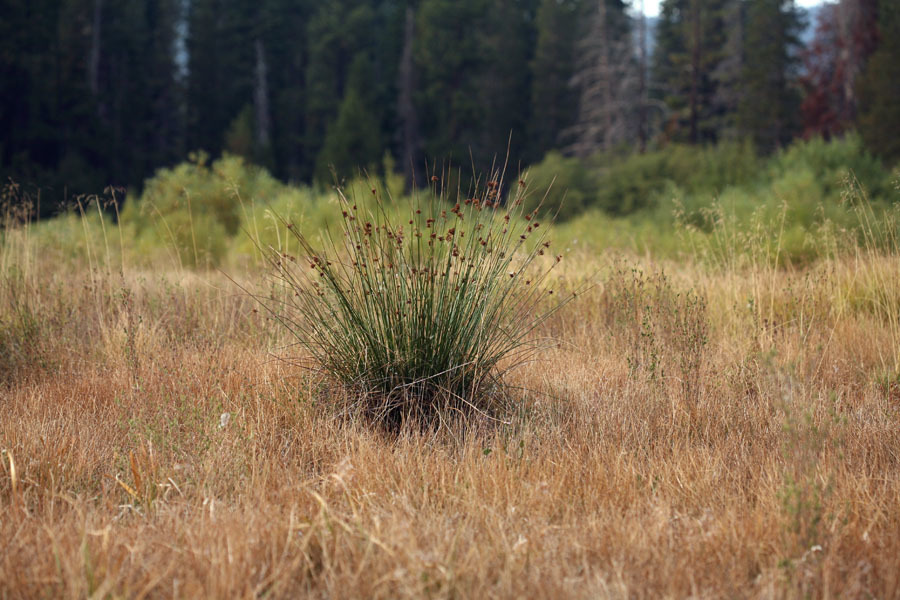
(c) Steve Matson, some rights reserved (CC BY) · licence
Family: Juncaceae · Type: Perennial · Native
Juncus laccatus (Shiny rush) is a native California perennial in the Juncaceae family, recognized by key diagnostic features are shiny dark sheaths with obscure veins and shiny yellow-brown fruit.
Shiny rush is a California native perennial found in northwestern California, the high Cascade Range, and northern and central Sierra Nevada in peatlands, wet meadows, shores, and swales at elevations below 2,100 meters. Without specific flowering time data, this rush produces dark brown flowers with distinctive dark brown stripes along the midvein. Growing with dense, clustered stems 45 to 105 centimeters tall and 1.3 to 2.1 millimeters wide, it develops a solid pith and upper stems that are smooth and shiny when fresh. Its leaf sheaths are 3 to 15 centimeters long, medium to dark brown or nearly black, with shiny, smooth surfaces and truncate tips that often split with age. The fruit is a shiny yellow-brown oblong structure 1.8 to 2.4 millimeters long with three inner chambers.
Identification and appearance
Key characters: 53 sympatric species; key diagnostic features are shiny dark sheaths with obscure veins and shiny yellow-brown fruit
Habitat and range
Habitat: Peatland, wet meadows, shores, swales
Elevation: < 2100 m
California counties: Plumas, Tehama, Tulare, Tuolumne, Yuba, Butte, Humboldt, Mariposa, El Dorado, Sonoma, Amador, Mendocino, Trinity, Lassen, Lake, Colusa, Del Norte
Outside California: to British Columbia, Arizona
How to tell it apart
vs Schoenoplectus: Juncus has leaf blades present; Schoenoplectus is leafless with only bladeless sheaths at base.; vs Carex: Juncus has round or flattened stems; Carex has triangular stems you can feel.; vs Luzula: Run finger along leaf edge - smooth = Juncus, hairy = Luzula.; vs Elegia: Juncus has small individual flowers; Elegia has showy papery bracts and branching structure.; vs Cyperus: Juncus has round stems and capsules; Cyperus has triangular stems and lens-shaped achenes.
Frequently asked questions
Is Juncus laccatus native to California?
Yes. Juncus laccatus is native to California (recorded as native).
Where in California does Juncus laccatus grow?
Juncus laccatus occurs in Plumas, Tehama, Tulare, Tuolumne, Yuba, Butte, Humboldt, Mariposa and other counties, at elevations of < 2100 m.
What plant family does Juncus laccatus belong to?
Juncus laccatus is in the Juncaceae family, genus Juncus.
What habitat does Juncus laccatus grow in?
Juncus laccatus grows in Peatland, wet meadows, shores, swales.
Related species
Other California species in the same genus, family, or bioregion.
Sources: Jepson eFlora · Index of California Plant Names · CalPhotos
Last updated 2026-09-30
Data from The California Species Project — 14,000+ California species with verified data from CNPS, CDFW, USFWS, Cal-IPC, and more.