Juniperus occidentalis
Western juniper
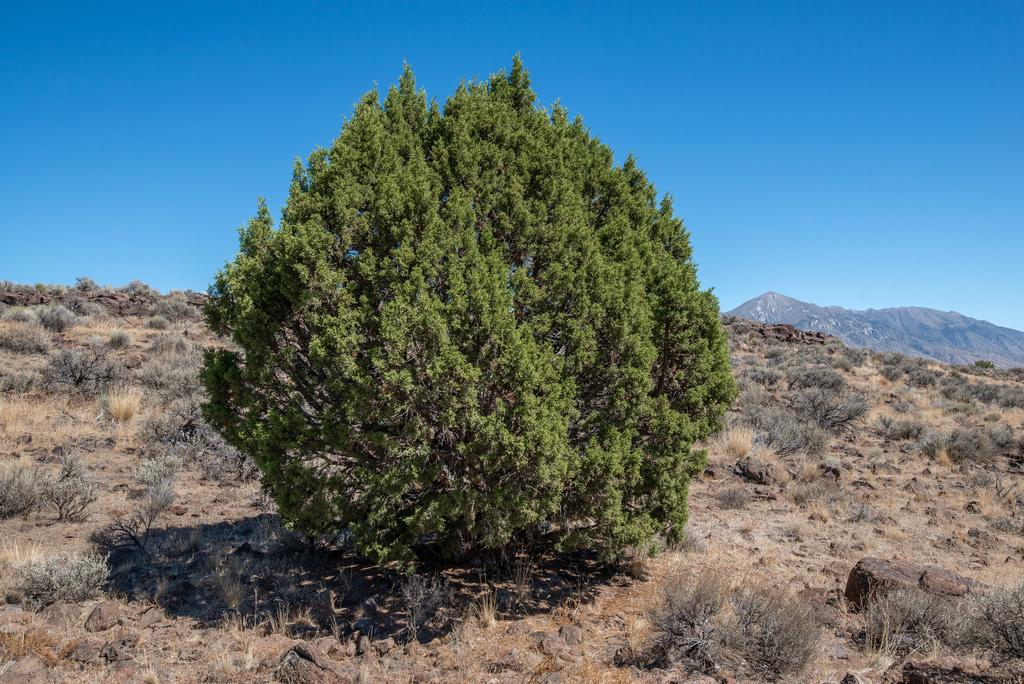
(c) Dominic Gentilcore, some rights reserved (CC BY), uploaded by Dominic Gentilcore · licence
Family: Cupressaceae · Type: Tree · Native
Juniperus occidentalis (Western juniper) is a native California tree in the Cupressaceae family, recognized by tree form, bark color, and cone characteristics distinguish it.
Western juniper is a native tree found in the high Cascade Range and Mountain Provinces in dry slopes, sagebrush, and juniper woodland at elevations of 700 to 2,300 meters. Its seed cones are distinctive blue-green maturing to blue-black and resinous, borne on trees 5 to 15 meters tall with brown bark. Growing with a broadly rounded crown and multiple stems, this juniper has complex leaf arrangements with leaves growing in 4 to 6 ranked patterns. The tree's leaves are oppositely arranged, creating a dense and textured appearance across its branches. Its small pollen cones measure 2 to 3 millimeters long and appear oblong, contributing to its reproductive strategy in challenging mountain environments.
Identification and appearance
Key characters: 3 sympatric species; tree form, bark color, and cone characteristics distinguish it
Habitat and range
Habitat: dry slopes, flats, sagebrush, juniper woodland
Elevation: 700-2300 m
California counties: Lassen, San Bernardino, Nevada, Siskiyou, Tulare, Ventura, Inyo, Plumas, Tuolumne, Madera, Mono, Modoc, Mariposa, Fresno, Shasta, El Dorado, Sierra, Alpine, Amador, Humboldt, Kern, Placer, San Luis Obispo, Colusa, Trinity, Tehama, Mendocino, Lake, Los Angeles, Glenn, San Diego, Napa
Outside California: to Washington, Idaho, western Nevada
How to tell it apart
vs Hesperocyparis: Juniper has fleshy berry-like cones; Hesperocyparis has woody round cones with shield-shaped scales.; vs Pinus: Juniper needles are single or in whorls of 3; pine needles come bundled in groups of 2-5 with papery sheaths.; vs Calocedrus: Juniper has berry-like cones; Calocedrus has elongated woody cones with flattened, scale-like sprays.; vs Cupressus: Juniper has berry-like cones; Cupressus has round woody cones with shield-shaped scales.; vs Salvia: Juniper is woody with evergreen needles or scales; Salvia is herbaceous with opposite aromatic leaves and lipped flowers.
Frequently asked questions
Is Juniperus occidentalis native to California?
Yes. Juniperus occidentalis is native to California (recorded as native).
Where in California does Juniperus occidentalis grow?
Juniperus occidentalis occurs in Lassen, San Bernardino, Nevada, Siskiyou, Tulare, Ventura, Inyo, Plumas and other counties, at elevations of 700-2300 m.
What plant family does Juniperus occidentalis belong to?
Juniperus occidentalis is in the Cupressaceae family, genus Juniperus.
What habitat does Juniperus occidentalis grow in?
Juniperus occidentalis grows in dry slopes, flats, sagebrush, juniper woodland.
Related species
Other California species in the same genus, family, or bioregion.
Sources: Jepson eFlora · Index of California Plant Names · CalPhotos
Last updated 2026-10-07
Data from The California Species Project — 14,000+ California species with verified data from CNPS, CDFW, USFWS, Cal-IPC, and more.