Kelloggia galioides
Milk kelloggia
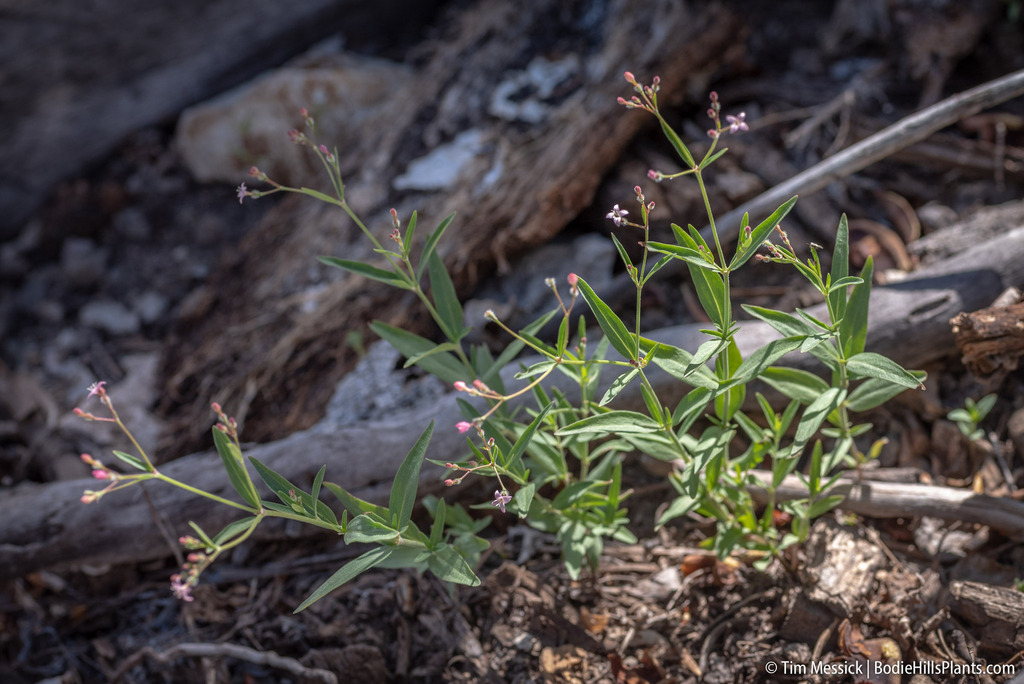
(c) Tim Messick, some rights reserved (CC BY), uploaded by Tim Messick · licence
Family: Rubiaceae · Type: Herb · Native
Kelloggia galioides (Milk kelloggia) is a native California herb in the Rubiaceae family, recognized by Range edge species - this genus reaches its southern limit in California, extending from the Pacific Northwest.
Milk kelloggia is a California native perennial found in the Klamath Ranges, northern Coast Ranges, California Ranges, Sierra Nevada, San Bernardino Mountains, Peninsular Ranges, and Modoc Plateau in open places within conifer forest at elevations of 700 to 3,110 meters. Flowering from May to August, this plant produces delicate pink or white flowers with slender tubes and lanceolate lobes. Growing with erect stems 15 to 40 centimeters tall that are slightly four-angled, it develops distinctive lanceolate to narrowly ovate leaves 19 to 38 millimeters long. Its leaves occasionally feature smaller axillary leaves, creating a layered appearance. The fruit is characterized by hooked hairs, which aid in seed dispersal.
Identification and appearance
Key characters: Range edge species - this genus reaches its southern limit in California, extending from the Pacific Northwest
Habitat and range
Habitat: +- open places in conifer forest
Elevation: 700-3110 m
California counties: El Dorado, Placer, Shasta, Tuolumne, Mono, Siskiyou, San Bernardino, Mariposa, Modoc, Fresno, Tulare, Plumas, Lassen, Trinity, San Diego, Nevada, Madera, Alpine, Butte, Sierra, Mendocino, Humboldt, Inyo, Amador, Riverside, Calaveras, Yuba, Colusa, Tehama, Del Norte, Lake, Kings
Outside California: to Washington, Montana, Wyoming, New Mexico
Bloom period
Kelloggia galioides blooms May-Aug.
How to tell it apart
vs Epilobium: Kelloggia has 4 petals and opposite leaves; Epilobium has 4 notched petals and alternate upper leaves.; vs Gayophytum: Kelloggia has opposite leaves throughout; Gayophytum has alternate leaves and thread-like stems.; vs Diodia: Kelloggia has long-stalked flowers in terminal clusters; Diodia has stalkless flowers at leaf joints.; vs Crucianella: Kelloggia has opposite leaves and open clusters; Crucianella has whorled leaves and dense cylindrical spikes.; vs Sherardia: Kelloggia has opposite leaves and open terminal clusters; Sherardia has whorled leaves and dense head-like clusters.
Frequently asked questions
Is Kelloggia galioides native to California?
Yes. Kelloggia galioides is native to California (recorded as native).
When does Kelloggia galioides bloom?
Kelloggia galioides blooms May-Aug.
Where in California does Kelloggia galioides grow?
Kelloggia galioides occurs in El Dorado, Placer, Shasta, Tuolumne, Mono, Siskiyou, San Bernardino, Mariposa and other counties, at elevations of 700-3110 m.
What plant family does Kelloggia galioides belong to?
Kelloggia galioides is in the Rubiaceae family, genus Kelloggia.
What habitat does Kelloggia galioides grow in?
Kelloggia galioides grows in +- open places in conifer forest.
Related species
Other California species in the same genus, family, or bioregion.
Sources: Jepson eFlora · Index of California Plant Names · CalPhotos
Last updated 2026-10-07
Data from The California Species Project — 14,000+ California species with verified data from CNPS, CDFW, USFWS, Cal-IPC, and more.