Koeberlinia spinosa var. tenuispina
Slender-spined all thorn, Slender-Spined All Thorn
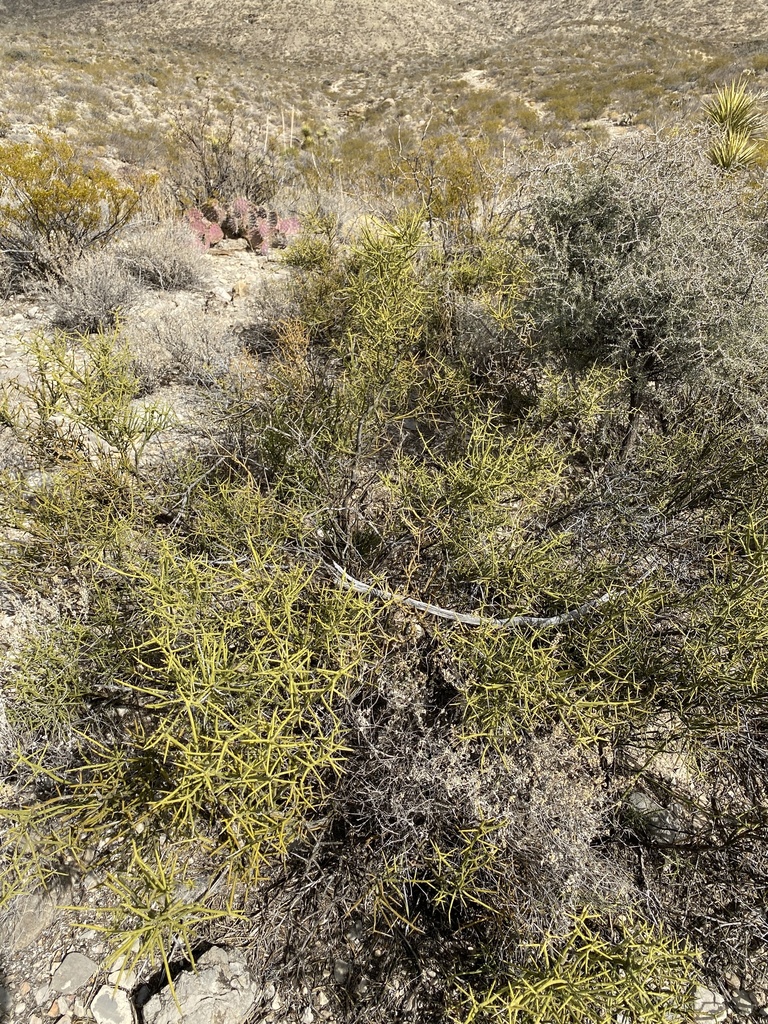
(c) CK2AZ, some rights reserved (CC BY), uploaded by CK2AZ · licence
Family: Koeberliniaceae · Type: Shrub / Tree · Native
Conservation status: CNPS 2B.2
Koeberlinia spinosa var. tenuispina (Slender-spined all thorn) is a native California shrub / tree in the Koeberliniaceae family, recognized by Range edge species - represents the only California population of a predominantly Mexican desert family.
Slender-spined all thorn is a rare (CNPS 2B.2) California native shrub found in the Chocolate Mountains in creosote-bush scrub at an elevation of 400 meters. Flowering from March to July, this plant produces delicate white flowers occasionally tinged with yellow. Growing 3 to 10 meters tall with pale green branchlets ending in narrow, sharp-pointed black or dark brown tips, it forms a distinctive spiny structure. Its leaves are extremely reduced, measuring less than 2 millimeters long, which gives the plant its characteristic all-thorn appearance. The fruit is small and glossy black, measuring 4 to 5 millimeters in diameter.
Identification and appearance
Key characters: Range edge species - represents the only California population of a predominantly Mexican desert family
Habitat and range
Habitat: Creosote-bush scrub
Elevation: 400 m
Outside California: southwestern Arizona, Mexico (eastern Baja California, northwestern Sonora)
Bloom period
Koeberlinia spinosa var. tenuispina blooms Mar-Jul.
Conservation status
CNPS 2B.2
How to tell it apart
vs Castela: Castela (crucifixion thorn) has stouter jointed green branchlets and clustered dry reddish fruits at the tips; Koeberlinia has slender pale-green twigs with black-tipped spines and small round black berries.; vs Canotia: Canotia has longer, striated, gray-green wand-like branches; Koeberlinia's branchlets are shorter, pale green, and end in sharp black or dark-brown spines.; vs Lycium: Lycium (desert-thorn) bears small fleshy leaves clustered on its spiny branches and tubular lavender-white flowers; Koeberlinia is essentially leafless with tiny 4-petaled greenish-white flowers.; vs Condalia: Condalia and Ziziphus are spiny but carry visible expanded leaves; Koeberlinia's green branchlets do the photosynthesis and its leaves are reduced to scales under 2 mm.; vs Prunus: thorny cherries and plums have broad flat leaves along the twigs; Koeberlinia's rigid, sharp-pointed green branchlets bear only minute scale leaves.
Frequently asked questions
Is Koeberlinia spinosa var. tenuispina native to California?
Yes. Koeberlinia spinosa var. tenuispina is native to California (recorded as native).
When does Koeberlinia spinosa var. tenuispina bloom?
Koeberlinia spinosa var. tenuispina blooms Mar-Jul.
What plant family does Koeberlinia spinosa var. tenuispina belong to?
Koeberlinia spinosa var. tenuispina is in the Koeberliniaceae family, genus Koeberlinia.
Is Koeberlinia spinosa var. tenuispina rare or endangered?
Koeberlinia spinosa var. tenuispina carries California Rare Plant Rank 2B.2, state rank S1.
What habitat does Koeberlinia spinosa var. tenuispina grow in?
Koeberlinia spinosa var. tenuispina grows in Creosote-bush scrub.
Related species
Other California species in the same genus, family, or bioregion.
Sources: Jepson eFlora · CalPhotos · CDFW CNDDB
Last updated 2026-10-07
Data from The California Species Project — 14,000+ California species with verified data from CNPS, CDFW, USFWS, Cal-IPC, and more.