Koeleria macrantha
June grass
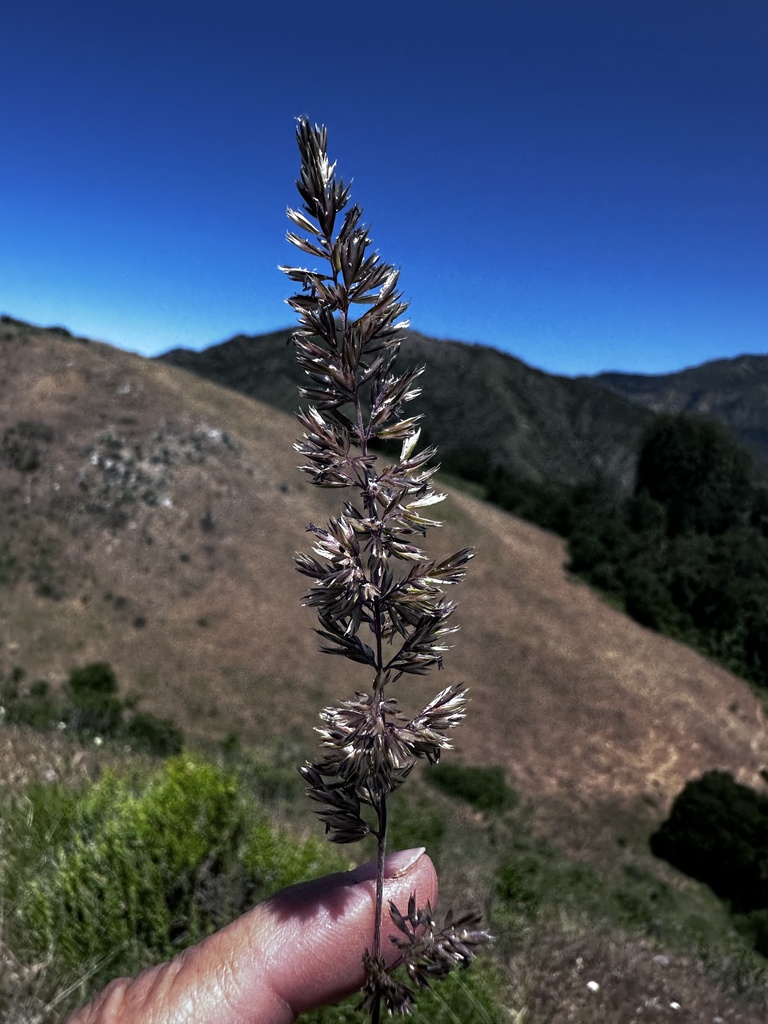
no rights reserved · CC0
Family: Poaceae · Type: Grass · Native
Koeleria macrantha (June grass) is a native California grass in the Poaceae family, recognized by larger size, elevation range, and native status.
June grass is a California native perennial found in northwestern California, the Cascade Range, Sierra Nevada, Sutter Buttes, central western California, Transverse Ranges, Peninsular Ranges, Great Basin, and desert mountains in dry, open sites with clay to rocky soils, including shrubland, woodland, and conifer forest at elevations up to 3,840 meters. Flowering from May to July, this plant produces tan to occasionally purple-tinged spikelets in compact, cylindrical inflorescences 2 to 15 centimeters long. Growing in dense tufts with erect stems 20 to 80 centimeters tall, it forms distinctive clumps with glabrous to slightly hairy stems. Its primarily basal leaves are tightly clustered, with narrow blades 2 to 20 centimeters long and 1 to 3 millimeters wide, typically with a ridged surface. The delicate spikelets are 4 to 6 millimeters long, with 2 to 4 small florets per spikelet.
Identification and appearance
Key characters: 1 sympatric species; distinguished by larger size, elevation range, and native status
Habitat and range
Habitat: Dry, open sites, clay to rocky soils, shrubland, woodland, conifer forest
Elevation: < 3840 m
California counties: Humboldt, San Luis Obispo, San Diego, Kern, Los Angeles, Santa Barbara, San Bernardino, Inyo, Tulare, Shasta, Contra Costa, Riverside, Santa Cruz, San Mateo, Del Norte, Siskiyou, Mono, Orange, Ventura, San Francisco, Monterey, Modoc, Lake, Fresno, Mendocino, Lassen, Marin, Trinity, Butte, Santa Clara, Sonoma, Napa, Sutter, Alameda, Solano, San Benito, Plumas, Mariposa, Colusa, Yolo, El Dorado, Yuba, Tehama, Tuolumne
Outside California: to Alaska, eastern Canada, central and eastern United States, northern Mexico, Eurasia
Bloom period
Koeleria macrantha blooms May-Jul.
How to tell it apart
vs Calamagrostis: Koeleria has a shiny, dense cylinder; Calamagrostis has looser, more open flower clusters.; vs Poa: Koeleria's spike is shiny and cylindrical; Poa has a branched, pyramidal flower cluster.; vs Holcus: Koeleria has silvery shine and dry habitats; Holcus is dull and prefers moist sites.; vs Melica: Koeleria has a tight, shiny cylinder; Melica has a loose, one-sided arrangement.; vs Dactylis: Koeleria has a cylindrical spike; Dactylis has flowers clustered in distinct one-sided lumps.
Frequently asked questions
Is Koeleria macrantha native to California?
Yes. Koeleria macrantha is native to California (recorded as native).
When does Koeleria macrantha bloom?
Koeleria macrantha blooms May-Jul.
Where in California does Koeleria macrantha grow?
Koeleria macrantha occurs in Humboldt, San Luis Obispo, San Diego, Kern, Los Angeles, Santa Barbara, San Bernardino, Inyo and other counties, at elevations of < 3840 m.
What plant family does Koeleria macrantha belong to?
Koeleria macrantha is in the Poaceae family, genus Koeleria.
What habitat does Koeleria macrantha grow in?
Koeleria macrantha grows in Dry, open sites, clay to rocky soils, shrubland, woodland, conifer forest.
Related species
Other California species in the same genus, family, or bioregion.
Sources: Jepson eFlora · Index of California Plant Names · CalPhotos
Last updated 2026-10-07
Data from The California Species Project — 14,000+ California species with verified data from CNPS, CDFW, USFWS, Cal-IPC, and more.