Kopsiopsis strobilacea
California ground-cone
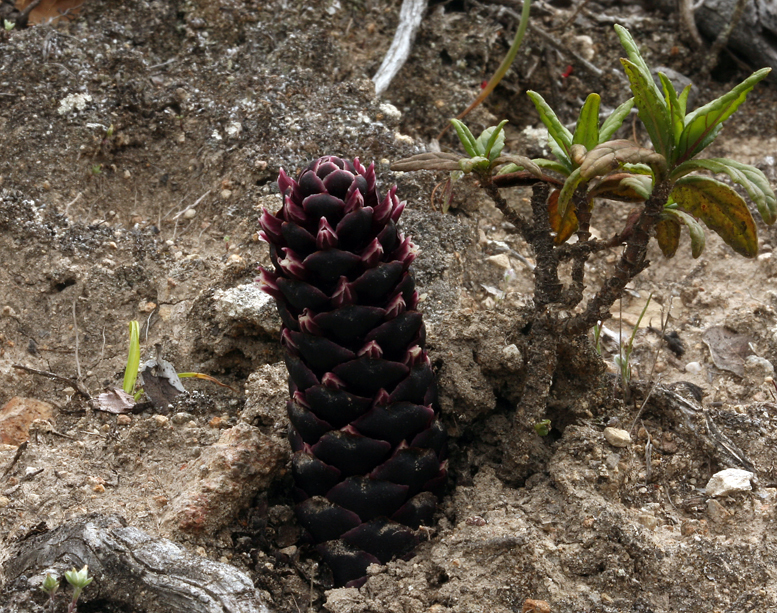
(c) Steve Matson, some rights reserved (CC BY) · licence
Family: Orobanchaceae · Type: Herb · Native
Kopsiopsis strobilacea (California ground-cone) is a native California herb in the Orobanchaceae family, recognized by larger size, darker coloration, larger bracts, and much broader geographic/elevational range.
California ground-cone is a native perennial found in northwestern California, the Cascade Range, northern Sierra Nevada, San Francisco Bay Area, Transverse Ranges, and Peninsular Ranges in open woodland and chaparral at elevations below 3,000 meters. Flowering from April to June, this plant produces distinctive red-brown to dark purple flower clusters 4 to 15 centimeters long with pale purple corolla lobes. Growing 10 to 30 centimeters tall with a unique parasitic habit, it emerges from the ground with dense, compact stems. Its bracts are prominent, reaching 15 to 20 millimeters long, with flower calyxes that may have 0 to 4 lobes approximately 3 to 7 millimeters in length. The small seeds are roughly 2 millimeters long, contributing to this intriguing ground-dwelling plant's unusual botanical profile.
Identification and appearance
Key characters: 1 sympatric species; distinguished by larger size, darker coloration, larger bracts, and much broader geographic/elevational range
Habitat and range
Habitat: Open woodland, chaparral, generally on
Elevation: < 3000 m
California counties: San Bernardino, Trinity, Los Angeles, Shasta, Siskiyou, Del Norte, Lake, Placer, Humboldt, Kern, Riverside, Napa, Santa Barbara, Contra Costa, Marin, Mendocino, Monterey, Nevada, San Benito, Santa Clara, Santa Cruz, Sonoma, El Dorado, Ventura, San Diego
Outside California: southern Oregon, Baja California
Bloom period
Kopsiopsis strobilacea blooms Apr-Jun.
How to tell it apart
vs Pleuricospora: Kopsiopsis has tightly overlapping scale-like bracts; Pleuricospora has separate, non-overlapping scales.; vs Aphyllon: Kopsiopsis is completely hairless with overlapping bracts; Aphyllon is hairy with separated bracts.; vs Sarcodes: Kopsiopsis has tightly overlapping bracts forming cone; Sarcodes has fleshy bell-shaped flowers along red stalk.; vs Pinus: Kopsiopsis flowers open to show tiny blooms; pine cones have woody scales without flowers.; vs Phelipanche: Kopsiopsis is hairless with tightly overlapping bracts; Phelipanche is hairy with separated bracts.
Frequently asked questions
Is Kopsiopsis strobilacea native to California?
Yes. Kopsiopsis strobilacea is native to California (recorded as native).
When does Kopsiopsis strobilacea bloom?
Kopsiopsis strobilacea blooms Apr-Jun.
Where in California does Kopsiopsis strobilacea grow?
Kopsiopsis strobilacea occurs in San Bernardino, Trinity, Los Angeles, Shasta, Siskiyou, Del Norte, Lake, Placer and other counties, at elevations of < 3000 m.
What plant family does Kopsiopsis strobilacea belong to?
Kopsiopsis strobilacea is in the Orobanchaceae family, genus Kopsiopsis.
What habitat does Kopsiopsis strobilacea grow in?
Kopsiopsis strobilacea grows in Open woodland, chaparral, generally on.
Related species
Other California species in the same genus, family, or bioregion.
Sources: Jepson eFlora · Index of California Plant Names · CalPhotos
Last updated 2026-10-07
Data from The California Species Project — 14,000+ California species with verified data from CNPS, CDFW, USFWS, Cal-IPC, and more.