Krameria bicolor
White rhatany
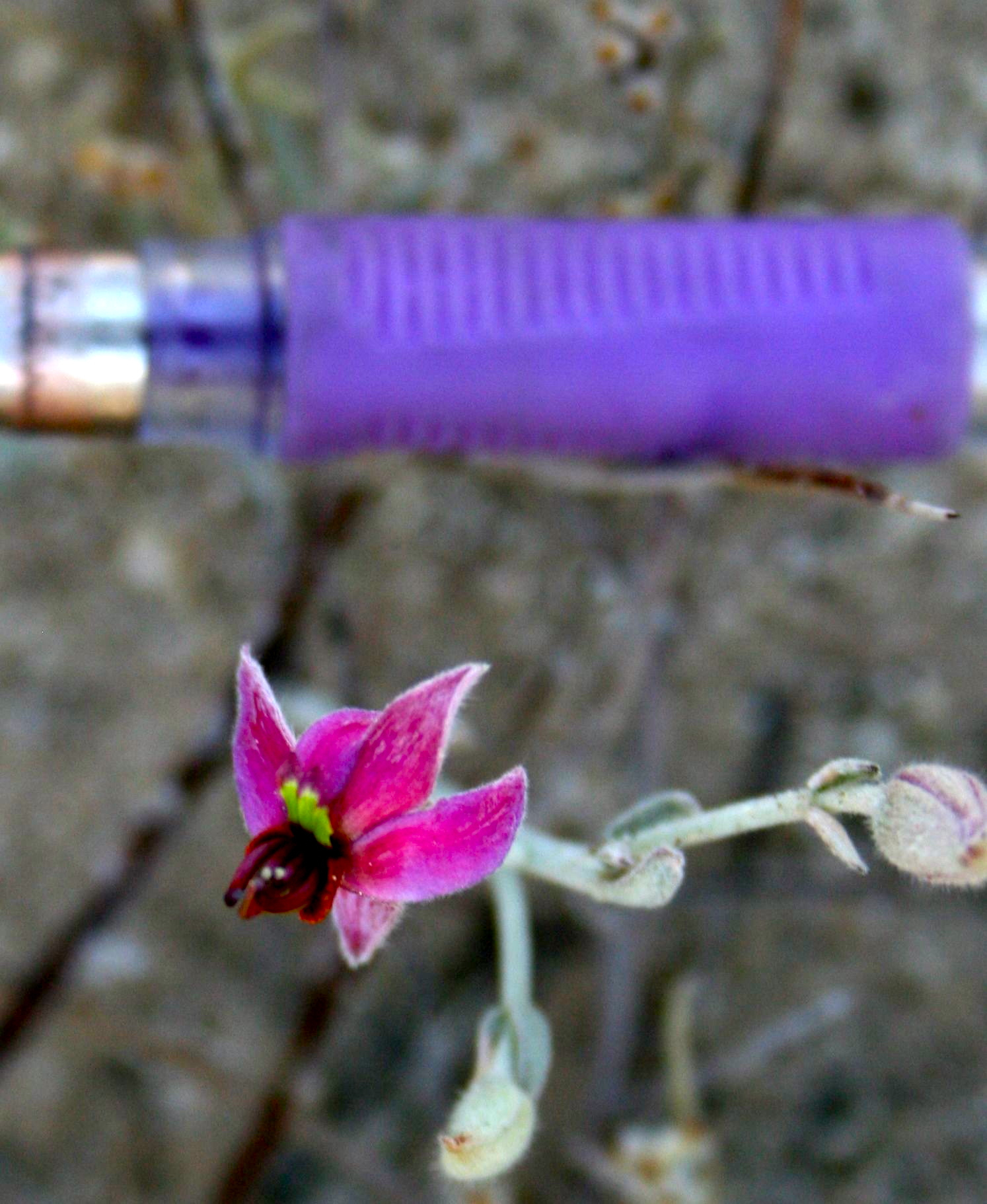
Photo by Chez Brungraber
Family: Krameriaceae · Type: Shrub · Native
Krameria bicolor (White rhatany) is a native California shrub in the Krameriaceae family, recognized by key differences are branch tip thorniness and fruit shape.
White rhatany is a California native perennial found in the southern desert bioregion in dry, rocky or sandy places, especially on lime soils, at elevations below 1,400 meters. Flowering from April to May, this plant produces flowers with deep purple-red sepals and magenta or purple petals with green bases, creating a striking color contrast. Growing as a densely hairy shrub less than 1 meter tall with branches that have thorn-like tips, it spreads with a distinctive architectural form. Its leaves are narrowly lanceolate, contributing to its slender and delicate appearance. The fruit is approximately spherical, completing the plant's compact and intricate structural profile.
Identification and appearance
Key characters: 1 sympatric species; key differences are branch tip thorniness and fruit shape
Habitat and range
Habitat: Dry, rocky or sandy places, especially on lime soils
Elevation: < 1400 m
California counties: San Diego, San Bernardino, Riverside, Imperial, Inyo
Outside California: to Nevada, Texas, northern Mexico
Bloom period
Krameria bicolor blooms Apr-May.
How to tell it apart
vs Coleogyne: Krameria has rose-purple irregular flowers; Coleogyne has yellow radially symmetrical flowers.; vs Eriogonum: Krameria has orchid-like bilateral flowers with visible stamens; Eriogonum has tiny radial flowers in dense heads.; vs Ephedra: Krameria has showy rose-purple flowers; Ephedra has inconspicuous scale-like flowers and jointed green stems.; vs Nicolletia: Krameria has irregular single flowers; Nicolletia has composite flower heads typical of Asteraceae.; vs Thamnosma: Krameria has lopsided flowers with barbed fruit; Thamnosma has radial 4-petaled flowers with smooth capsules.
Frequently asked questions
Is Krameria bicolor native to California?
Yes. Krameria bicolor is native to California (recorded as native).
When does Krameria bicolor bloom?
Krameria bicolor blooms Apr-May.
Where in California does Krameria bicolor grow?
Krameria bicolor occurs in San Diego, San Bernardino, Riverside, Imperial, Inyo, at elevations of < 1400 m.
What plant family does Krameria bicolor belong to?
Krameria bicolor is in the Krameriaceae family, genus Krameria.
What habitat does Krameria bicolor grow in?
Krameria bicolor grows in Dry, rocky or sandy places, especially on lime soils.
Related species
Other California species in the same genus, family, or bioregion.
Sources: Jepson eFlora · Index of California Plant Names · CalPhotos
Last updated 2026-10-07
Data from The California Species Project — 14,000+ California species with verified data from CNPS, CDFW, USFWS, Cal-IPC, and more.