Lagurus ovatus
Hare's tail grass
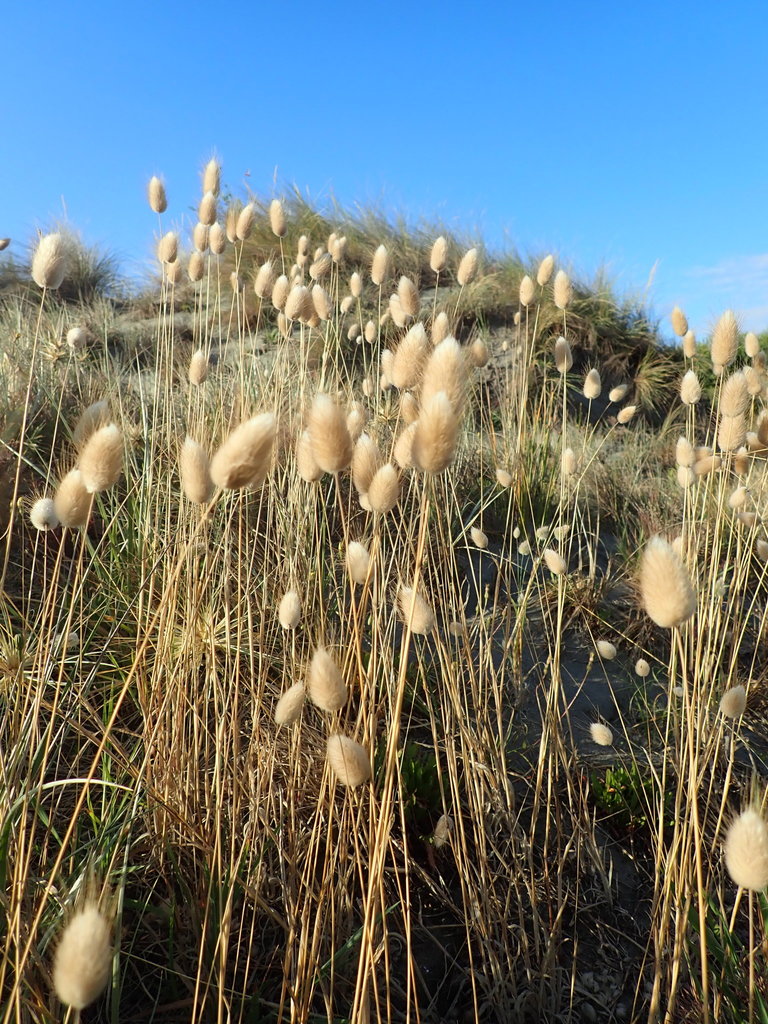
(c) Arnim Littek, some rights reserved (CC BY), uploaded by Arnim Littek · licence
Family: Poaceae · Type: Grass · Not Native
Lagurus ovatus (Hare's tail grass) is a non-native California grass in the Poaceae family, recognized by Mediterranean introduction - distinctive ornamental grass that occasionally escapes cultivation.
Hare's tail grass is a naturalized annual grass found in coastal and central California regions including Humboldt County, San Francisco Bay Area, and Sacramento Valley in disturbed places at elevations generally below 200 meters. Flowering from May to July, this grass produces soft, dense, ovoid to cylindric white to pale green flower heads 1.5 to 3 centimeters long that resemble fluffy rabbit tails. Growing with ascending to erect stems 10 to 50 centimeters tall, it forms tufted clusters with soft hairy stems. Its leaves are flat, 2 to 10 centimeters long and 3 to 10 millimeters wide, with inflated sheaths that loosely surround the stem. The flower spikelets feature delicate, soft-hairy glumes with three distinctive awns, including one long awn on the lemma back that can reach up to 22 millimeters.
Identification and appearance
Key characters: Mediterranean introduction - distinctive ornamental grass that occasionally escapes cultivation
Habitat and range
Habitat: Disturbed places
Elevation: generally < 200 m
California counties: Sonoma, Monterey, San Francisco, Marin, Mendocino, Yolo, Butte, Alameda, Sacramento, Orange
Outside California: Oregon, Canada, eastern United States, New Mexico, native to Mediterranean
Bloom period
Lagurus ovatus blooms May-Jul.
How to tell it apart
vs Polypogon: Polypogon (rabbitsfoot grass) has a soft, bristly, often lobed cylindrical silvery-green panicle; Lagurus has a single compact, egg-shaped, woolly-white tuft.; vs Alopecurus: Alopecurus (foxtail) heads are narrow cylinders of short-awned spikelets, soft but not woolly-white; Lagurus is a rounded, densely long-hairy ovoid head.; vs Phleum: Phleum (timothy) has a firm, dense cylindrical spike that feels bristly-rough; Lagurus's head is plush, oval, and cottony-soft.; vs Cenchrus: fountain grasses (Cenchrus/Pennisetum) have long bottlebrush spikes with stiff protruding bristles; Lagurus has one short, soft, egg-shaped puff.; vs Lamarckia: Lamarckia's dense panicle is one-sided and glossy golden-yellow; Lagurus's is symmetric, egg-shaped, and woolly-white.
Frequently asked questions
Is Lagurus ovatus native to California?
No. Lagurus ovatus is not native to California (recorded as not native).
When does Lagurus ovatus bloom?
Lagurus ovatus blooms May-Jul.
Where in California does Lagurus ovatus grow?
Lagurus ovatus occurs in Sonoma, Monterey, San Francisco, Marin, Mendocino, Yolo, Butte, Alameda and other counties, at elevations of generally < 200 m.
What plant family does Lagurus ovatus belong to?
Lagurus ovatus is in the Poaceae family, genus Lagurus.
What habitat does Lagurus ovatus grow in?
Lagurus ovatus grows in Disturbed places.
Related species
Other California species in the same genus, family, or bioregion.
Sources: Jepson eFlora · Index of California Plant Names · CalPhotos
Last updated 2026-10-07
Data from The California Species Project — 14,000+ California species with verified data from CNPS, CDFW, USFWS, Cal-IPC, and more.