Lamarckia aurea
Goldentop grass
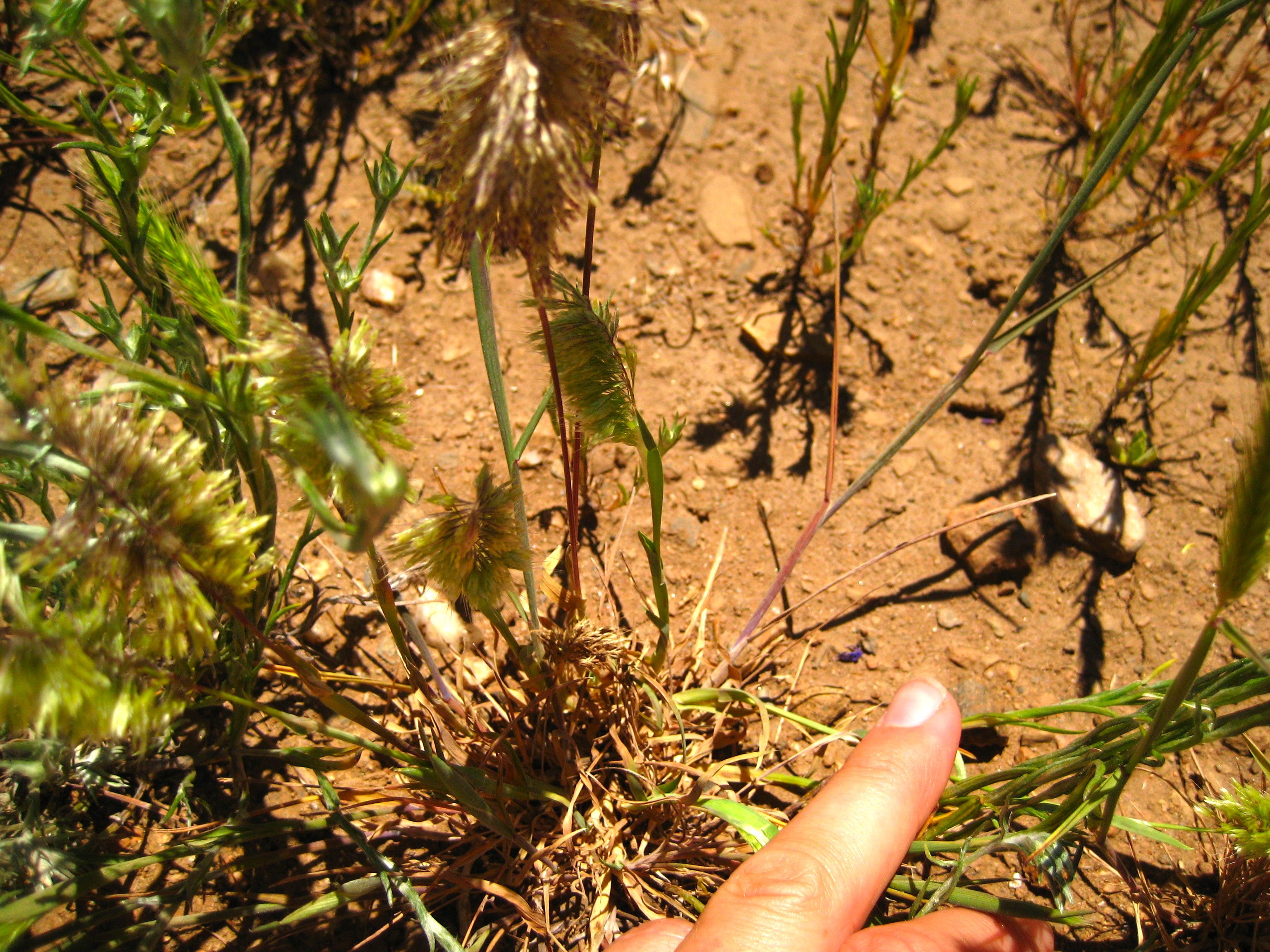
Photo by Chez Brungraber
Family: Poaceae · Type: Grass · Not Native
Lamarckia aurea (Goldentop grass) is a non-native California grass in the Poaceae family, recognized by Mediterranean introduction - ornamental grass with highly distinctive golden inflorescence structure.
Goldentop grass is a naturalized annual grass found in northern coastal ranges, northern inner coastal ranges, Sierra Nevada foothills, Tehachapi, central western, and southwestern California in open ground, moist seeps, rocky hillsides, and sandy soil at elevations below 1,250 meters. Flowering from February to May, this grass produces golden yellow to purple spikelets in dense, terminal panicle-like clusters with distinctive falling cluster formations. Growing 7 to 40 centimeters tall with generally erect stems, it forms a tufted, glabrous clump. Its flat leaf blades measure 2.5 to 9 centimeters long and 2.5 to 7 millimeters wide, with membranous ligules 3 to 7 millimeters long and irregularly cut tips. Each spikelet features fertile florets with straight awns 6 to 7 millimeters long, creating a delicate, intricate grass structure.
Identification and appearance
Key characters: Mediterranean introduction - ornamental grass with highly distinctive golden inflorescence structure
Habitat and range
Habitat: Open ground, moist seeps, rocky hillsides, sandy soil
Elevation: < 1250 m
California counties: Kern, San Luis Obispo, Los Angeles, Ventura, San Diego, Riverside, Orange, Santa Barbara, Tulare, San Bernardino, Santa Clara, Monterey, Stanislaus, Alameda, Tuolumne, Calaveras, Merced, San Benito, Sonoma, Marin, Mendocino, Butte, San Mateo, Glenn, Napa, Contra Costa, Santa Cruz
Outside California: Arizona, native to Mediterranean
Bloom period
Lamarckia aurea blooms Feb-May.
How to tell it apart
vs Cynosurus: Cynosurus (dogtail) has a dense one-sided green cluster with comb-like sterile spikelets; Lamarckia's dense one-sided panicle is shining golden-yellow and silky, often purple-tinged.; vs Lagurus: Lagurus is a woolly, egg-shaped white puff; Lamarckia is a glossy golden, one-sided oblong tuft that nods to one side.; vs Polypogon: Polypogon's soft panicle is silvery-green and bristly-awned; Lamarckia's is golden, lustrous, and drooping to one side.; vs Dactylis: Dactylis (orchardgrass) is a coarse perennial with stiff, clumped one-sided greenish clusters; Lamarckia is a small annual with a soft, shining golden head.; vs Koeleria: Koeleria has a pale silvery-green, symmetric spike-like panicle; Lamarckia's is gold and distinctly one-sided.
Frequently asked questions
Is Lamarckia aurea native to California?
No. Lamarckia aurea is not native to California (recorded as not native).
When does Lamarckia aurea bloom?
Lamarckia aurea blooms Feb-May.
Where in California does Lamarckia aurea grow?
Lamarckia aurea occurs in Kern, San Luis Obispo, Los Angeles, Ventura, San Diego, Riverside, Orange, Santa Barbara and other counties, at elevations of < 1250 m.
What plant family does Lamarckia aurea belong to?
Lamarckia aurea is in the Poaceae family, genus Lamarckia.
What habitat does Lamarckia aurea grow in?
Lamarckia aurea grows in Open ground, moist seeps, rocky hillsides, sandy soil.
Related species
Other California species in the same genus, family, or bioregion.
Sources: Jepson eFlora · Index of California Plant Names · CalPhotos
Last updated 2026-10-07
Data from The California Species Project — 14,000+ California species with verified data from CNPS, CDFW, USFWS, Cal-IPC, and more.