Laphamia intricata
Desert rock daisy
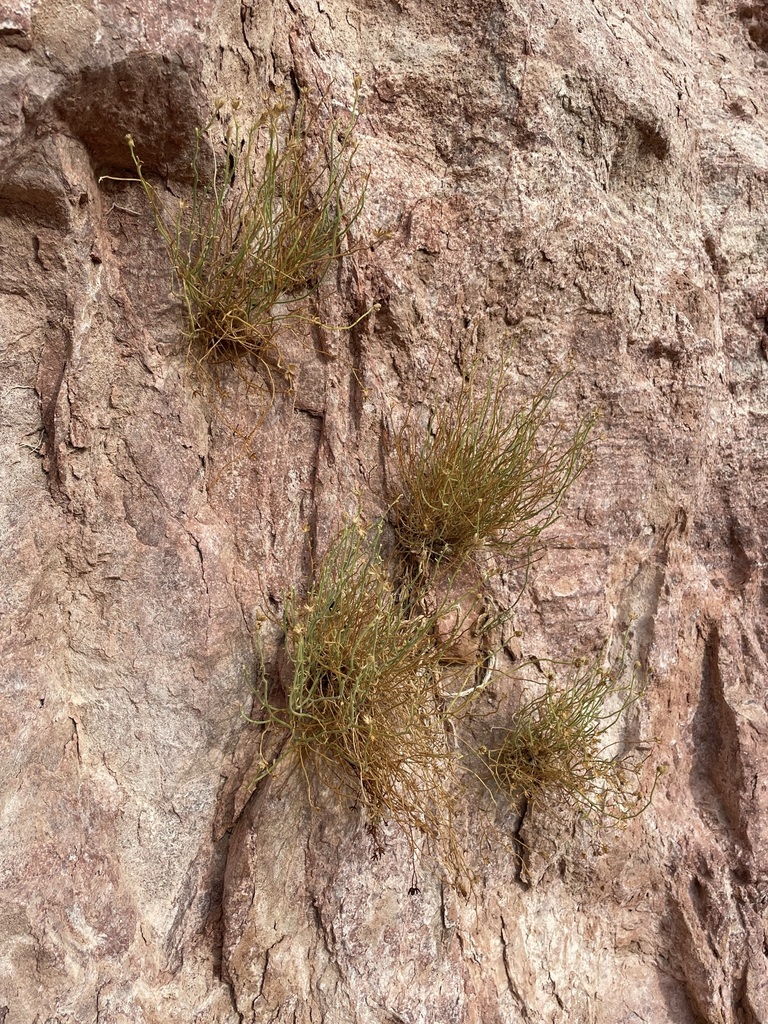
(c) Matt Berger, some rights reserved (CC BY) · licence
Family: Asteraceae · Type: Subshrub · Native
Laphamia intricata (Desert rock daisy) is a native California subshrub in the Asteraceae family, recognized by extremely narrow linear leaves vs broader leaves of congeners.
Desert rock daisy is a California native shrub found in the desert mountains in limestone cliffs and arid canyons at elevations of 800 to 1,700 meters. Flowering from June to November, this plant produces white to cream disk flowers in small heads approximately 5 millimeters long. Growing with compact woody stems 13 to 40 centimeters tall and covered in short rough hairs, it forms a dense subshrub with a woody base. Its leaves are narrow and linear, generally alternate, with blades 3 to 8 millimeters long and less than 1 millimeter wide, having acute or obtuse tips and mostly entire margins. The fruit is 2 to 2.8 millimeters long, with rounded or angled surfaces and coarsely ciliate margins.
Identification and appearance
Key characters: 3 sympatric species; distinguished by extremely narrow linear leaves vs broader leaves of congeners
Habitat and range
Habitat: Limestone cliffs in arid mountains and canyons
Elevation: 800-1700 m
Outside California: Nevada
Bloom period
Laphamia intricata blooms Jun-Nov.
Frequently asked questions
Is Laphamia intricata native to California?
Yes. Laphamia intricata is native to California (recorded as native).
When does Laphamia intricata bloom?
Laphamia intricata blooms Jun-Nov.
What plant family does Laphamia intricata belong to?
Laphamia intricata is in the Asteraceae family, genus Laphamia.
What habitat does Laphamia intricata grow in?
Laphamia intricata grows in Limestone cliffs in arid mountains and canyons.
Related species
Other California species in the same genus, family, or bioregion.
Sources: Jepson eFlora · CalPhotos
Last updated 2026-10-07
Data from The California Species Project — 14,000+ California species with verified data from CNPS, CDFW, USFWS, Cal-IPC, and more.