Laphamia villosa
Hanaupah rock daisy
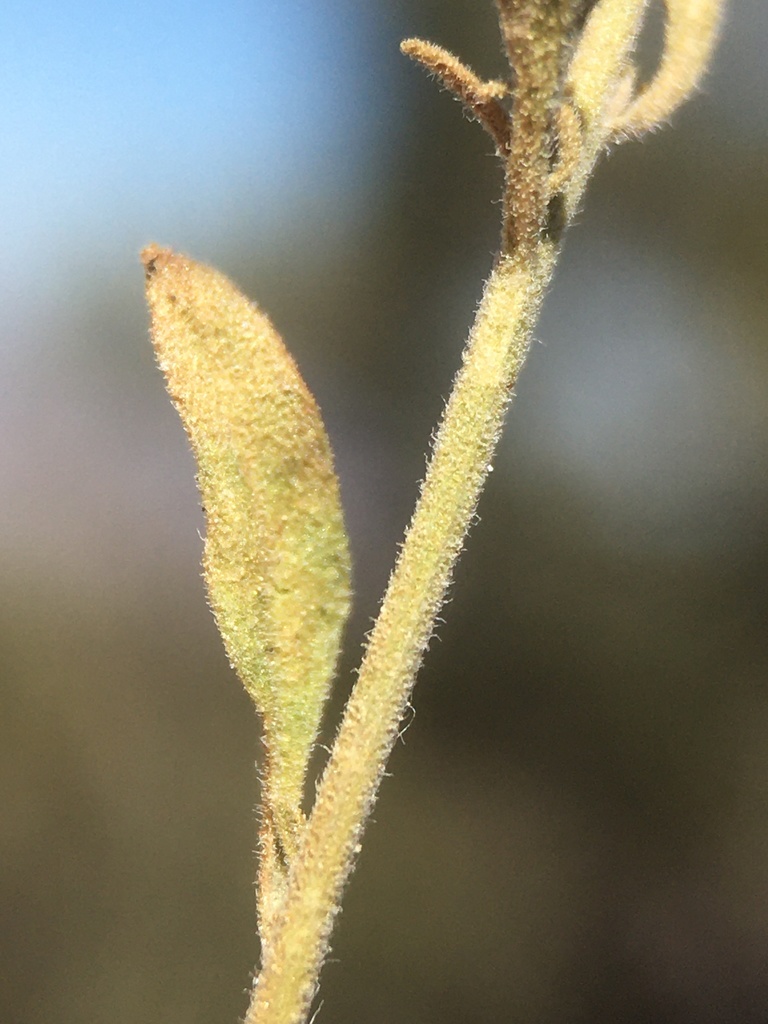
(c) Matt Berger, some rights reserved (CC BY), uploaded by Matt Berger · licence
Family: Asteraceae · Type: Subshrub · Native
Conservation status: CNPS 1B.3
Laphamia villosa (Hanaupah rock daisy) is a native California subshrub in the Asteraceae family, recognized by soft-hairy texture, large ovate leaves often with lobes, and compact stature.
Hanaupah rock daisy is a rare (CNPS 1B.3) California native shrub found in the western Inyo Mountains and northern Death Valley Mountains, specifically in the Panamint and Grapevine Mountain ranges, growing on bare rocky outcrops and cliffs in pinyon and juniper woodland at elevations of 1,500 to 2,750 meters. Flowering from July to September, this plant produces yellow disk flowers in small heads 5 to 7 millimeters in diameter. Growing as a compact subshrub 6 to 20 centimeters tall with a woody base, it has soft-hairy stems that form a dense, low-growing clump. Its alternate leaves are 12 to 22 millimeters long, ovate to wedge-shaped with acute tips, sometimes featuring 1 to 3 short pointed lobes, and covered in soft hairs. The plant produces small fruits 3 to 3.5 millimeters long, occasionally with a thin crown of scales or a few short bristles.
Identification and appearance
Key characters: 3 sympatric species; distinguished by soft-hairy texture, large ovate leaves often with lobes, and compact stature
Habitat and range
Habitat: Bare, rocky outcrops and cliffs in pinyon/juniper woodland
Elevation: 1500-2750 m
Bloom period
Laphamia villosa blooms Jul-Sep.
Conservation status
CNPS 1B.3
Frequently asked questions
Is Laphamia villosa native to California?
Yes. Laphamia villosa is native to California (recorded as native).
When does Laphamia villosa bloom?
Laphamia villosa blooms Jul-Sep.
What plant family does Laphamia villosa belong to?
Laphamia villosa is in the Asteraceae family, genus Laphamia.
Is Laphamia villosa rare or endangered?
Laphamia villosa carries California Rare Plant Rank 1B.3, state rank S2.
What habitat does Laphamia villosa grow in?
Laphamia villosa grows in Bare, rocky outcrops and cliffs in pinyon/juniper woodland.
Related species
Other California species in the same genus, family, or bioregion.
- Laphamia intricata — Desert rock daisy
- Laphamia inyoensis — Inyo rock daisy
- Laphamia megalocephala
- Laphamia megalocephala var. megalocephala — Nevada rock daisy
- Laphamia megalocephala var. oligophylla — Small-leaved rock daisy
- Laphamia sp. — Rock daisy
- Lapsana communis — Common nipplewort
- Lapsana sp. — Nipplewort
- Lasiospermum bipinnatum — Woolly fruit
- Lasiospermum sp. — Cocoonhead
Sources: Jepson eFlora · CNPS Rare Plant Inventory · Index of California Plant Names · CalPhotos · CDFW CNDDB
Last updated 2026-10-07
Data from The California Species Project — 14,000+ California species with verified data from CNPS, CDFW, USFWS, Cal-IPC, and more.