Lapsana communis
Common nipplewort
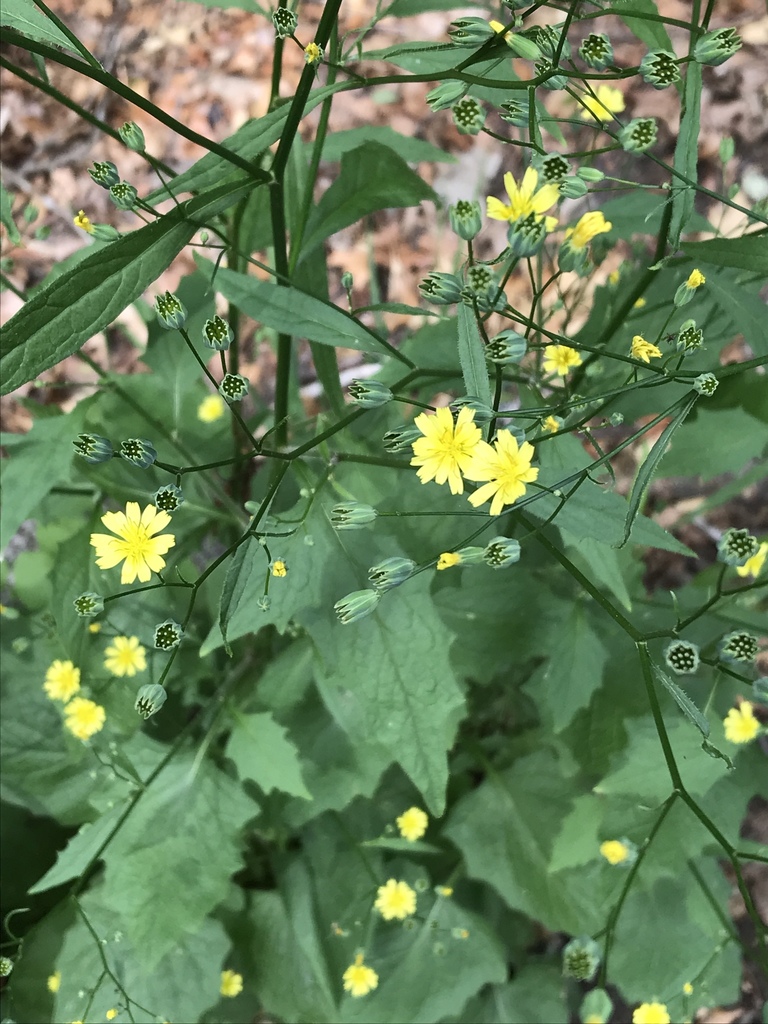
no rights reserved, uploaded by Carl Guyer · CC0
Family: Asteraceae · Type: Herb · Not Native
Lapsana communis (Common nipplewort) is a non-native California herb in the Asteraceae family, recognized by European introduction - weedy species of disturbed shaded habitats, well-established in temperate regions.
Common nipplewort is a naturalized annual found in northwestern California, Sierra Nevada, Central Valley, Central Coast, San Francisco Bay Area, and southwestern California in shady places and disturbed areas at elevations below 1,600 meters. Flowering from June to September, this plant produces bright yellow flowers in slender, ascending clusters with delicate ligules 4 to 10 millimeters long. Growing with erect stems 20 to 150 centimeters tall, it has a distinctive milky sap and generally develops a single stem from the base. Its alternate leaves range from 2 to 20 centimeters long, typically ovate in shape with entire or toothed edges and occasionally few-lobed near the petiole base. The fruit is pale brown, curved, and fusiform, measuring 3 to 5 millimeters long with approximately 20 veins.
Identification and appearance
Key characters: European introduction - weedy species of disturbed shaded habitats, well-established in temperate regions
Habitat and range
Habitat: Shady places, disturbed areas
Elevation: < 1600 m
Outside California: widely adventive in North America, native to Europe
Bloom period
Lapsana communis blooms Jun-Sep.
How to tell it apart
vs Rhagadiolus: Lapsana fruits are small (3-5mm) and not individually wrapped; Rhagadiolus fruits are large (10-15mm) and rigidly spreading.; vs Crepis: Lapsana prefers shade and has smooth fruits; Crepis grows in sun and has beaked or bristly fruits.; vs Mycelis: Lapsana has yellow flowers; Mycelis has blue or purple flowers.; vs Adenocaulon: Lapsana has yellow composite flowers; Adenocaulon has tiny white flowers and large triangular leaves.; vs Hieracium: Lapsana has branching flower clusters; Hieracium typically has hairy leaves and single or few flower heads.
Frequently asked questions
Is Lapsana communis native to California?
No. Lapsana communis is not native to California (recorded as not native).
When does Lapsana communis bloom?
Lapsana communis blooms Jun-Sep.
What plant family does Lapsana communis belong to?
Lapsana communis is in the Asteraceae family, genus Lapsana.
What habitat does Lapsana communis grow in?
Lapsana communis grows in Shady places, disturbed areas.
Related species
Other California species in the same genus, family, or bioregion.
Sources: Jepson eFlora · Index of California Plant Names · CalPhotos
Last updated 2026-10-07
Data from The California Species Project — 14,000+ California species with verified data from CNPS, CDFW, USFWS, Cal-IPC, and more.