Lasthenia californica subsp. californica
California goldfields, California Goldfields
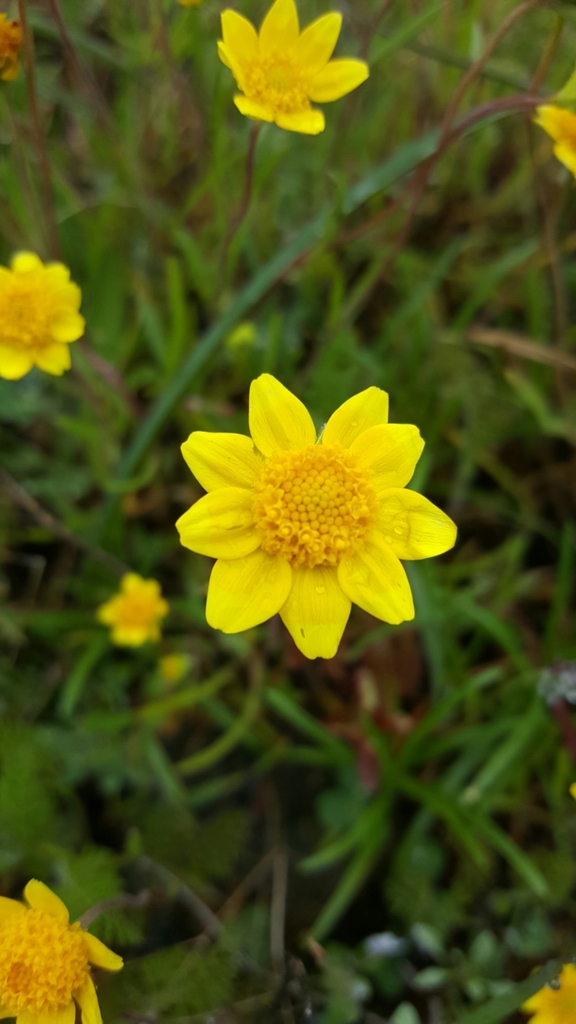
(c) Jamie Carter, some rights reserved (CC BY), uploaded by Jamie Carter · licence
Family: Asteraceae · Type: Herb · Native
Lasthenia californica subsp. californica (California goldfields) is a native California herb in the Asteraceae family, recognized by widespread and variable, requires multiple features for identification.
California goldfields is a California native annual found in northwestern California (excluding North Coast Ranges), the Cascade Range, Sierra Nevada, Central Valley, central western California, southern California Coast, and western Transverse Ranges in many habitats at elevations below 1,500 meters. Flowering from February to June, this plant produces bright yellow ray flowers in heads 5 to 10 millimeters wide with distinctive bell-shaped involucres. Growing with erect or occasionally decumbent stems up to 15 to 25 centimeters tall, it forms delicate fibrous root systems. Its leaves are linear to oblanceolate, 0.8 to 7 centimeters long, with entire margins or occasionally 3 to 5 small teeth, and covered in fine hairs. The fruit is small, less than 3 millimeters long, ranging from black to gray in color.
Identification and appearance
Key characters: 20 sympatric species; widespread and variable, requires multiple features for identification
Habitat and range
Habitat: Many habitats
Elevation: < 1500 m
California counties: Contra Costa, Alameda, Lake, Ventura, Tehama, Butte, Marin, Napa, Santa Clara, San Benito, Amador, Solano, Monterey, Humboldt, Calaveras, San Mateo, Tulare, Los Angeles, San Francisco, Sonoma, Mendocino, Stanislaus, Trinity, Merced, Sacramento, San Luis Obispo, Tuolumne, Fresno, Madera, Nevada, Mariposa, Yolo, Santa Cruz, Del Norte, San Diego, Inyo, Santa Barbara, Colusa, San Joaquin, Yuba
Outside California: southwestern Oregon
Bloom period
Lasthenia californica subsp. californica blooms Feb-Jun.
How to tell it apart
vs Monolopia: Monolopia has alternate leaves; Lasthenia has opposite leaves throughout most of stem.; vs Eriophyllum: Eriophyllum is woolly-hairy; Lasthenia is smooth or only slightly hairy.; vs Ranunculus: Ranunculus has separate shiny petals and divided basal leaves; Lasthenia has composite flower heads.; vs Pseudobahia: Pseudobahia leaves are alternate above; Lasthenia leaves remain opposite throughout.; vs Blennosperma: Blennosperma has phyllaries fused into a cup; Lasthenia has separate overlapping phyllaries.
Frequently asked questions
Is Lasthenia californica subsp. californica native to California?
Yes. Lasthenia californica subsp. californica is native to California (recorded as native).
When does Lasthenia californica subsp. californica bloom?
Lasthenia californica subsp. californica blooms Feb-Jun.
Where in California does Lasthenia californica subsp. californica grow?
Lasthenia californica subsp. californica occurs in Contra Costa, Alameda, Lake, Ventura, Tehama, Butte, Marin, Napa and other counties, at elevations of < 1500 m.
What plant family does Lasthenia californica subsp. californica belong to?
Lasthenia californica subsp. californica is in the Asteraceae family, genus Lasthenia.
What habitat does Lasthenia californica subsp. californica grow in?
Lasthenia californica subsp. californica grows in Many habitats.
Related species
Other California species in the same genus, family, or bioregion.
Sources: Jepson eFlora · Index of California Plant Names · CalPhotos
Last updated 2026-10-07
Data from The California Species Project — 14,000+ California species with verified data from CNPS, CDFW, USFWS, Cal-IPC, and more.