Lathyrus vestitus var. vestitus
Common pacific pea
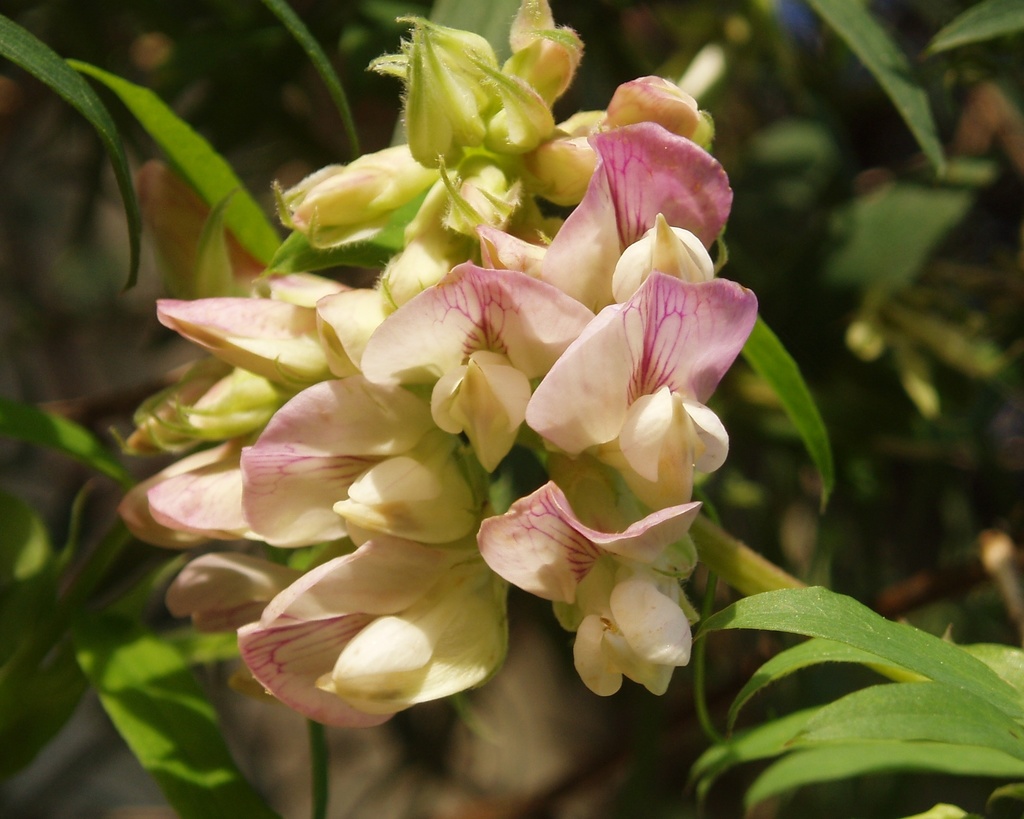
(c) Tom Hilton, some rights reserved (CC BY) · licence
Family: Fabaceae · Type: Vine · Native
Lathyrus vestitus var. vestitus (Common pacific pea) is a native California vine in the Fabaceae family, recognized by most widespread variety with moderate banner reflexion.
Common pacific pea is a California native perennial found in northern coastal, north coastal range, central western, and southwestern California bioregions in conifer forest, chaparral, and oak woodland at elevations below 1,500 meters. Flowering from February to July, this plant produces pale lavender to purple flowers with a distinctive banner petal bent approximately 90 degrees. Growing with slender climbing stems up to one meter tall, it develops a delicate vine-like structure through surrounding vegetation. Its leaves are composed of several leaflets typical of pea-family plants, with smooth margins and a soft green coloration. The plant may appear glabrous or slightly puberulent, giving it a subtle textural variation across different growing conditions.
Identification and appearance
Key characters: 26 sympatric species; most widespread variety with moderate banner reflexion
Habitat and range
Habitat: Conifer forest in north to chaparral and oak woodland in south
Elevation: < 1500 m
California counties: San Diego, Los Angeles, Kern, San Bernardino, Monterey, Ventura, Riverside, Alameda, Santa Barbara, Orange, Santa Clara, San Luis Obispo, San Mateo, Mendocino, Solano, Napa, Contra Costa, Marin, Colusa, San Francisco, Sonoma, Santa Cruz, Lake, San Benito, Mariposa, Humboldt, Yolo
Bloom period
Lathyrus vestitus var. vestitus blooms Feb-Jul.
How to tell it apart
vs Vicia: Lathyrus style is flattened with hairs on top only; Vicia style is round and hairy all around.; vs Pickeringia: Lathyrus has tendrils and compound leaves; Pickeringia is a spiny shrub with simple leaves.; vs Pisum: Lathyrus has small normal stipules; Pisum has giant leafy stipules larger than leaflets.; vs Lupinus: Lathyrus has two leaflets and tendrils; Lupinus has palmate leaves with no tendrils.; vs Hosackia: Lathyrus has exactly two leaflets and tendrils; Hosackia has 3-9 leaflets with no tendrils.
Frequently asked questions
Is Lathyrus vestitus var. vestitus native to California?
Yes. Lathyrus vestitus var. vestitus is native to California (recorded as native).
When does Lathyrus vestitus var. vestitus bloom?
Lathyrus vestitus var. vestitus blooms Feb-Jul.
Where in California does Lathyrus vestitus var. vestitus grow?
Lathyrus vestitus var. vestitus occurs in San Diego, Los Angeles, Kern, San Bernardino, Monterey, Ventura, Riverside, Alameda and other counties, at elevations of < 1500 m.
What plant family does Lathyrus vestitus var. vestitus belong to?
Lathyrus vestitus var. vestitus is in the Fabaceae family, genus Lathyrus.
What habitat does Lathyrus vestitus var. vestitus grow in?
Lathyrus vestitus var. vestitus grows in Conifer forest in north to chaparral and oak woodland in south.
Related species
Other California species in the same genus, family, or bioregion.
- Lathyrus angulatus — Angled pea vine
- Lathyrus aphaca — Yellow pea
- Lathyrus biflorus — Two-flowered pea
- Lathyrus brownii — Brown's brush pea
- Lathyrus cicera — Red peavine
- Lathyrus delnorticus — Del norte pea
- Lens culinaris — Lentil
- Lens sp.
- Lotus angustissimus — Slender bird's foot trefoil
- Lotus corniculatus — Bird's-foot trefoil
Sources: Jepson eFlora · Index of California Plant Names · CalPhotos
Last updated 2026-10-07
Data from The California Species Project — 14,000+ California species with verified data from CNPS, CDFW, USFWS, Cal-IPC, and more.