Layia glandulosa
White layia
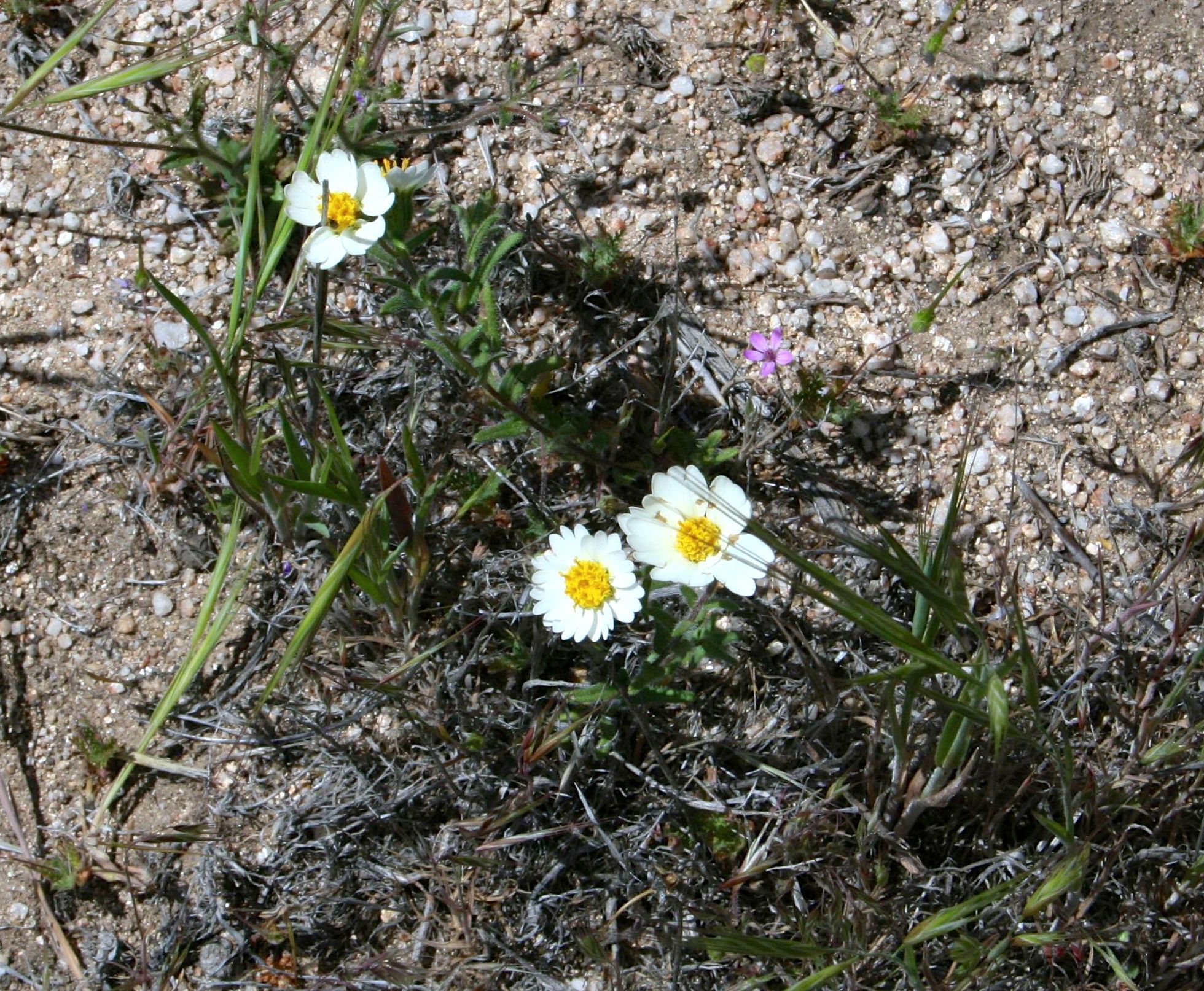
Photo by Chez Brungraber
Family: Asteraceae · Type: Herb · Native
Layia glandulosa (White layia) is a native California herb in the Asteraceae family, recognized by uniformly dark purple stems and white rays.
White layia is a native annual found in the high Sierra Nevada, southern Sierra Nevada foothills, Tehachapi, central and southern San Joaquin Valley, Coast Ranges, Great Basin, and desert regions in generally coarse sandy or gravelly soils at elevations below 2,700 meters. Flowering from February to July, this plant produces white ray flowers 3 to 22 millimeters long that occasionally age to pink or pale yellow, with yellow to brownish disk flowers in bell-shaped heads. Growing 3 to 60 centimeters tall with uniformly dark purple stems that are glandular and sometimes spicy-scented, it develops a variable growth habit. Its leaves range from linear to obovate, with proximal leaves often irregularly toothed or lobed, typically less than 10 centimeters long. The fruit develops ray fruits that are glabrous with a pappus of 10 to 15 white, scabrous scales.
Identification and appearance
Key characters: 12 sympatric species; uniformly dark purple stems and white rays
Habitat and range
Habitat: Generally coarse sandy or gravelly (silty) soils
Elevation: < 2700 m
Outside California: to Washington, Idaho, Utah, New Mexico, Baja California
Bloom period
Layia glandulosa blooms Feb-Jul.
How to tell it apart
vs Madia: Layia has prominent feathery seed bristles 2-4mm; Madia has tiny or no seed bristles.; vs Glebionis: Layia has feathery white seed plumes; Glebionis has yellow-orange rays and no seed plumes.; vs Deinandra: Layia has fluffy feathery seed bristles; Deinandra has straight, non-feathery bristles.; vs Monoptilon: Layia has 2-4mm feathery bristles; Monoptilon has shorter non-feathery bristles.; vs Hemizonia: Layia has prominent feathery seed plumes; Hemizonia has short non-feathery bristles or scales.
Frequently asked questions
Is Layia glandulosa native to California?
Yes. Layia glandulosa is native to California (recorded as native).
When does Layia glandulosa bloom?
Layia glandulosa blooms Feb-Jul.
What plant family does Layia glandulosa belong to?
Layia glandulosa is in the Asteraceae family, genus Layia.
What habitat does Layia glandulosa grow in?
Layia glandulosa grows in Generally coarse sandy or gravelly (silty) soils.
Related species
Other California species in the same genus, family, or bioregion.
Sources: Jepson eFlora · Index of California Plant Names · CalPhotos
Last updated 2026-10-07
Data from The California Species Project — 14,000+ California species with verified data from CNPS, CDFW, USFWS, Cal-IPC, and more.