Leersia oryzoides
Rice cutgrass
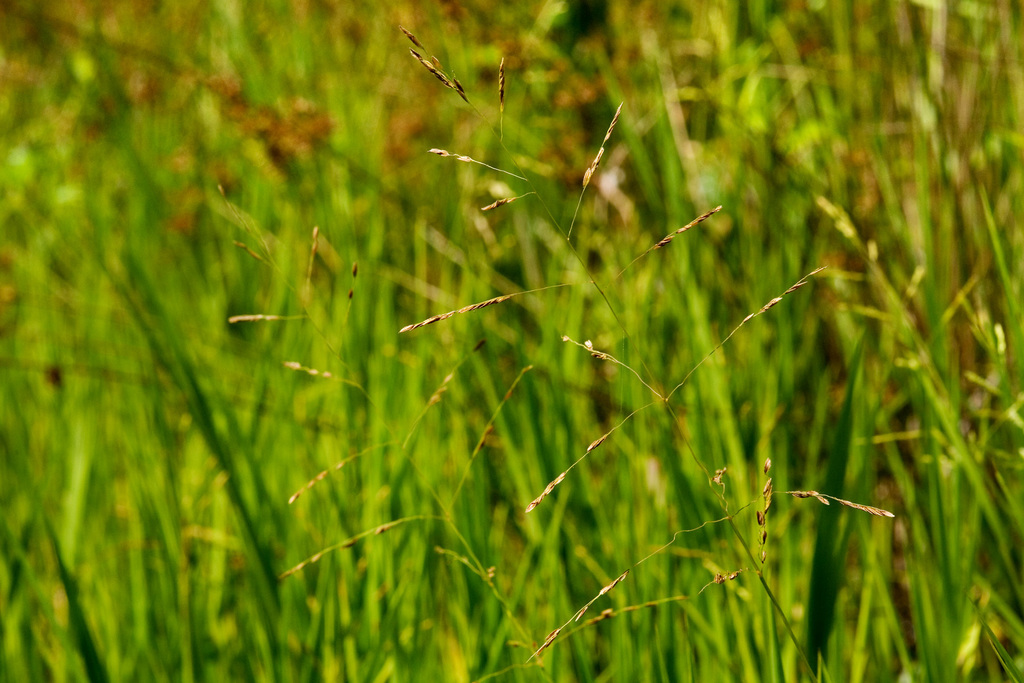
no rights reserved · CC0
Family: Poaceae · Type: Grass · Native
Leersia oryzoides (Rice cutgrass) is a native California grass in the Poaceae family, recognized by Widely distributed species with disjunct populations in California; represents the grass family's adaptation to aquatic habitats.
Rice cutgrass is a California native perennial found in the California Floristic Province (except the Central Western region) in marshes, streams, and ponds at elevations below 1,200 meters. Flowering from August to October, this grass produces pale flowers in delicate, spreading branches 12 to 20 centimeters long. Growing with tall stems 1 to 1.5 meters high, it has nodes covered in soft hairs and an upright, robust form. Its leaves are distinctive, with blades 10 to 28 centimeters long and 8 to 14 millimeters wide, featuring strongly scabrous margins with downward-pointing teeth that give the plant a rough texture. The spikelets are small, approximately 4 to 5 millimeters long, with oblong to narrowly elliptic shapes.
Identification and appearance
Key characters: Widely distributed species with disjunct populations in California; represents the grass family's adaptation to aquatic habitats
Habitat and range
Habitat: Marshes, streams, ponds
Elevation: < 1200 m
California counties: Amador, Colusa, Merced, Riverside, Yolo, Sacramento, Trinity, San Bernardino, El Dorado, Glenn, Lake, Mendocino, Orange, Siskiyou, Sonoma, San Joaquin, Placer, Nevada, Contra Costa, Humboldt, Kern, Napa, Plumas, Solano, Sutter, Tulare, Yuba, Butte, Fresno, Tehama, Shasta, Madera, Inyo, Alameda, Stanislaus, Calaveras, Santa Cruz, Santa Barbara
Outside California: to British Columbia, eastern North America, Eurasia
Bloom period
Leersia oryzoides blooms Aug-Oct.
How to tell it apart
vs Glyceria: Glyceria (mannagrass) has smooth leaf margins and spikelets with several florets; Leersia has viciously back-barbed, cutting leaf edges and one-flowered, laterally flattened spikelets.; vs Oryza: cultivated rice (Oryza) has larger, often awned spikelets and non-cutting leaves; Leersia spikelets are small, awnless, and overlap like fish scales.; vs Phalaris: Phalaris has a dense, often spike-like panicle with firm shiny florets; Leersia has an open, spreading panicle of flat, sparsely bristly spikelets.; vs Echinochloa: Echinochloa (barnyard grass) lacks a ligule and has bristly one-sided racemes; Leersia has a tiny truncate ligule and a delicate open panicle.; vs Zizania: wild rice (Zizania) is much taller with separate male and female flower branches; Leersia has uniform bisexual spikelets and reaches only about 1.5 m.
Frequently asked questions
Is Leersia oryzoides native to California?
Yes. Leersia oryzoides is native to California (recorded as native).
When does Leersia oryzoides bloom?
Leersia oryzoides blooms Aug-Oct.
Where in California does Leersia oryzoides grow?
Leersia oryzoides occurs in Amador, Colusa, Merced, Riverside, Yolo, Sacramento, Trinity, San Bernardino and other counties, at elevations of < 1200 m.
What plant family does Leersia oryzoides belong to?
Leersia oryzoides is in the Poaceae family, genus Leersia.
What habitat does Leersia oryzoides grow in?
Leersia oryzoides grows in Marshes, streams, ponds.
Related species
Other California species in the same genus, family, or bioregion.
Sources: Jepson eFlora · Index of California Plant Names · CalPhotos
Last updated 2026-10-07
Data from The California Species Project — 14,000+ California species with verified data from CNPS, CDFW, USFWS, Cal-IPC, and more.