Lemna minuta
Least duckweed
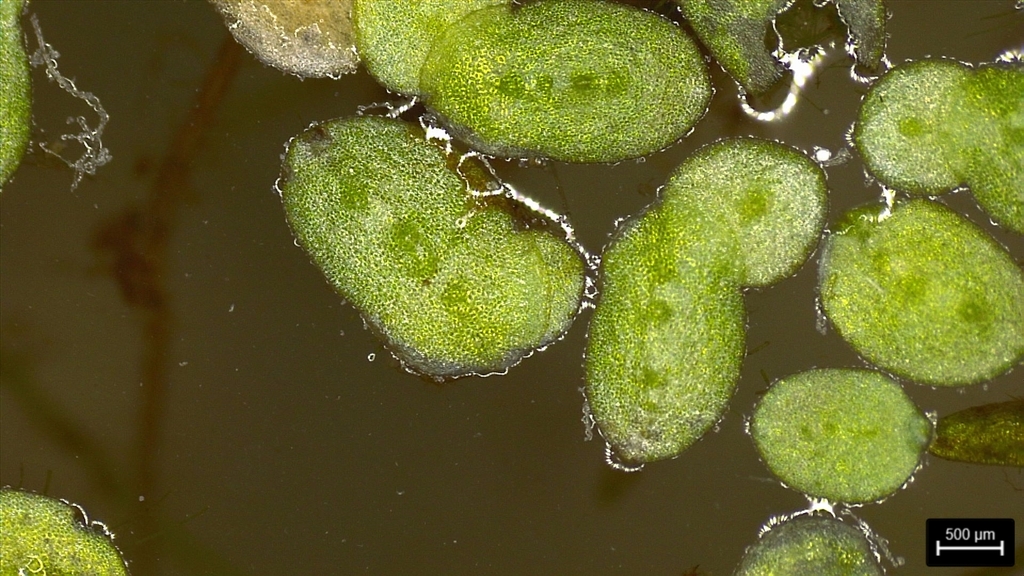
(c) Dan Johnson, some rights reserved (CC BY) · licence
Family: Araceae · Type: Herb · Native
Lemna minuta (Least duckweed) is a native California herb in the Araceae family, recognized by key diagnostic is tiny size (1-2.5 mm) and thin margins.
Least duckweed is a California native perennial found in coastal, central, and southern California regions, including the Sierra Nevada, San Joaquin Valley, and desert areas in freshwater habitats at elevations below 2,200 meters. Flowering in August, this aquatic plant produces pale green, thin plant bodies that are generally elliptic to oblong and typically grow in pairs. Growing just 1 to 2.5 millimeters long, the duckweed has a single obscure vein that extends less than two-thirds the distance from its root attachment to its symmetric tip. Its delicate plant body is characterized by visible air spaces between cells and a slightly thinner margin. Seeds are distinctively cross-lined between ribs, creating a unique textural pattern.
Identification and appearance
Key characters: Co-occurs with 6 species; key diagnostic is tiny size (1-2.5 mm) and thin margins
Habitat and range
Habitat: Common. Freshwater
Elevation: < 2200 m
California counties: San Bernardino, San Diego, San Mateo, Ventura, Sonoma, Madera, Inyo, San Luis Obispo, Trinity, Riverside, Contra Costa, San Francisco, Kern, Mendocino, Colusa, San Joaquin, Los Angeles, Mono, Napa, Orange, Siskiyou, Butte, Santa Barbara, Tulare, Marin, Lake, Amador, Fresno, Humboldt, Monterey, Nevada, Plumas, Santa Clara, Santa Cruz, Sierra, Sutter, Yuba, Glenn, Tehama, Lassen, Modoc, Solano, El Dorado, Yolo, San Benito
Outside California: western United States, South America, Europe, northern Asia
Bloom period
Lemna minuta blooms Aug.
How to tell it apart
vs Azolla: Lemna is smooth bright green with a single root; Azolla is feathery textured, often reddish, with no visible roots.; vs Callitriche: Lemna floats as separate tiny discs; Callitriche has distinct stems with opposite leaves forming small rosettes.; vs Nasturtium: Lemna is a tiny rootless-looking disc; Nasturtium has obvious stems, compound leaves, and grows rooted in mud.; vs Spirodela: Count the roots: Lemna has exactly one root per disc, Spirodela has multiple roots clustered together beneath each disc.; vs Landoltia: Count the roots: Lemna has one root per disc, Landoltia has 2-7 roots hanging down like a tiny broom.
Frequently asked questions
Is Lemna minuta native to California?
Yes. Lemna minuta is native to California (recorded as native).
When does Lemna minuta bloom?
Lemna minuta blooms Aug.
Where in California does Lemna minuta grow?
Lemna minuta occurs in San Bernardino, San Diego, San Mateo, Ventura, Sonoma, Madera, Inyo, San Luis Obispo and other counties, at elevations of < 2200 m.
What plant family does Lemna minuta belong to?
Lemna minuta is in the Araceae family, genus Lemna.
What habitat does Lemna minuta grow in?
Lemna minuta grows in Common. Freshwater.
Related species
Other California species in the same genus, family, or bioregion.
Sources: Jepson eFlora · Index of California Plant Names · CalPhotos
Last updated 2026-10-07
Data from The California Species Project — 14,000+ California species with verified data from CNPS, CDFW, USFWS, Cal-IPC, and more.