Lepidium campestre
Cow cress
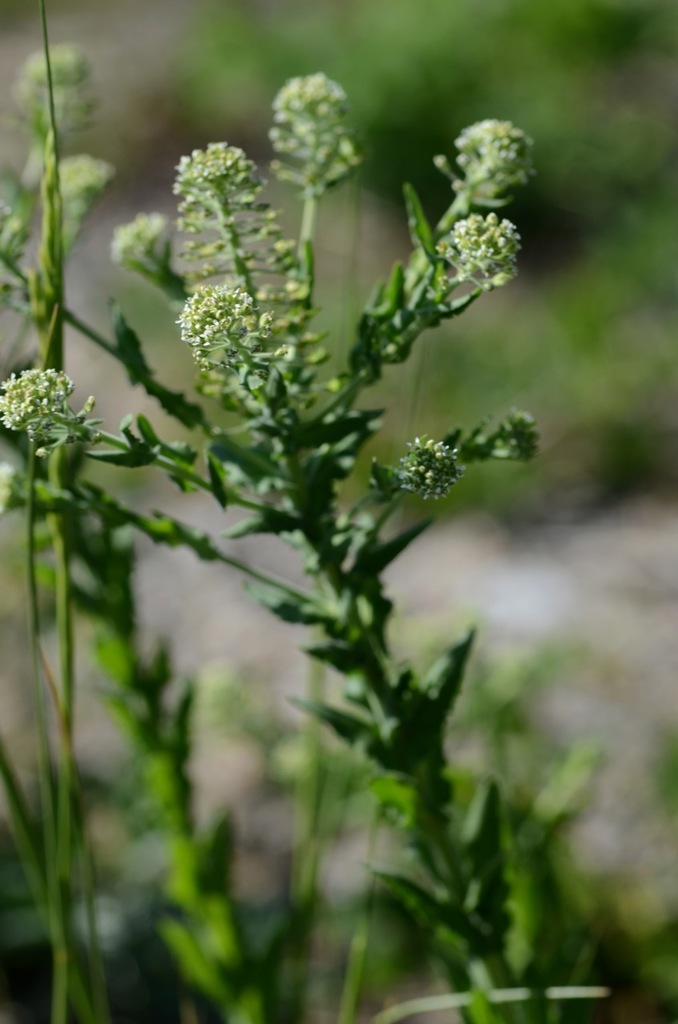
(c) Radio Tonreg, some rights reserved (CC BY) · licence
Family: Brassicaceae · Type: Herb · Not Native
Lepidium campestre (Cow cress) is a non-native California herb in the Brassicaceae family, recognized by rosetted basal leaves, sagittate stem leaf bases.
Cow cress is a naturalized annual herb found in the Klamath Ranges, northern Sierra Nevada, and California Ranges in disturbed areas, fields, woodland, and meadows at elevations of 100 to 2,600 meters. Flowering from May to July, this plant produces small white flowers about 1 to 1.8 millimeters long with delicate spoon-shaped petals. Growing to heights of 1.2 to 5 meters with erect stems that are simple or branched, it develops dense, stiff hairs along its structure. Its leaves form a basal rosette and include mid-stem leaves that are sessile, ranging from oblanceolate to lanceolate, with some leaves dentate or partially entire and featuring a sagittate or lobed base. The fruit is widely oblong to ovate, flat, and broadly winged at the tip, with thin papillate valve walls.
Identification and appearance
Key characters: 15 sympatric species; key features are rosetted basal leaves, sagittate stem leaf bases
Habitat and range
Habitat: Common. Disturbed areas, fields, woodland, meadows
Elevation: 100-2600 m
California counties: Placer, Tuolumne, Kern, Plumas, Shasta, Siskiyou, Trinity, Tulare, Calaveras, Humboldt, Nevada, San Diego, Sierra, Yuba, Amador, Alpine, Modoc, El Dorado, Del Norte, Butte, Mono, Monterey, Mendocino, Lassen, Contra Costa, Tehama, Napa, San Mateo
Outside California: widespread North America, native to Europe
Bloom period
Lepidium campestre blooms May-Jul.
How to tell it apart
vs Capsella: Small round-to-oval pods versus distinctive triangular heart-shaped pods.; vs Cotula: Mustard with seed pods and 4 petals versus composite with disk flowers only.; vs Soliva: Mustard with flattened seed pods versus composite with spiny achenes.; vs Thysanocarpus: Fruits stand upright or spread versus hanging downward in Thysanocarpus.; vs Lobularia: Flattened oval pods with 1-2 seeds versus inflated round pods with 2 seeds.
Frequently asked questions
Is Lepidium campestre native to California?
No. Lepidium campestre is not native to California (recorded as not native).
When does Lepidium campestre bloom?
Lepidium campestre blooms May-Jul.
Where in California does Lepidium campestre grow?
Lepidium campestre occurs in Placer, Tuolumne, Kern, Plumas, Shasta, Siskiyou, Trinity, Tulare and other counties, at elevations of 100-2600 m.
What plant family does Lepidium campestre belong to?
Lepidium campestre is in the Brassicaceae family, genus Lepidium.
What habitat does Lepidium campestre grow in?
Lepidium campestre grows in Common. Disturbed areas, fields, woodland, meadows.
Related species
Other California species in the same genus, family, or bioregion.
Sources: Jepson eFlora · Index of California Plant Names · CalPhotos
Last updated 2026-10-07
Data from The California Species Project — 14,000+ California species with verified data from CNPS, CDFW, USFWS, Cal-IPC, and more.