Lepidium chalepense
Lens-podded hoary cress
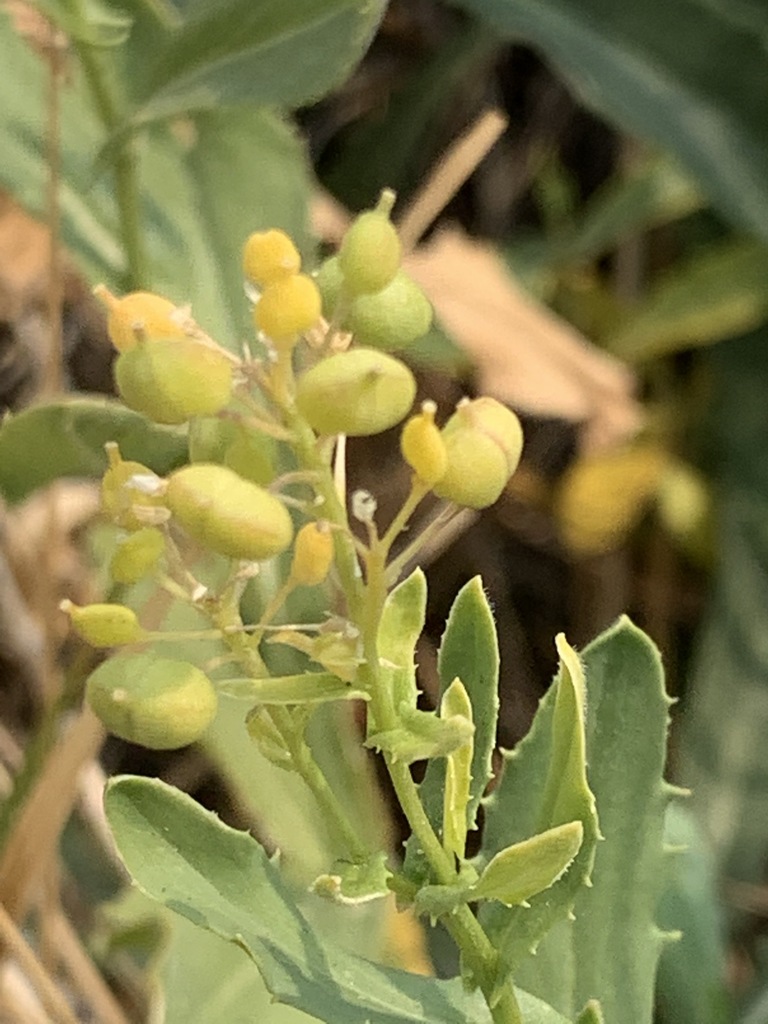
no rights reserved, uploaded by Leah Gardner · CC0
Family: Brassicaceae · Type: Shrub · Not Native
Conservation status: Cal-IPC Yes
Lepidium chalepense (Lens-podded hoary cress) is a non-native California shrub in the Brassicaceae family, recognized by rhizomed perennial habit, obovoid indehiscent fruits, clasping leaves.
Lens-podded hoary cress is a naturalized perennial herb found in California's Foothills and Great Basin regions in disturbed areas, pastures, fields, and riverbanks at elevations of 300 to 4,200 meters. Flowering from May to June, this plant produces small white flowers in delicate clusters with petals 3 to 5 millimeters long. Growing with erect or partially decumbent stems 2 to 6 meters tall and many-branched toward the top, it forms dense patches with stiff hairs covering most of its structure. Its leaves vary from obovate to spoon-shaped at the base, becoming oblong to lanceolate along the stem, with bases that can be lobed or clasping and edges ranging from entire to slightly toothed. The fruit is an obovoid pod 3.5 to 5.8 millimeters long with smooth, thin walls and a wingless tip.
Identification and appearance
Key characters: 24 sympatric species; key features are rhizomed perennial habit, obovoid indehiscent fruits, clasping leaves
Habitat and range
Habitat: Disturbed areas, pastures, fields, riverbanks
Elevation: 300-4200 m
California counties: San Bernardino, Riverside, Los Angeles, Kern, Sacramento, Yolo, Santa Barbara, Ventura, Mono, Tulare, Contra Costa, Modoc, Plumas, San Luis Obispo, Shasta, Fresno, Yuba, San Joaquin, Alameda, Solano, Lassen, Butte, Glenn, Tehama, Placer, Colusa, Siskiyou, Monterey, San Diego, Napa
Outside California: Canada, western and central United States, native to western and central Asia
Bloom period
Lepidium chalepense blooms May-Jun.
Conservation status
Cal-IPC Yes
How to tell it apart
vs Capsella: Small round-to-oval pods versus distinctive triangular heart-shaped pods.; vs Cotula: Mustard with seed pods and 4 petals versus composite with disk flowers only.; vs Soliva: Mustard with flattened seed pods versus composite with spiny achenes.; vs Thysanocarpus: Fruits stand upright or spread versus hanging downward in Thysanocarpus.; vs Lobularia: Flattened oval pods with 1-2 seeds versus inflated round pods with 2 seeds.
Frequently asked questions
Is Lepidium chalepense native to California?
No. Lepidium chalepense is not native to California (recorded as not native).
When does Lepidium chalepense bloom?
Lepidium chalepense blooms May-Jun.
Where in California does Lepidium chalepense grow?
Lepidium chalepense occurs in San Bernardino, Riverside, Los Angeles, Kern, Sacramento, Yolo, Santa Barbara, Ventura and other counties, at elevations of 300-4200 m.
What plant family does Lepidium chalepense belong to?
Lepidium chalepense is in the Brassicaceae family, genus Lepidium.
Is Lepidium chalepense invasive in California?
Lepidium chalepense is listed by Cal-IPC with an invasiveness rating of Yes.
Related species
Other California species in the same genus, family, or bioregion.
Sources: Jepson eFlora · CalPhotos
Last updated 2026-10-07
Data from The California Species Project — 14,000+ California species with verified data from CNPS, CDFW, USFWS, Cal-IPC, and more.