Lepidium coronopus
Swine cress, Swine Cress
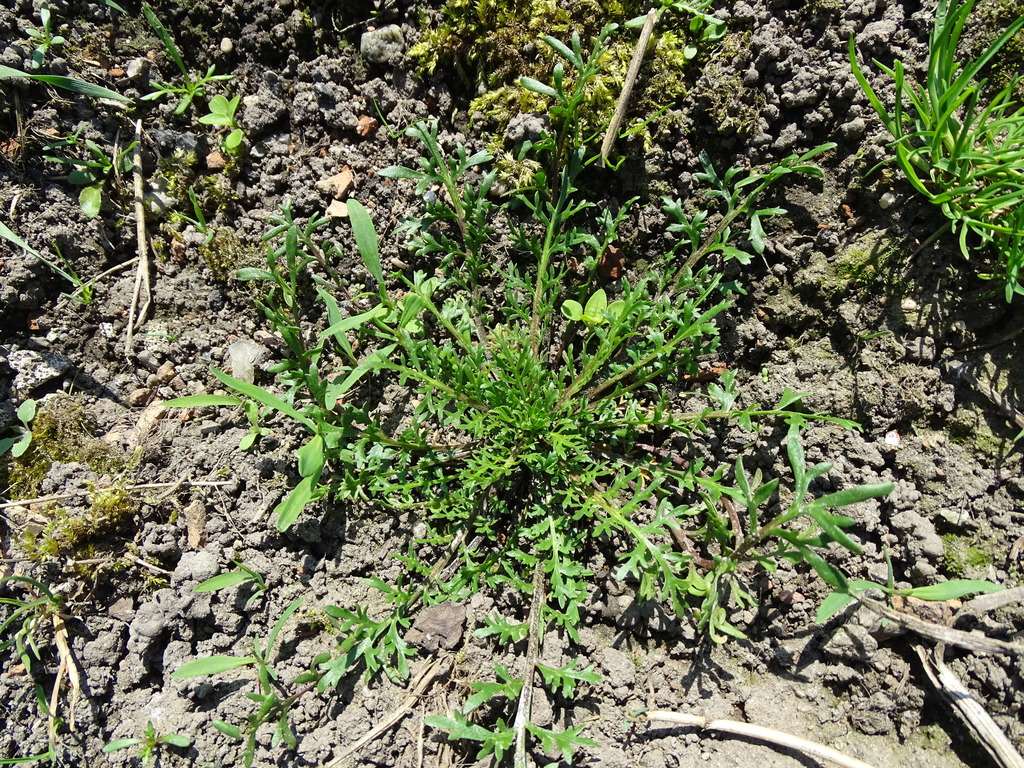
(c) Grzegorz Grzejszczak, some rights reserved (CC BY-SA) · licence
Family: Brassicaceae · Type: Herb · Not Native
Lepidium coronopus (Swine cress) is a non-native California herb in the Brassicaceae family, recognized by prostrate habit, reniform indehiscent fruits, 1-2-pinnately divided leaves.
Swine cress is a naturalized annual found in the Sacramento Valley, San Francisco Bay Area, and Desert Sonoran regions in disturbed areas, fields, and pastures at elevations below 300 meters. Flowering from March to June, this plant produces small white flowers about 1 to 2 millimeters wide in delicate clusters. Growing with prostrate to decumbent stems 15 to 35 centimeters tall, it branches extensively near the base. Its basal leaves are 4 to 10 centimeters long, intricately divided into pinnate segments with entire or slightly toothed lobes. The distinctive flattened, kidney-shaped fruits are 2.3 to 3.4 millimeters long with thick, prominently veined walls.
Identification and appearance
Key characters: 18 sympatric species; key features are prostrate habit, reniform indehiscent fruits, 1-2-pinnately divided leaves
Habitat and range
Habitat: Disturbed areas, fields, pastures
Elevation: < 300 m
California counties: Contra Costa, Yolo, Imperial, Alameda, Solano
Outside California: eastern Canada, central and eastern United States, native to southern Europe, southwestern Asia, northern Africa
Bloom period
Lepidium coronopus blooms Mar-Jun.
How to tell it apart
vs Capsella: Small round-to-oval pods versus distinctive triangular heart-shaped pods.; vs Cotula: Mustard with seed pods and 4 petals versus composite with disk flowers only.; vs Soliva: Mustard with flattened seed pods versus composite with spiny achenes.; vs Thysanocarpus: Fruits stand upright or spread versus hanging downward in Thysanocarpus.; vs Lobularia: Flattened oval pods with 1-2 seeds versus inflated round pods with 2 seeds.
Frequently asked questions
Is Lepidium coronopus native to California?
No. Lepidium coronopus is not native to California (recorded as not native).
When does Lepidium coronopus bloom?
Lepidium coronopus blooms Mar-Jun.
Where in California does Lepidium coronopus grow?
Lepidium coronopus occurs in Contra Costa, Yolo, Imperial, Alameda, Solano, at elevations of < 300 m.
What plant family does Lepidium coronopus belong to?
Lepidium coronopus is in the Brassicaceae family, genus Lepidium.
What habitat does Lepidium coronopus grow in?
Lepidium coronopus grows in Disturbed areas, fields, pastures.
Related species
Other California species in the same genus, family, or bioregion.
Sources: Jepson eFlora · Index of California Plant Names · CalPhotos
Last updated 2026-10-07
Data from The California Species Project — 14,000+ California species with verified data from CNPS, CDFW, USFWS, Cal-IPC, and more.