Leptosiphon floribundus subsp. hallii
Santa rosa mountains leptosiphon, Santa Rosa Mountains Leptosiphon
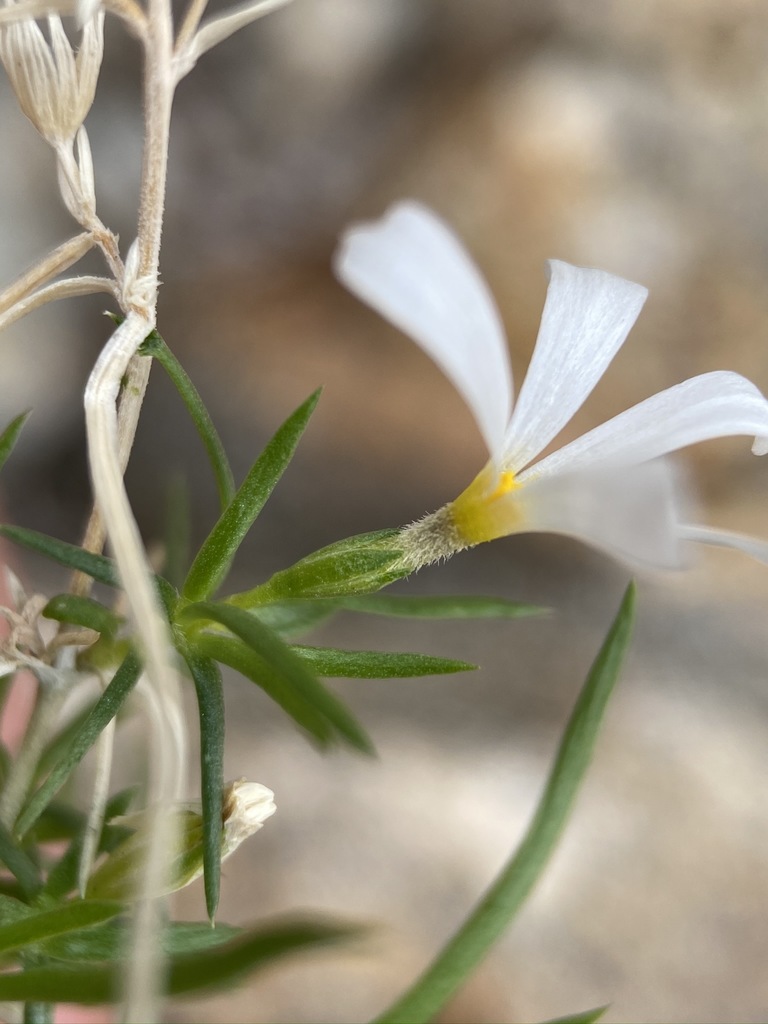
(c) Matt Berger, some rights reserved (CC BY), uploaded by Matt Berger · licence
Family: Polemoniaceae · Type: Subshrub · Native
Conservation status: CNPS 1B.3
Leptosiphon floribundus subsp. hallii (Santa rosa mountains leptosiphon) is a native California subshrub in the Polemoniaceae family, recognized by simple leaves (lobes 0) and desert canyon habitat distinctive.
Santa rosa mountains leptosiphon is a rare (CNPS 1B.3) California native perennial found in the eastern Peninsular Ranges in Santa Rosa Mountains desert canyons at elevations of 1,000 to 2,000 meters. Flowering from April to May, this plant produces delicate white to pale pink flowers in small clusters. Growing with slender stems 10 to 30 centimeters tall, it forms a compact and delicate form. Its leaves are uniquely characterized by smooth surfaces with narrow lobes that are nearly absent. The plant's glabrous (smooth) stems and foliage contribute to its subtle, elegant appearance in harsh desert canyon environments.
Identification and appearance
Key characters: 8 sympatric species; simple leaves (lobes 0) and desert canyon habitat distinctive
Habitat and range
Habitat: Desert canyons
Elevation: 1000-2000 m
California counties: Riverside, San Diego
Bloom period
Leptosiphon floribundus subsp. hallii blooms Apr-May.
Conservation status
CNPS 1B.3
How to tell it apart
vs Linanthus: Leptosiphon flowers open in daytime on stalks >2mm; Linanthus flowers often open at dusk/night on very short stalks.; vs Phlox: Leptosiphon leaves are deeply divided into fingers; Phlox leaves are completely undivided.; vs Navarretia: Leptosiphon has soft, flexible leaf lobes; Navarretia has rigid, spine-tipped leaf lobes and bracts.; vs Gilia: Leptosiphon has opposite palmately-lobed leaves; Gilia has alternate pinnately-lobed leaves.; vs Sabulina: Leptosiphon has tubular 5-petaled flowers and lobed leaves; Sabulina has 5 separate petals and needle-like leaves.
Frequently asked questions
Is Leptosiphon floribundus subsp. hallii native to California?
Yes. Leptosiphon floribundus subsp. hallii is native to California (recorded as native).
When does Leptosiphon floribundus subsp. hallii bloom?
Leptosiphon floribundus subsp. hallii blooms Apr-May.
Where in California does Leptosiphon floribundus subsp. hallii grow?
Leptosiphon floribundus subsp. hallii occurs in Riverside, San Diego, at elevations of 1000-2000 m.
What plant family does Leptosiphon floribundus subsp. hallii belong to?
Leptosiphon floribundus subsp. hallii is in the Polemoniaceae family, genus Leptosiphon.
Is Leptosiphon floribundus subsp. hallii rare or endangered?
Leptosiphon floribundus subsp. hallii carries California Rare Plant Rank 1B.3, state rank S1S2.
Related species
Other California species in the same genus, family, or bioregion.
Sources: Jepson eFlora · CNPS Rare Plant Inventory · Index of California Plant Names · CalPhotos · CDFW CNDDB
Last updated 2026-10-07
Data from The California Species Project — 14,000+ California species with verified data from CNPS, CDFW, USFWS, Cal-IPC, and more.