Leptosiphon liniflorus
Narrowflower flaxflower
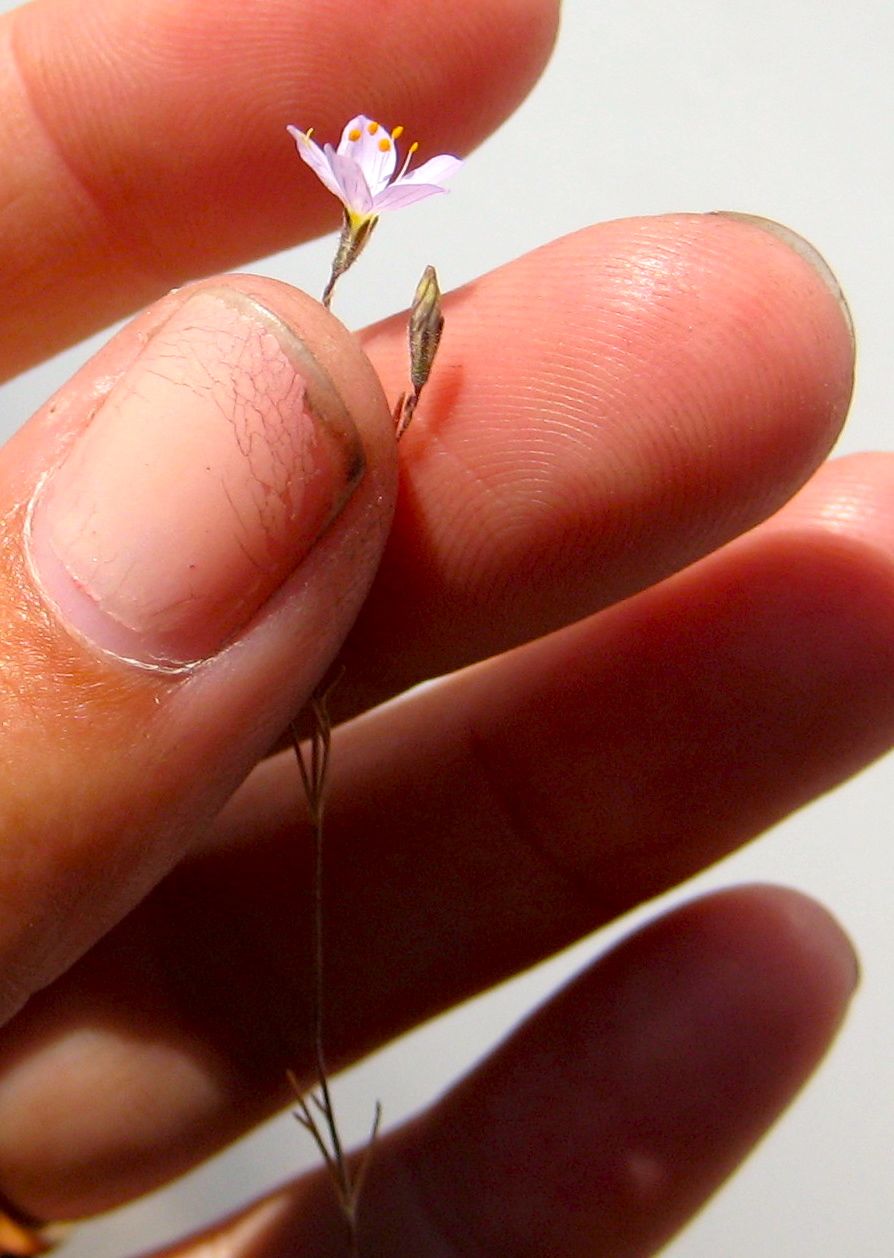
Photo by Chez Brungraber
Family: Polemoniaceae · Type: Herb · Native
Leptosiphon liniflorus (Narrowflower flaxflower) is a native California herb in the Polemoniaceae family, recognized by large white funnel-shaped flowers with purple-veined lobes diagnostic.
Narrowflower flaxflower is a California native annual found in the California Floristic Province and western Mojave Desert in woodland openings, particularly on serpentine soils, at elevations up to 1,700 meters. Flowering from April to June, this plant produces white flowers with yellow throats and purple-veined petals approximately 8 to 10 millimeters long. Growing with branched stems 10 to 50 centimeters tall, some glabrous and others hairy, it forms delicate open structures. Its leaves are composed of linear lobes 1 to 3 centimeters long, arranged in a distinctive pattern along the stems. The flowers emerge in small clusters or individually, with stamens extending beyond the delicate white and yellow corolla.
Identification and appearance
Key characters: 35 sympatric species; large white funnel-shaped flowers with purple-veined lobes diagnostic
Habitat and range
Habitat: Woodland, openings, common on serpentine, desert
Elevation: < 1700 m
California counties: Los Angeles, Kern, Riverside, San Diego, Ventura, San Bernardino, Santa Barbara, San Mateo, Monterey, Mariposa, Tulare, Placer, San Luis Obispo, Contra Costa, Merced, Alameda, Orange, San Benito, Kings, Yolo, Modoc, San Francisco, Lake, Santa Clara, Sacramento, Fresno, Solano, Madera, Stanislaus
Outside California: to Washington
Bloom period
Leptosiphon liniflorus blooms Apr-Jun.
How to tell it apart
vs Linanthus: Leptosiphon flowers open in daytime on stalks >2mm; Linanthus flowers often open at dusk/night on very short stalks.; vs Phlox: Leptosiphon leaves are deeply divided into fingers; Phlox leaves are completely undivided.; vs Navarretia: Leptosiphon has soft, flexible leaf lobes; Navarretia has rigid, spine-tipped leaf lobes and bracts.; vs Gilia: Leptosiphon has opposite palmately-lobed leaves; Gilia has alternate pinnately-lobed leaves.; vs Sabulina: Leptosiphon has tubular 5-petaled flowers and lobed leaves; Sabulina has 5 separate petals and needle-like leaves.
Frequently asked questions
Is Leptosiphon liniflorus native to California?
Yes. Leptosiphon liniflorus is native to California (recorded as native).
When does Leptosiphon liniflorus bloom?
Leptosiphon liniflorus blooms Apr-Jun.
Where in California does Leptosiphon liniflorus grow?
Leptosiphon liniflorus occurs in Los Angeles, Kern, Riverside, San Diego, Ventura, San Bernardino, Santa Barbara, San Mateo and other counties, at elevations of < 1700 m.
What plant family does Leptosiphon liniflorus belong to?
Leptosiphon liniflorus is in the Polemoniaceae family, genus Leptosiphon.
What habitat does Leptosiphon liniflorus grow in?
Leptosiphon liniflorus grows in Woodland, openings, common on serpentine, desert.
Related species
Other California species in the same genus, family, or bioregion.
Sources: Jepson eFlora · Index of California Plant Names · CalPhotos
Last updated 2026-10-07
Data from The California Species Project — 14,000+ California species with verified data from CNPS, CDFW, USFWS, Cal-IPC, and more.