Leptosiphon rattanii
Rattan's leptosiphon
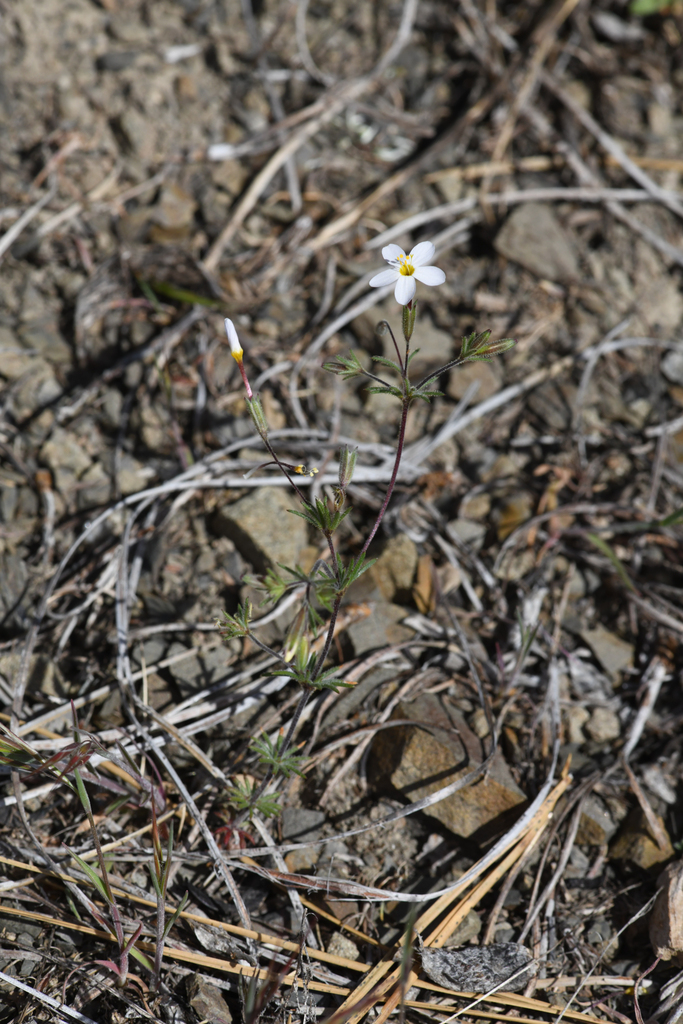
(c) Trevor Van Loon, some rights reserved (CC BY) · licence
Family: Polemoniaceae · Type: Herb · Native
Conservation status: CNPS 4.3
Leptosiphon rattanii (Rattan's leptosiphon) is a native California herb in the Polemoniaceae family, recognized by maroon tube exserted from calyx and single flowers diagnostic.
Rattan's leptosiphon is a California native annual found in northern coastal ranges in dry openings within conifer forest at elevations of 1,700 to 2,000 meters. Flowering from May to July, this delicate plant produces white flowers with distinctive maroon tubes and yellow throats, each bloom emerging singly on thread-like stems. Growing 5 to 20 centimeters tall with thin, generally hairy stems, it forms a delicate and intricate appearance in forest clearings. Its leaves have fine linear lobes 2 to 5 millimeters long, contributing to the plant's slender, understated structure. The flower's unique maroon tube with a yellow throat and white lobes creates an intriguing color contrast characteristic of this subtle woodland species.
Identification and appearance
Key characters: 15 sympatric species; maroon tube exserted from calyx and single flowers diagnostic
Habitat and range
Habitat: dry openings in conifer forest
Elevation: 1700-2000 m
California counties: Glenn, Trinity, Mendocino, Tehama, Lake, Shasta, Siskiyou
Bloom period
Leptosiphon rattanii blooms May-Jul.
Conservation status
CNPS 4.3
How to tell it apart
vs Linanthus: Leptosiphon flowers open in daytime on stalks >2mm; Linanthus flowers often open at dusk/night on very short stalks.; vs Phlox: Leptosiphon leaves are deeply divided into fingers; Phlox leaves are completely undivided.; vs Navarretia: Leptosiphon has soft, flexible leaf lobes; Navarretia has rigid, spine-tipped leaf lobes and bracts.; vs Gilia: Leptosiphon has opposite palmately-lobed leaves; Gilia has alternate pinnately-lobed leaves.; vs Sabulina: Leptosiphon has tubular 5-petaled flowers and lobed leaves; Sabulina has 5 separate petals and needle-like leaves.
Frequently asked questions
Is Leptosiphon rattanii native to California?
Yes. Leptosiphon rattanii is native to California (recorded as native).
When does Leptosiphon rattanii bloom?
Leptosiphon rattanii blooms May-Jul.
Where in California does Leptosiphon rattanii grow?
Leptosiphon rattanii occurs in Glenn, Trinity, Mendocino, Tehama, Lake, Shasta, Siskiyou, at elevations of 1700-2000 m.
What plant family does Leptosiphon rattanii belong to?
Leptosiphon rattanii is in the Polemoniaceae family, genus Leptosiphon.
Is Leptosiphon rattanii rare or endangered?
Leptosiphon rattanii carries California Rare Plant Rank 4.3, state rank S4.
Related species
Other California species in the same genus, family, or bioregion.
Sources: Jepson eFlora · CNPS Rare Plant Inventory · Index of California Plant Names · CalPhotos · CDFW CNDDB
Last updated 2026-10-07
Data from The California Species Project — 14,000+ California species with verified data from CNPS, CDFW, USFWS, Cal-IPC, and more.