Leptosyne hamiltonii
Mount hamilton tickseed, Mount Hamilton Tickseed
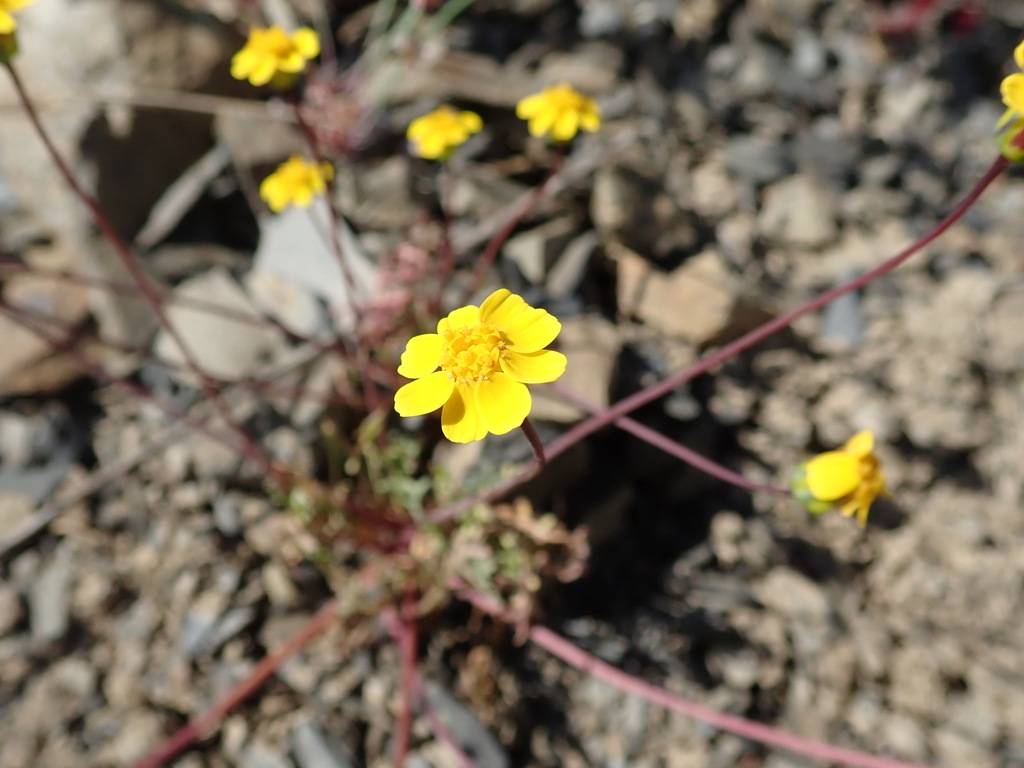
(c) joergmlpts, some rights reserved (CC BY) · licence
Family: Asteraceae · Type: Herb · Native
Conservation status: CNPS 1B.2
Leptosyne hamiltonii (Mount hamilton tickseed) is a native California herb in the Asteraceae family, recognized by reflexed short rays and cylindric involucre are key.
Mount hamilton tickseed is a rare (CNPS 1B.2) California native annual found in the eastern San Francisco Bay Area's Diablo Range on dry exposed slopes at elevations of 600 to 1,300 meters. Flowering from March to May, this plant produces yellow ray flowers 3 to 8 millimeters long that are oblong to obovate and reflexed, surrounding a dense central disk. Growing 5 to 25 centimeters tall with one to many erect, glabrous stems, it forms a delicate, slender profile. Its finely divided leaves are deeply pinnate, with narrow linear segments about 1 millimeter wide that are grooved on the upper surface. The fruits are distinctive, with ray fruits 5 millimeters long that are brown or tan with brown splotches, and shiny disk fruits with ascending hairs along the margins.
Identification and appearance
Key characters: 3 sympatric species; reflexed short rays and cylindric involucre are key
Habitat and range
Habitat: dry exposed slopes
Elevation: 600-1300 m
California counties: Stanislaus, Santa Clara
Bloom period
Leptosyne hamiltonii blooms Mar-May.
Conservation status
CNPS 1B.2
How to tell it apart
vs Monolopia: Two distinct bract layers (outer leafy, inner thin) vs. single series of equal bracts.; vs Glebionis: Fertile ray flowers (make seeds) vs. sterile rays in crown daisy.; vs Encelia: Herbaceous to shrubby but not exclusively woody vs. always woody shrub.; vs Lasthenia: Large flower heads on individual stems vs. small heads often clustered in goldfields.; vs Coreopsis: Alternate or basal leaves vs. opposite leaves in Coreopsis.
Frequently asked questions
Is Leptosyne hamiltonii native to California?
Yes. Leptosyne hamiltonii is native to California (recorded as native).
When does Leptosyne hamiltonii bloom?
Leptosyne hamiltonii blooms Mar-May.
Where in California does Leptosyne hamiltonii grow?
Leptosyne hamiltonii occurs in Stanislaus, Santa Clara, at elevations of 600-1300 m.
What plant family does Leptosyne hamiltonii belong to?
Leptosyne hamiltonii is in the Asteraceae family, genus Leptosyne.
Is Leptosyne hamiltonii rare or endangered?
Leptosyne hamiltonii carries California Rare Plant Rank 1B.2, state rank S2.
Related species
Other California species in the same genus, family, or bioregion.
Sources: Jepson eFlora · CNPS Rare Plant Inventory · Index of California Plant Names · CalPhotos · CDFW CNDDB
Last updated 2026-10-07
Data from The California Species Project — 14,000+ California species with verified data from CNPS, CDFW, USFWS, Cal-IPC, and more.