Leucocrinum montanum
Common starlily
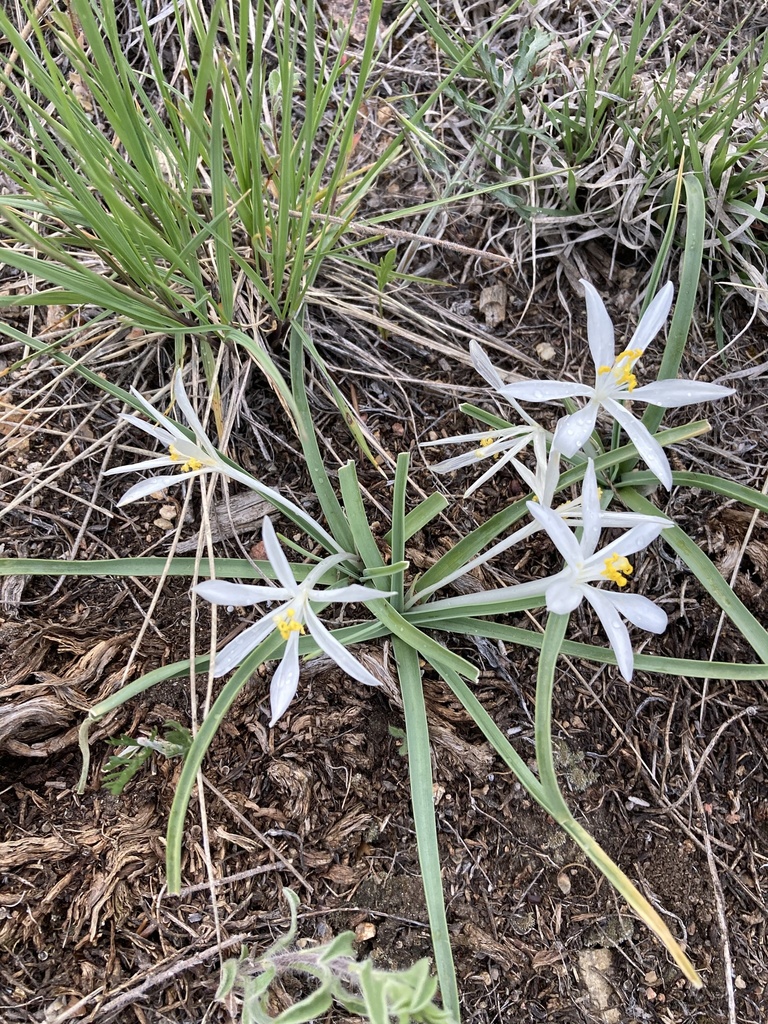
(c) Christine Laney, some rights reserved (CC BY) · licence
Family: Agavaceae · Type: Herb · Native
Leucocrinum montanum (Common starlily) is a native California herb in the Agavaceae family, recognized by Great Basin species at western range limit in California; unique underground flowering structure.
Common starlily is a California native perennial found in the Klamath Ranges, Cascade Range, and Modoc Plateau in sandy flats, sagebrush scrub, juniper woodland, and montane forest at elevations of 1,000 to 1,500 meters. Flowering from May to June, this plant produces pure white, star-shaped flowers 5 to 10 centimeters long with six spreading lobes, creating a dramatic salverform perianth. Growing without a visible stem, it emerges from a short, often deep caudex with fleshy roots and spreading linear leaves 10 to 20 centimeters long that emerge from a base sheathed by membranous bracts. Its basal leaves are slender and linear, emerging directly from the ground in a distinctive rosette pattern. The fruit is a small 5 to 8 millimeter, three-angled capsule containing black, angled seeds.
Identification and appearance
Key characters: Great Basin species at western range limit in California; unique underground flowering structure
Habitat and range
Habitat: Sandy flats, sagebrush scrub, juniper woodland, montane forest
Elevation: 1000-1500 m
California counties: Modoc, Lassen, El Dorado, Plumas, Nevada, Siskiyou, Shasta, Sierra, Mono
Outside California: to Oregon, Nebraska, Utah
Bloom period
Leucocrinum montanum blooms May-Jun.
How to tell it apart
vs Toxicoscordion: Leucocrinum has no above-ground stem with flowers at ground level; Toxicoscordion has an obvious upright flowering stem.; vs Agave: Leucocrinum is stemless with thin grass-like leaves; Agave forms rosettes with thick succulent sword-like leaves.; vs Hesperoyucca: Leucocrinum has no stem with ground-level flowers; Hesperoyucca has massive 6-14 foot tall flower stalks.; vs Yucca: Leucocrinum is stemless with flowers at ground level; Yucca has obvious above-ground stems or trunks.; vs Hesperocallis: Leucocrinum has grass-like leaves and small flowers at ground level; Hesperocallis has large wavy-edged leaves and tall flower spikes.
Frequently asked questions
Is Leucocrinum montanum native to California?
Yes. Leucocrinum montanum is native to California (recorded as native).
When does Leucocrinum montanum bloom?
Leucocrinum montanum blooms May-Jun.
Where in California does Leucocrinum montanum grow?
Leucocrinum montanum occurs in Modoc, Lassen, El Dorado, Plumas, Nevada, Siskiyou, Shasta, Sierra and other counties, at elevations of 1000-1500 m.
What plant family does Leucocrinum montanum belong to?
Leucocrinum montanum is in the Agavaceae family, genus Leucocrinum.
What habitat does Leucocrinum montanum grow in?
Leucocrinum montanum grows in Sandy flats, sagebrush scrub, juniper woodland, montane forest.
Related species
Other California species in the same genus, family, or bioregion.
Sources: Jepson eFlora · Index of California Plant Names · CalPhotos
Last updated 2026-10-07
Data from The California Species Project — 14,000+ California species with verified data from CNPS, CDFW, USFWS, Cal-IPC, and more.