Ligusticum grayi
Gray's licorice root
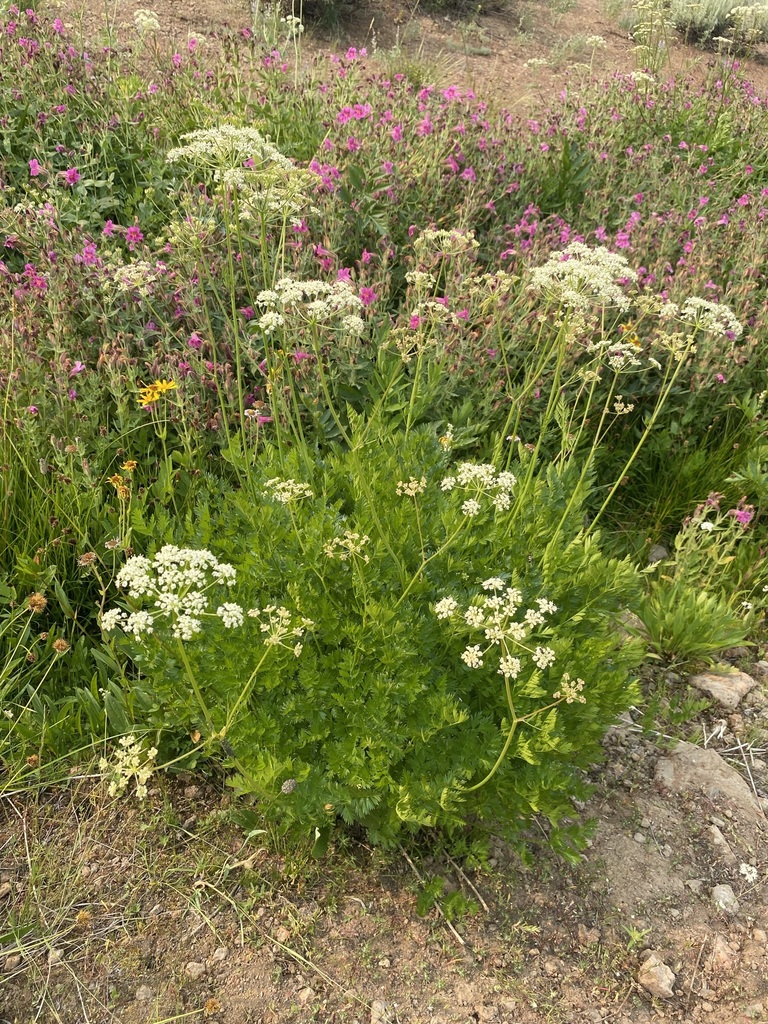
(c) Matt Berger, some rights reserved (CC BY), uploaded by Matt Berger · licence
Family: Apiaceae · Type: Herb · Native
Ligusticum grayi (Gray's licorice root) is a native California herb in the Apiaceae family.
Gray's licorice root is a California native perennial found in the Klamath Ranges, northern High Sierra Nevada, Sierra Nevada, and Modoc Plateau in wet soil of subalpine meadows and conifer forests at elevations of 1,000 to 3,300 meters. Flowering from June to September, this plant produces small white to cream-colored flowers in delicate compound umbels with 5 to 18 unequal rays. Growing 20 to 80 centimeters tall with a glabrous (smooth) stem, it develops a robust structure with large, intricately divided leaves. Its leaves are complex, featuring 2-pinnate or ternate-pinnate blades up to 25 centimeters long, with leaflets 1 to 4 centimeters in length, each deeply lobed with narrow, acute segments. The fruit is a small oblong-ovate structure 4 to 5 millimeters long, with narrowly winged ribs and 3 to 5 oil tubes per rib-interval.
Identification and appearance
Key characters: 2 sympatric species; key differentiators are wet habitat, deeply lobed narrow acute leaf segments, and single reduced cauline leaf
Habitat and range
Habitat: Wet soil of subalpine meadows, conifer forest
Elevation: 1000-3300 m
California counties: Tulare, Mariposa, San Diego, Alpine, Fresno, Mono, El Dorado, Plumas, Tuolumne, Placer, Siskiyou, Trinity, Madera, Nevada, Sierra, Mendocino, Modoc, Butte, Amador, Del Norte, Tehama, Lassen, Sonoma, Shasta, Humboldt, Calaveras, Glenn
Outside California: to Washington, Montana, Nevada
Bloom period
Ligusticum grayi blooms Jun-Sep.
How to tell it apart
vs Perideridia: Ligusticum has fibrous-wrapped stem bases; Perideridia has smooth bases with tuberous roots.; vs Conium: Ligusticum has fibrous stem bases in mountains; Conium has purple-spotted stems in disturbed lowlands.; vs Oenanthe: Ligusticum has fibrous stem bases; Oenanthe has thickened root crowns in wetlands.; vs Angelica: Ligusticum stem bases wrapped in fibrous remains; Angelica bases smooth and clean.; vs Lomatium: Ligusticum has white flowers and fibrous stem bases; Lomatium often yellow-flowered without fibrous bases.
Frequently asked questions
Is Ligusticum grayi native to California?
Yes. Ligusticum grayi is native to California (recorded as native).
When does Ligusticum grayi bloom?
Ligusticum grayi blooms Jun-Sep.
Where in California does Ligusticum grayi grow?
Ligusticum grayi occurs in Tulare, Mariposa, San Diego, Alpine, Fresno, Mono, El Dorado, Plumas and other counties, at elevations of 1000-3300 m.
What plant family does Ligusticum grayi belong to?
Ligusticum grayi is in the Apiaceae family, genus Ligusticum.
What habitat does Ligusticum grayi grow in?
Ligusticum grayi grows in Wet soil of subalpine meadows, conifer forest.
Related species
Other California species in the same genus, family, or bioregion.
Sources: Jepson eFlora · Index of California Plant Names · CalPhotos
Last updated 2026-10-07
Data from The California Species Project — 14,000+ California species with verified data from CNPS, CDFW, USFWS, Cal-IPC, and more.