Lilium pardalinum
California tiger lily
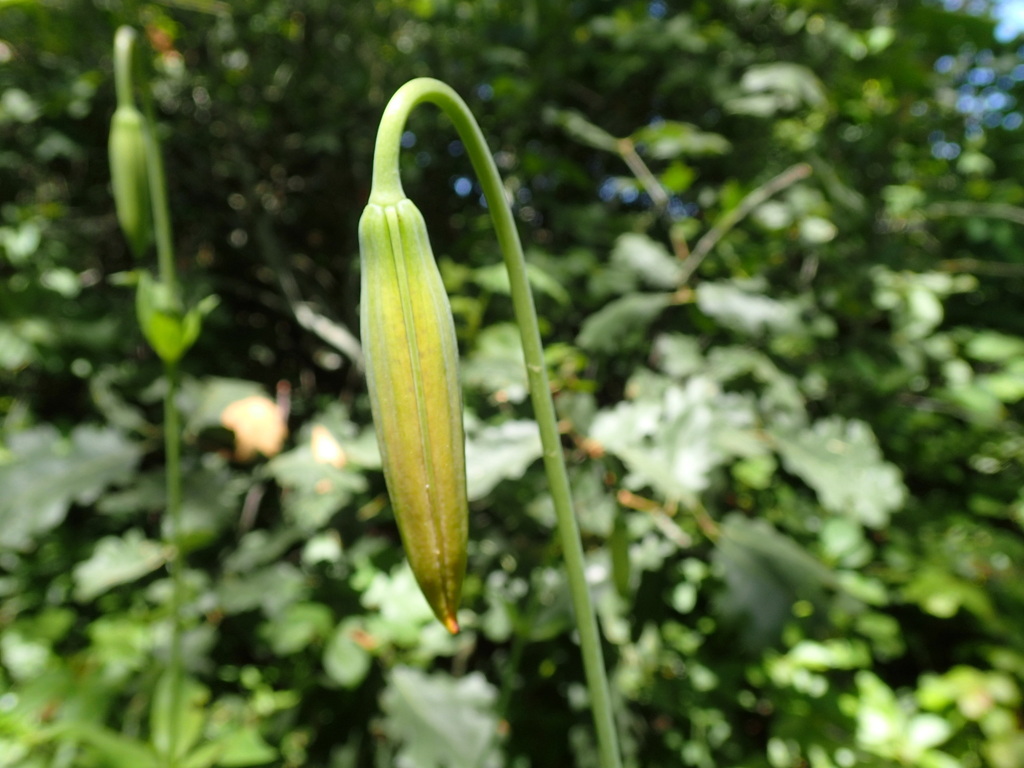
no rights reserved · CC0
Family: Liliaceae · Type: Herb · Native
Lilium pardalinum (California tiger lily) is a native California herb in the Liliaceae family, recognized by Streambank/wet-meadow Turk's-cap lily; clonal branched rhizome-like bulb; 2-toned orange-to-red reflexed flowers.
California tiger lily is a native perennial found in northern California forests and montane areas at elevations of 100 to 2,000 meters. Flowering from June to August, this plant produces large pendent flowers with pale orange to red petals marked with maroon spots edged in yellow, ranging from 3.4 to 10.4 centimeters long. Growing up to 2.8 meters tall with a spreading, often branched bulb, it develops multiple stems that can produce 1 to 28 dramatic bell-shaped blossoms. Its leaves are alternate or arranged in whorls, typically 4 to 27 centimeters long and elliptic in shape, spreading along the stem. The plant's complex flower structure features widely diverging filaments with magenta to orange anthers that produce red-brown to yellow pollen.
Identification and appearance
Key characters: Streambank/wet-meadow Turk's-cap lily; clonal branched rhizome-like bulb; 2-toned orange-to-red reflexed flowers
Habitat and range
California counties: Lassen, Santa Cruz, Plumas, Santa Barbara, Mendocino, Shasta, Lake, Kern, Tulare, Monterey, Humboldt, Nevada, Trinity, Placer, Tehama, Inyo, Del Norte, Siskiyou, Sierra, San Luis Obispo, Santa Clara, Marin, Mono, Mariposa, Fresno, Alameda, Butte, Calaveras, El Dorado, Madera, San Bernardino, Ventura, San Mateo, Sonoma, Tuolumne, Yuba, Contra Costa, Colusa, San Diego, Napa
How to tell it apart
vs Hemerocallis: Lilium has whorled stem leaves; Hemerocallis has all leaves at base in a clump.; vs Fritillaria: Lilium has >12 leaves in whorls; Fritillaria has fewer leaves scattered or whorled.; vs Alstroemeria: Lilium has leaves right-side up; Alstroemeria has twisted leaf bases making leaves upside-down.; vs Amaryllis: Lilium has leafy stems; Amaryllis has naked flower stalks with all leaves at base.; vs Hippeastrum: Lilium has leafy stems and many whorled leaves; Hippeastrum has leafless flower stalks.
Frequently asked questions
Is Lilium pardalinum native to California?
Yes. Lilium pardalinum is native to California (recorded as native).
Where in California does Lilium pardalinum grow?
Lilium pardalinum occurs in Lassen, Santa Cruz, Plumas, Santa Barbara, Mendocino, Shasta, Lake, Kern and other counties.
What plant family does Lilium pardalinum belong to?
Lilium pardalinum is in the Liliaceae family, genus Lilium.
Related species
Other California species in the same genus, family, or bioregion.
Sources: Jepson eFlora · Index of California Plant Names · CalPhotos
Last updated 2026-10-07
Data from The California Species Project — 14,000+ California species with verified data from CNPS, CDFW, USFWS, Cal-IPC, and more.