Linanthus maculatus subsp. emaculatus
Jacumba Mountains linanthus
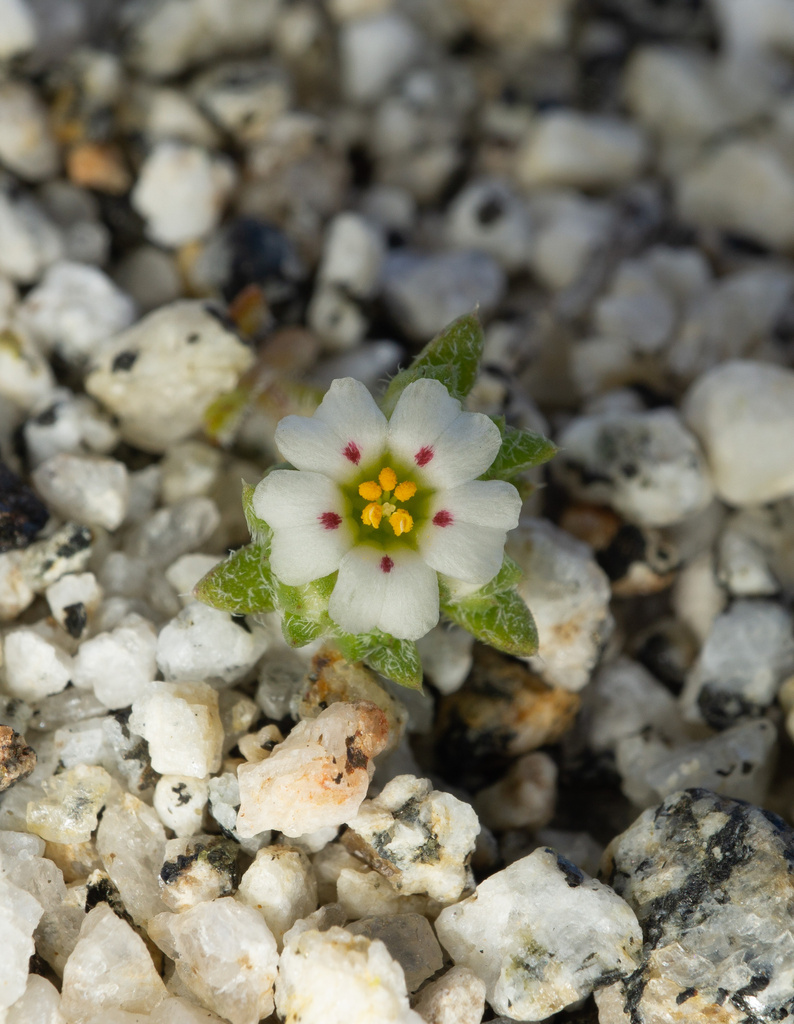
(c) Matt Berger, some rights reserved (CC BY) · licence
Family: Polemoniaceae · Type: Perennial · Native
Conservation status: CNPS 1B.1
Linanthus maculatus subsp. emaculatus (Jacumba Mountains linanthus) is a native California perennial in the Polemoniaceae family, recognized by key difference is absence of red basal spots on corolla lobes.
Jacumba Mountains linanthus is a rare (CNPS 1B.1) California native perennial found in southern desert regions in sandy dune margins, washes, and flats at elevations of 340 to 590 meters. Flowering from March to April, this delicate plant produces white to pale lavender flowers without the typical basal red spot characteristic of many linanthus species. Growing with slender, branching stems 10 to 30 centimeters tall, it forms compact clusters in open sandy terrain. Its narrow, linear leaves are arranged in opposite pairs, typically 1 to 3 centimeters long and blending subtly with the surrounding sandy landscape. This diminutive wildflower represents a rare and localized population in the arid southwestern California desert environment.
Identification and appearance
Key characters: 14 sympatric species; key difference is absence of red basal spots on corolla lobes
Habitat and range
Habitat: Dune margins, washes, flats
Elevation: 340-590 m
Bloom period
Linanthus maculatus subsp. emaculatus blooms Mar-Apr.
Conservation status
CNPS 1B.1
How to tell it apart
vs Phlox: Linanthus has alternate leaves; Phlox has opposite leaves paired along the stem.; vs Leptosiphon: Linanthus has rigid, sharp leaf tips and nocturnal flowers; Leptosiphon has soft leaf tips and day-blooming flowers.; vs Gilia: Linanthus has wheel-shaped flowers with lobes longer than tube; Gilia has narrow funnel flowers with tube longer than lobes.; vs Coleonema: Linanthus has palm-divided leaves and phlox flowers; Coleonema has needle-like leaves and 5-petaled star flowers.; vs Navarretia: Linanthus has open wheel flowers and non-spiny leaves; Navarretia has tiny tube flowers hidden in spiny bracts.
Frequently asked questions
Is Linanthus maculatus subsp. emaculatus native to California?
Yes. Linanthus maculatus subsp. emaculatus is native to California (recorded as native).
When does Linanthus maculatus subsp. emaculatus bloom?
Linanthus maculatus subsp. emaculatus blooms Mar-Apr.
What plant family does Linanthus maculatus subsp. emaculatus belong to?
Linanthus maculatus subsp. emaculatus is in the Polemoniaceae family, genus Linanthus.
Is Linanthus maculatus subsp. emaculatus rare or endangered?
Linanthus maculatus subsp. emaculatus carries California Rare Plant Rank 1B.1, state rank S1.
What habitat does Linanthus maculatus subsp. emaculatus grow in?
Linanthus maculatus subsp. emaculatus grows in Dune margins, washes, flats.
Related species
Other California species in the same genus, family, or bioregion.
Sources: Jepson eFlora · CNPS Rare Plant Inventory · Index of California Plant Names · CalPhotos · CDFW CNDDB
Last updated 2026-09-30
Data from The California Species Project — 14,000+ California species with verified data from CNPS, CDFW, USFWS, Cal-IPC, and more.