Linanthus parryae
Parry's linanthus
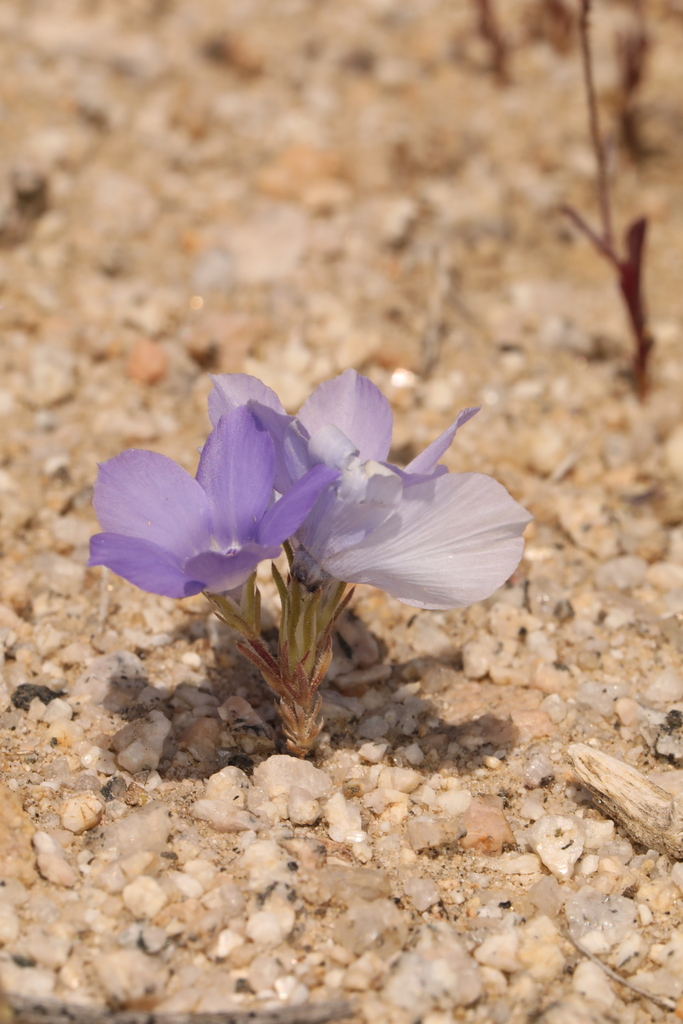
(c) Steve Matson, some rights reserved (CC BY) · licence
Family: Polemoniaceae · Type: Herb · Native
Linanthus parryae (Parry's linanthus) is a native California herb in the Polemoniaceae family, recognized by low habit with stems hidden by leaves and jagged petal edges.
Parry's linanthus is a California native annual found in southern Sierra Nevada, Tehachapi, southern San Joaquin Valley, south Coast Ranges, western Transverse Ranges, southern eastern Sierra Nevada, and Mojave Desert in sandy, open, flat areas at elevations below 2,000 meters. Flowering from March to May, this plant produces blue-purple or white flowers with jagged lobes and distinctive purple marks at their base. Growing with decumbent or short-erect stems 2 to 10 centimeters tall, hidden by dense leaves and covered in glandular hairs. Its leaves are crowded with linear lobes 5 to 15 millimeters long, and are notably hairy. The plant produces small obovoid fruits containing 18 to 36 seeds that swell and become gelatinous when wet.
Identification and appearance
Key characters: 17 sympatric species; low habit with stems hidden by leaves and jagged petal edges
Habitat and range
Habitat: Sandy, open, flat areas
Elevation: < 2000 m
California counties: Kern, San Bernardino, Los Angeles, Riverside, Tulare, Ventura, Inyo, Mono, San Luis Obispo, Monterey
Bloom period
Linanthus parryae blooms Mar-May.
How to tell it apart
vs Phlox: Linanthus has alternate leaves; Phlox has opposite leaves paired along the stem.; vs Leptosiphon: Linanthus has rigid, sharp leaf tips and nocturnal flowers; Leptosiphon has soft leaf tips and day-blooming flowers.; vs Gilia: Linanthus has wheel-shaped flowers with lobes longer than tube; Gilia has narrow funnel flowers with tube longer than lobes.; vs Coleonema: Linanthus has palm-divided leaves and phlox flowers; Coleonema has needle-like leaves and 5-petaled star flowers.; vs Navarretia: Linanthus has open wheel flowers and non-spiny leaves; Navarretia has tiny tube flowers hidden in spiny bracts.
Frequently asked questions
Is Linanthus parryae native to California?
Yes. Linanthus parryae is native to California (recorded as native).
When does Linanthus parryae bloom?
Linanthus parryae blooms Mar-May.
Where in California does Linanthus parryae grow?
Linanthus parryae occurs in Kern, San Bernardino, Los Angeles, Riverside, Tulare, Ventura, Inyo, Mono and other counties, at elevations of < 2000 m.
What plant family does Linanthus parryae belong to?
Linanthus parryae is in the Polemoniaceae family, genus Linanthus.
What habitat does Linanthus parryae grow in?
Linanthus parryae grows in Sandy, open, flat areas.
Related species
Other California species in the same genus, family, or bioregion.
Sources: Jepson eFlora · Index of California Plant Names · CalPhotos
Last updated 2026-10-07
Data from The California Species Project — 14,000+ California species with verified data from CNPS, CDFW, USFWS, Cal-IPC, and more.