Linanthus pungens
Granite gilia, Granite Gilia
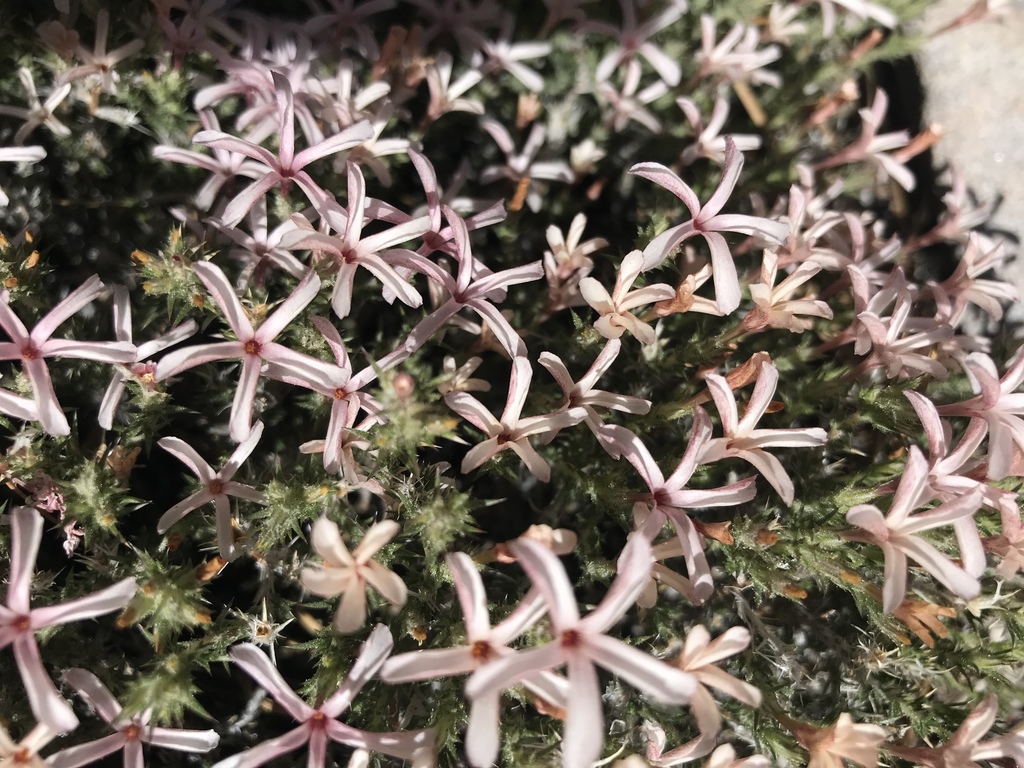
(c) Sula Vanderplank, some rights reserved (CC BY) · licence
Family: Polemoniaceae · Type: Subshrub · Native
Linanthus pungens (Granite gilia) is a native California subshrub in the Polemoniaceae family, recognized by woody subshrub with palmate sharp leaves.
Granite gilia is a California native perennial found in montane, subalpine forest, and alpine fell-fields of the Sierra Nevada at elevations of 1,700 to 4,000 meters. Flowering from May to August, this plant produces white or light pink flowers with darker shading on the petal margins, opening in the evening and featuring funnel-shaped corollas 7 to 15 millimeters long. Growing with hairy stems 10 to 30 centimeters tall, it forms a compact subshrub-like habit. Its distinctive leaves are alternate with 3 to 7 palmate lobes, typically sharp-tipped with the middle lobe generally the longest. The plant produces small, narrowly ovoid fruits containing 15 to 30 seeds.
Identification and appearance
Key characters: 26 sympatric species; woody subshrub with palmate sharp leaves
Habitat and range
Habitat: Open, rocky areas in montane, subalpine forest, alpine fell-fields
Elevation: 1700-4000 m.
California counties: San Bernardino, Inyo, Mono, Los Angeles, Riverside, San Diego, Lassen, Tulare, Shasta, Kern, Siskiyou, Alpine, El Dorado, Sierra, Butte, Tehama, Plumas, Orange, Fresno, Modoc, Trinity, Nevada, Ventura, Tuolumne, Placer, Imperial, Glenn, Colusa, Marin, Mariposa
Outside California: to British Columbia, Rocky Mountains.
Bloom period
Linanthus pungens blooms May-Aug.
How to tell it apart
vs Phlox: Linanthus has alternate leaves; Phlox has opposite leaves paired along the stem.; vs Leptosiphon: Linanthus has rigid, sharp leaf tips and nocturnal flowers; Leptosiphon has soft leaf tips and day-blooming flowers.; vs Gilia: Linanthus has wheel-shaped flowers with lobes longer than tube; Gilia has narrow funnel flowers with tube longer than lobes.; vs Coleonema: Linanthus has palm-divided leaves and phlox flowers; Coleonema has needle-like leaves and 5-petaled star flowers.; vs Navarretia: Linanthus has open wheel flowers and non-spiny leaves; Navarretia has tiny tube flowers hidden in spiny bracts.
Frequently asked questions
Is Linanthus pungens native to California?
Yes. Linanthus pungens is native to California (recorded as native).
When does Linanthus pungens bloom?
Linanthus pungens blooms May-Aug.
Where in California does Linanthus pungens grow?
Linanthus pungens occurs in San Bernardino, Inyo, Mono, Los Angeles, Riverside, San Diego, Lassen, Tulare and other counties, at elevations of 1700-4000 m..
What plant family does Linanthus pungens belong to?
Linanthus pungens is in the Polemoniaceae family, genus Linanthus.
What habitat does Linanthus pungens grow in?
Linanthus pungens grows in Open, rocky areas in montane, subalpine forest, alpine fell-fields.
Related species
Other California species in the same genus, family, or bioregion.
Sources: Jepson eFlora · Index of California Plant Names · CalPhotos
Last updated 2026-10-07
Data from The California Species Project — 14,000+ California species with verified data from CNPS, CDFW, USFWS, Cal-IPC, and more.