Linanthus pungens subsp. pulchriflorus
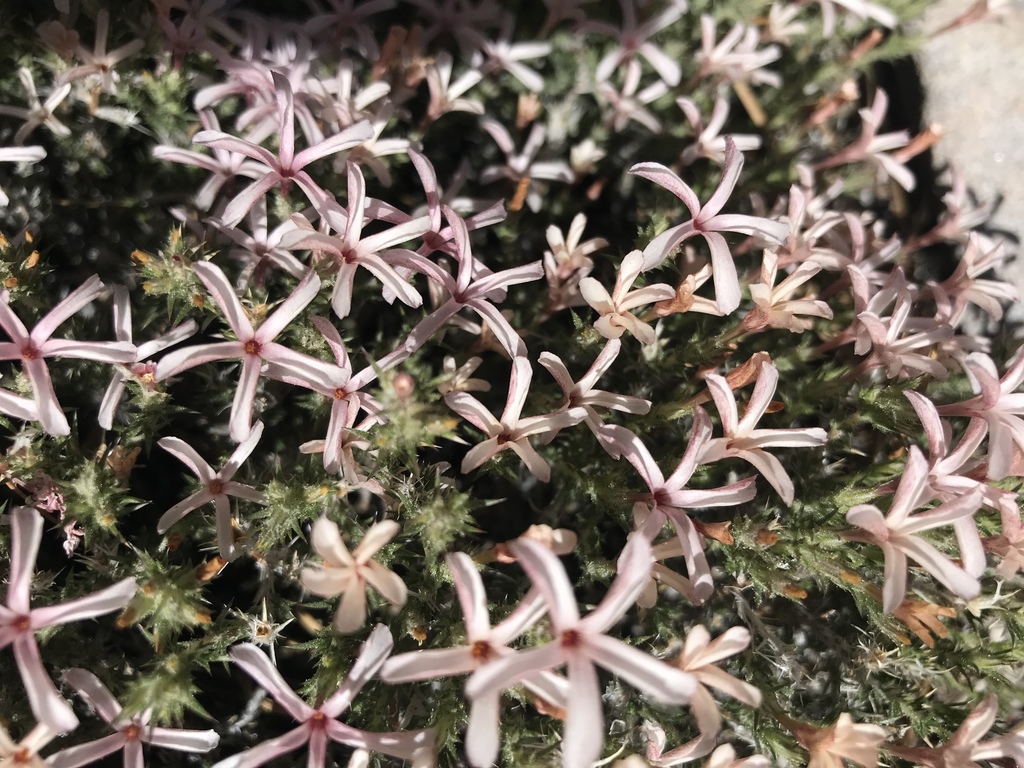
Photo: parent species Linanthus pungens · (c) Sula Vanderplank, some rights reserved (CC BY) · licence
Family: Polemoniaceae · Type: Perennial · Native
Linanthus pungens subsp. pulchriflorus is a native California perennial in the Polemoniaceae family, recognized by glandular and non-glandular hairs, 3-13-lobed leaves, and ≥5-lobed bracts.
Linanthus pungens subsp. pulchriflorus is a California native perennial found in the high Sierra Nevada Mountains in open, rocky areas of montane, subalpine forest, and alpine fell-fields at elevations of 1,700 to 4,000 meters. Flowering from May to August, this plant produces delicate white to pale lavender flowers in small clusters with distinctive lobed bracts. Growing with slender stems covered in both glandular and non-glandular hairs, it forms compact clusters in alpine environments. Its leaves are typically divided into 3 to 13 narrow lobes, giving the plant a delicate and intricate appearance. The plant's unique combination of hairy stems and deeply lobed leaves makes it well-adapted to its high-elevation rocky habitat.
Identification and appearance
Key characters: 26 sympatric species; distinguished by glandular and non-glandular hairs, 3-13-lobed leaves, and ≥5-lobed bracts
Habitat and range
Habitat: Open, rocky areas in montane, subalpine forest, alpine fell-fields
Elevation: 1700-4000 m
Outside California: to Utah
Bloom period
Linanthus pungens subsp. pulchriflorus blooms May-Aug.
How to tell it apart
vs Phlox: Linanthus has alternate leaves; Phlox has opposite leaves paired along the stem.; vs Leptosiphon: Linanthus has rigid, sharp leaf tips and nocturnal flowers; Leptosiphon has soft leaf tips and day-blooming flowers.; vs Gilia: Linanthus has wheel-shaped flowers with lobes longer than tube; Gilia has narrow funnel flowers with tube longer than lobes.; vs Coleonema: Linanthus has palm-divided leaves and phlox flowers; Coleonema has needle-like leaves and 5-petaled star flowers.; vs Navarretia: Linanthus has open wheel flowers and non-spiny leaves; Navarretia has tiny tube flowers hidden in spiny bracts.
Frequently asked questions
Is Linanthus pungens subsp. pulchriflorus native to California?
Yes. Linanthus pungens subsp. pulchriflorus is native to California (recorded as native).
When does Linanthus pungens subsp. pulchriflorus bloom?
Linanthus pungens subsp. pulchriflorus blooms May-Aug.
What plant family does Linanthus pungens subsp. pulchriflorus belong to?
Linanthus pungens subsp. pulchriflorus is in the Polemoniaceae family, genus Linanthus.
What habitat does Linanthus pungens subsp. pulchriflorus grow in?
Linanthus pungens subsp. pulchriflorus grows in Open, rocky areas in montane, subalpine forest, alpine fell-fields.
Related species
Other California species in the same genus, family, or bioregion.
- Linanthus sp.
- Linanthus arenicola — Sand linanthus
- Linanthus bellus — Desert beauty
- Linanthus bernardinus — Pioneertown linanthus
- Linanthus bigelovii subsp. johnsonii
- Linanthus californicus — Prickly phlox
- Loeseliastrum depressum — Depressed standing-cypress
- Loeseliastrum matthewsii — Desert calico
- Loeseliastrum schottii — Schott gilia
Sources: Jepson eFlora · CalPhotos
Last updated 2026-09-30
Data from The California Species Project — 14,000+ California species with verified data from CNPS, CDFW, USFWS, Cal-IPC, and more.