Linaria vulgaris
Butter-and-eggs
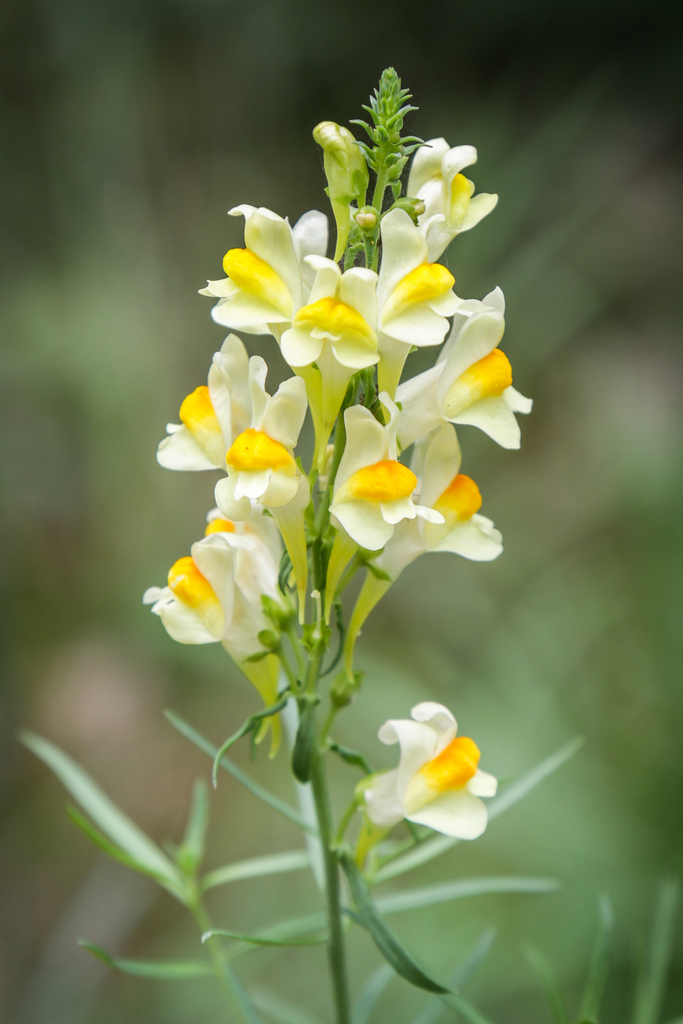
(c) Maja Dumat, some rights reserved (CC BY) · licence
Family: Plantaginaceae · Type: Herb · Not Native
Conservation status: Cal-IPC Yes
Linaria vulgaris (Butter-and-eggs) is a non-native California herb in the Plantaginaceae family, recognized by yellow flowers like L. dalmatica but with narrow non-clasping leaves and winged seeds.
Butter-and-eggs is a naturalized perennial herb found in coastal, northern California, and interior regions including the northern Sierra Nevada, Sacramento Valley, central western California, and southern California coast at elevations up to 2,150 meters in disturbed areas. Flowering from June to August, this plant produces yellow flowers with an orange-hairy lower lip, forming dense racemes approximately 18 to 32 millimeters long. Growing with ascending to erect stems 30 to 100 centimeters tall, it develops simple or occasionally branched green stems. Its leaves are crowded, narrow and linear, measuring 25 to 50 millimeters long, and ranging from glabrous to sparsely soft-shaggy-hairy. The plant produces small flat, winged seeds about 1.5 millimeters in size within fruits 9 to 12 millimeters long.
Identification and appearance
Key characters: Co-occurs with 5 species; yellow flowers like L. dalmatica but with narrow non-clasping leaves and winged seeds
Habitat and range
Habitat: Disturbed areas
Elevation: < 2150 m
California counties: Mendocino, Monterey, Marin, Humboldt, El Dorado, Plumas, Modoc, Nevada, Placer, Tehama, Del Norte, Siskiyou, Alameda, Sonoma, Butte, San Luis Obispo, Santa Barbara, Sierra
Outside California: widely naturalized, native to Mediterranean
Bloom period
Linaria vulgaris blooms Jun-Aug.
Conservation status
Cal-IPC Yes
How to tell it apart
vs Antirrhinum: Linaria has a true backward-pointing spur; Antirrhinum has only a sac-like swelling at flower base.; vs Nemesia: Linaria has a long backward-pointing spur; Nemesia has a short spur or pouch.; vs Collinsia: Linaria has spurred flowers with throat swelling; Collinsia has keeled lower lip with stamens tucked inside.; vs Salvia: Linaria has five stamens and spurred flowers; Salvia has two stamens and square stems.
Frequently asked questions
Is Linaria vulgaris native to California?
No. Linaria vulgaris is not native to California (recorded as not native).
When does Linaria vulgaris bloom?
Linaria vulgaris blooms Jun-Aug.
Where in California does Linaria vulgaris grow?
Linaria vulgaris occurs in Mendocino, Monterey, Marin, Humboldt, El Dorado, Plumas, Modoc, Nevada and other counties, at elevations of < 2150 m.
What plant family does Linaria vulgaris belong to?
Linaria vulgaris is in the Plantaginaceae family, genus Linaria.
Is Linaria vulgaris invasive in California?
Linaria vulgaris is listed by Cal-IPC with an invasiveness rating of Yes.
Related species
Other California species in the same genus, family, or bioregion.
- Linaria bipartita — Clovenlip toadflax
- Linaria dalmatica subsp. dalmatica — Dalmatian toadflax
- Linaria maroccana — Moroccan toad flax
- Linaria pinifolia — Pine needle toad flax
- Linaria purpurea — Purple toad flax
- Linaria sp. — Toadflax
- Maurandella antirrhiniflora — Violet twining snapdragon
- Maurandella sp.
- Nothochelone nemorosa — False turtlehead
- Nothochelone sp.
Sources: Jepson eFlora · Index of California Plant Names · CalPhotos
Last updated 2026-10-07
Data from The California Species Project — 14,000+ California species with verified data from CNPS, CDFW, USFWS, Cal-IPC, and more.