Lindernia dubia
Yellowseed false pimpernel
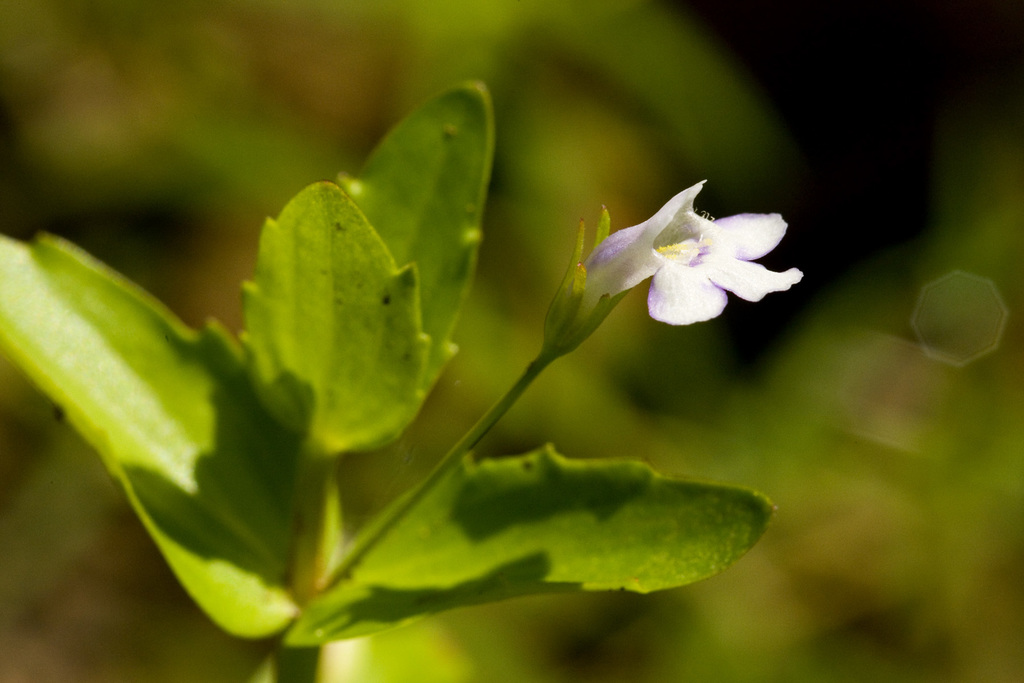
no rights reserved · CC0
Family: Linderniaceae · Type: Herb · Native
Lindernia dubia (Yellowseed false pimpernel) is a native California herb in the Linderniaceae family, recognized by Widespread species with scattered California populations; represents former Scrophulariaceae now in separate family.
Yellowseed false pimpernel is a native perennial found in the Klamath Ranges, northern California Coast Ranges, high Cascade Range, Sierra Nevada, Central Valley, San Francisco Bay Area, Peninsular Ranges, and southeastern Sierra Nevada in wet meadows, pond borders, lakes, and streams at elevations below 1,700 meters. Flowering from June to August, this plant produces white to lavender flowers approximately 7 to 10 millimeters long with delicate petals. Growing with spreading to erect stems up to 27 centimeters tall that often root at the lower nodes, it can form low, sprawling patches in moist habitats. Its leaves are sessile, lanceolate to ovate, ranging from 1 to 37 millimeters long and tapering to a round-clasping base. The tiny seeds are distinctive, measuring 1.5 to 3 times longer than wide and colored a vibrant yellow to golden-yellow.
Identification and appearance
Key characters: Widespread species with scattered California populations; represents former Scrophulariaceae now in separate family
Habitat and range
Habitat: Wet meadows, pond borders, lakes and streams
Elevation: < 1700 m
California counties: Los Angeles, Sonoma, Lake, Amador, Orange, Madera, Sacramento, Sutter, Butte, Kern, Tuolumne, Inyo, Placer, Tehama, Tulare, San Diego, Santa Cruz, Stanislaus, San Joaquin, Kings, Merced, Fresno, Mariposa
Outside California: to Washington, southern Canada, eastern United States (eastern of Rocky Mountains), Mexico to South America, Europe, Asia
Bloom period
Lindernia dubia blooms Jun-Aug.
How to tell it apart
vs Bacopa: Lindernia has two stamens plus forked staminodes; Bacopa has four fertile stamens.; vs Dopatrium: Lindernia has normal lance-shaped leaves; Dopatrium has tiny scale-like upper leaves.; vs Callitriche: Lindernia has tubular flowers with visible petals; Callitriche has no petals.; vs Hippuris: Lindernia has tubular flowers; Hippuris has no petals or sepals, just tiny stamens.; vs Synthyris: Lindernia is aquatic with smooth leaves; Synthyris is terrestrial with toothed rounded basal leaves.
Frequently asked questions
Is Lindernia dubia native to California?
Yes. Lindernia dubia is native to California (recorded as native).
When does Lindernia dubia bloom?
Lindernia dubia blooms Jun-Aug.
Where in California does Lindernia dubia grow?
Lindernia dubia occurs in Los Angeles, Sonoma, Lake, Amador, Orange, Madera, Sacramento, Sutter and other counties, at elevations of < 1700 m.
What plant family does Lindernia dubia belong to?
Lindernia dubia is in the Linderniaceae family, genus Lindernia.
What habitat does Lindernia dubia grow in?
Lindernia dubia grows in Wet meadows, pond borders, lakes and streams.
Related species
Other California species in the same genus, family, or bioregion.
Sources: Jepson eFlora · Index of California Plant Names · CalPhotos
Last updated 2026-10-07
Data from The California Species Project — 14,000+ California species with verified data from CNPS, CDFW, USFWS, Cal-IPC, and more.